Long Plays
After Kyrie: Mr. Mister and the Album That Could Not Be Welcome to the Real World
Their previous album had spent two weeks at number one on the Billboard 200 and produced two consecutive number-one Hot 100 singles. The follow-up, released twenty-two months later, peaked at number 55, generated one Top 30 single, and effectively ended the band's commercial career. The standard rock-history vocabulary calls Go On... a flop. The accurate framing is more complicated, and substantially more interesting.
There is a specific kind of commercial-rock career the mid-1980s AOR infrastructure produced in small numbers, and Mr. Mister occupied one of its cleanest examples. The band’s second album, Welcome to the Real World, released by RCA on November 27, 1985, reached number one on the Billboard 200 in the week of February 15, 1986, holding for two weeks. Its two lead singles — “Broken Wings” (August 1985) and “Kyrie” (November 1985) — both reached number one on the Hot 100 in consecutive runs across late 1985 and early 1986, and a third, “Is It Love,” reached number eight that spring. The album sold over two million copies in the United States, and the band became, briefly and substantially, one of the most visible American rock acts of the mid-1980s — positioned, in the industry vocabulary of the period, as the natural successors to Journey and Toto.
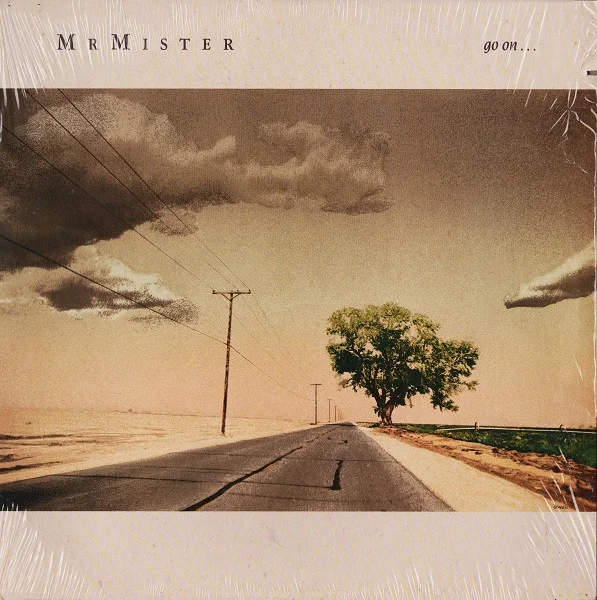
What happened next is the editorial territory here. The follow-up, Go On…, released by RCA on September 8, 1987 — twenty-two months later — peaked at number 55. Its lead single, “Something Real (Inside Me/Inside You),” reached number 29 on the Hot 100; none of the three subsequent singles charted meaningfully. By early 1989 guitarist Steve Farris had left; by 1990 the band had effectively dissolved; and the fourth album, Pull, recorded across 1989 and 1990, was rejected by RCA and went unreleased for two decades before emerging on Richard Page’s own Little Dume Recordings in November 2010. The standard vocabulary calls Go On… a flop — a deliberate pivot that alienated the audience the band had assembled, with no creative achievement substantial enough to justify the cost. That framing is partially accurate: the album did sell far less, the band did dissolve within three years, the commercial career did end. But the rest of it — that Go On… was an unforced error driven by misguided ambition — is more complicated than the narrative suggests, and the album is more substantial than its reception has been positioned to admit.
The Pre-History: Pages, Sessions, and the AOR Sideman Economy
Mr. Mister did not arrive in 1985 as an overnight sensation. The band’s two principal songwriters — vocalist-bassist Richard Page and keyboardist Steve George — had been working the Los Angeles commercial-music infrastructure for nearly a decade by the time the second album reached number one. They had grown up together in Phoenix, attended high school together, relocated to LA by the late 1970s, and begun the session work West Coast musicians of their generation pursued. Page’s CV across the period was substantial in ways the Mr. Mister narrative rarely registers — backing vocals on Mötley Crüe’s Shout at the Devil (1983), Whitesnake tracks including “Now You’re Gone,” and Twisted Sister’s Stay Hungry (1984); session vocal work for Quincy Jones; compositions for Michael Jackson, Rick Springfield, Donna Summer, Kenny Loggins, and Al Jarreau. George’s parallel career ran similar territory — Al Jarreau, Barry Manilow, Kenny Loggins (whose musical director he would become in the 1990s) — and the partnership functioned as a working unit within the LA session network, increasingly visible to musicians even as the public knew neither name.
What they had been trying to build alongside the session work was their own band. The Pages — formed in LA in 1978, Page on vocals and bass, George on keyboards, session players cycling through — was the vehicle, releasing three albums on Epic and Capitol (Pages in 1978, Future Street in 1979, the self-titled Pages in 1981) in the yacht-rock/soft-rock/jazz-fusion register the West Coast scene was developing. The records demonstrated substantial accomplishment without producing a breakthrough; dropped by Epic, signed to Capitol, dropped again, the group dissolved by 1981. What followed was a conscious decision to build a harder-edged band matching the template the early-1980s landscape was beginning to favor. Page and George recruited drummer Pat Mastelotto (from Eddie Money’s band) and guitarist Steve Farris (a session player), and the four-piece that became Mr. Mister was assembled across 1982 with the explicit aim of occupying the space Toto, Journey, and Foreigner had defined. The debut, I Wear the Face, released by RCA on March 27, 1984, peaked at a modest number 170 — but demonstrated RCA’s commitment to developing the project across records. Its lyrics came primarily from John Lang, Page’s cousin, who would write the words to “Broken Wings,” “Kyrie,” “Is It Love,” and most of the band’s peak material. The Page–George–Lang collaboration was the creative engine that would produce Welcome to the Real World.
The Commercial Peak: Welcome to the Real World
The album’s trajectory across the following nine months was one of the more substantial mainstream-rock moments of the mid-1980s. “Broken Wings” reached number one on December 7, 1985, holding two weeks; “Kyrie” reached number one on March 1, 1986, also for two; the album itself topped the Billboard 200 in February. Consecutive number-one singles plus a number-one album inside a four-month window placed the band in an unusually small commercial cohort, and the roughly two million U.S. copies, with substantial international sales, put the record firmly in the peak tier. The supporting tour, the MTV rotation, and the broader saturation made them, by summer 1986, one of the most visible American acts of the year, framed by the industry as the next configuration of the AOR-pop template that had been generating multi-platinum sales since the late 1970s.
What the standard narrative underweights is what the band had actually been doing. The framing that Welcome to the Real World was a calculated hit-single product undersells it. “Broken Wings” was built around the conceit of two lovers separated by emotional injury — lovers as wounded birds relearning flight — a substantively literary lyric the era’s commercial-rock vocabulary did not typically produce; “Kyrie” took its title from the Greek liturgical “Kyrie eleison,” “Lord, have mercy,” building a spiritual conceit the pop audience encountered as a hook. The commercial polish was real, and so was the lyrical substance underneath it. This matters for what came next, because the creative direction Go On… would document was not a sudden departure from the band’s actual interests. The seriousness Go On… foregrounded was already present in the earlier material, concealed beneath the polish that had carried the songs to number one. The shift was not the introduction of seriousness to a frivolous band; it was the foregrounding of seriousness that had been embedded in commercial polish.
The Decision: What Mr. Mister Wanted Go On… to Be
The documentary record about what the band wanted is substantial. Page has been direct about the pressure RCA exerted: “After Real World, that’s when the pressure hit,” he told Popdose in 2010, “and they were like, ‘Okay, well, where’s the “Broken Wings” and where’s the “Kyrie”; let’s keep this going.’” That was the standard label position for a follow-up to a peak record — replicate the formula, extend the cycle. What the band wanted was different. Go On… was meant to be, in Page’s framing to the Chicago Tribune in 1987, “a kind of document of what is happening to us and the world”: a primarily lyrical shift toward topical material — war, loss, the spiritual and political ground beneath the late-1980s moment — with hit singles a secondary consideration. This is the point the “calculated commercial misstep” reading misses. The album was a deliberate choice by musicians who had achieved enough credibility to attempt a pivot and understood, at least partly, that it carried risk. Whether the risk-reward calculation was wise is what the trajectory would answer; the decision itself was a substantive creative one made at the band’s peak.
The Recording: Kevin Killen and the Village Recorder
The producer they brought in captures what they were attempting. Welcome to the Real World had been produced by the band with engineer Paul DeVilliers (who would return for Pull); for Go On… they brought in Kevin Killen as co-producer — the engineer of Peter Gabriel’s So (1986), with extensive early-1980s U2 work behind him and Elvis Costello and Kate Bush ahead. Asking the man who had captured So’s dense, layered production to deliver Mr. Mister’s third album was a creative statement in itself, and his philosophy was substantially less reverb-dependent than the template Welcome to the Real World had occupied. “Kevin doesn’t like to mess around with a lot of reverb,” Page told the Tribune. “He likes everything in your face, so the listener doesn’t have to search to find it.” The wash of reverb-heavy textures that had given “Broken Wings” and “Kyrie” their radio polish — the soaring choruses, the cavernous drums, the keyboard washes — was largely replaced by a tighter, more direct sound. The sessions ran roughly seven months at The Village Recorder in West LA, with mastering by Bob Ludwig at Masterdisk; Pat Mastelotto’s significant back problems during the period forced the band to work around his limitations and extended the timeline.
The Album
Go On… was released on September 8, 1987 — eleven tracks (ten on vinyl; the CD-and-single-only “Bare My Soul” the extra), about fifty-six minutes. It opens with “Stand and Deliver,” an up-tempo arrangement originally written for Tina Turner before being folded into the sessions; it became the final single in March 1988 and featured in Ramón Menéndez’s 1988 film Stand and Deliver, the Edward James Olmos vehicle about East LA teacher Jaime Escalante, which gave the track cultural visibility independent of its chart performance. “Healing Waters,” the second track and a Europe-only second single, earned a 1988 Grammy nomination for Best Gospel Performance by a Duo or Group — not a gospel song in any strict sense, but its redemptive religious vocabulary registered with award voters as the pop-radio audience never did (it lost to Mylon LeFevre & Broken Heart’s Crack the Sky). “Dust,” the third track and one of the strongest, addressed the Amerasian children left behind in Vietnam and Southeast Asia after American withdrawals, building across a six-and-a-half-minute structure — the most ambitious track on the album, and the kind structurally incompatible with the late-1980s radio template.
“Something Real (Inside Me/Inside You),” the lead single, was the most direct commercial vehicle — written in 1985, with an earlier version on the soundtrack to the 1986 Rob Lowe hockey film Youngblood (it later appeared on Miami Vice) — and its number 29 peak was the album’s commercial high point, the follow-ups (“Healing Waters” in Europe, “The Border” briefly in November 1987, “Stand and Deliver” in March 1988) failing to chart meaningfully. The remaining tracks ranged across the album’s concerns — “The Tube” on media saturation and surveillance, “Control” and “Watching the World” extending the topical engagement, “Power Over Me” and “Bare My Soul” in a more standard relationship register, the Farris co-write “Man of a Thousand Dances” providing the most straightforwardly rock-oriented moment, and “The Border” closing on five minutes of atmospheric complexity. Heard in 2026, the album is substantially less of a wholesale departure than the narrative claims — denser arrangements, less reverb, more topical lyrics, but a sonic vocabulary recognizably continuous with the previous record, Page’s vocals in the same register, George’s keyboards in the same palette, Farris’s guitar in the same range. The “progressive rock” framing some retrospectives apply is not accurate; the “preachy” framing is overstated, with only “Healing Waters” directly spiritual and the rest varying across topical ground without settling into any single moralistic register. It is mature commercial pop-rock with topical lyrical engagement.
The Commercial Trajectory: What Actually Happened
Go On… entered the Billboard 200 at number 62 on September 26, 1987, climbed to number 55 the following week, and descended from there, largely gone from the upper chart by December. The reasons were interlocking. The lead single’s number 29 was below the threshold that signals cross-format momentum — technically a Top 30 hit, functionally below what a follow-up to consecutive number ones required — and the subsequent singles’ failure compounded it; “Stand and Deliver,” despite its film tie-in, got limited airplay, the film succeeding while the song independent of it did not. The broader context made it worse. The hair metal peak was cresting in 1987 and 1988 — Bon Jovi’s Slippery When Wet (October 1986) running its full cycle against the same audience, Def Leppard’s Hysteria arriving three weeks before Go On…, Whitesnake’s number-two self-titled album selling across the exact window Go On… should have been building momentum — and rock radio was tilting decisively toward harder, more anthemic, less topically engaged material. A Mr. Mister album with less anthemic content than its predecessor was structurally positioned to underperform regardless of its quality. There was also corporate upheaval: RCA had been acquired by BMG in 1986, and the restructuring across 1987 and 1988 displaced the executives who had developed the band with new BMG-era figures whose priorities had not been built around it, so the label’s promotional commitment, while never formally withdrawn, was substantially less consistent than before.
What the Band Thought of the Album
The record of how the band felt diverges sharply from the flop framing. Page told the Sun-Sentinel in 1987: “It was our desire not to make the same album twice. Why perpetuate one sound over and over again? We wanted a change — something completely different — and we’re very happy with it.” Across the decades since, the band has consistently called Go On… “some of the best stuff we ever did” — not entirely defensive, given that “Dust,” “Healing Waters,” “The Border,” and “Stand and Deliver” all stand as accomplished work. The commercial outcome did not produce work demonstrably inferior to the Welcome to the Real World material; it produced an album whose ambitions were incompatible with the radio template it was released into.
The Dissolution: Farris’s Departure and the Unreleased Fourth Album
The dissolution unfolded across roughly three years. Steve Farris departed in July 1988 amid “disagreements between Page and Farris” whose specifics were never detailed but appear to reflect creative-direction tensions from the sessions; he went on to a substantial session career including extensive work with Eddie Money. The remaining three — Page, George, Mastelotto — began Pull in fall 1988, conceived as a more organic, less synth-heavy continuation, with Paul DeVilliers returning to produce across a string of LA studios (Sunset Sound, Ocean Way, Southcombe, American Recorders, The Sound Factory, Soundcastle, Record One, Enterprise) in 1989 and 1990, using a rotating cast of session guitarists in Farris’s place — Buzz Feiten, Trevor Rabin of Yes, Doug Macaskill, Peter McRae. The result was even further from the Welcome to the Real World template than Go On… had been. When the band presented it to RCA in 1990, the label’s response, as the band has consistently recounted, was “We don’t know what to do with this.” RCA refused to release it, and the band — unable to continue without label support — simply dissolved across 1990 with no formal announcement.
Pull sat in the RCA vaults for two decades while incomplete bootlegs circulated among fans, finally emerging on November 23, 2010, on Page’s Little Dume Recordings in collaboration with RCA/Legacy, twenty years after it was finished. The members’ later trajectories extended well past the band: Page launched a solo career (Shelter Me, 1996) and joined Ringo Starr’s All-Starr Band in 2010, replacing Richard Marx, for five years; George kept writing and producing, with cuts for Al Jarreau, the Pointer Sisters, Patti LaBelle, and Meat Loaf; Mastelotto took the most surprising turn, joining King Crimson in 1994 and becoming one of Robert Fripp’s principal drummers across the next three decades; and Farris continued his session work before brief one-off Mr. Mister reunion performances in 2023 and 2025.
What Go On… Actually Was
The album was a deliberate creative work the band remains proud of. The topical lyrics and Killen’s tighter production were real, but not the wholesale departure the narrative claims, and the record sold less because the seriousness it foregrounded was incompatible with what late-1980s radio supported — not because the work was inferior. The deeper problem was timing: Mr. Mister’s peak had been the last gasp of the AOR-pop template that had run through Toto, Journey, and Foreigner, and Go On… arrived as the audience was moving toward the harder edge of the hair metal cohort. The trajectory was not a referendum on the album’s quality but on whether the marketplace of late 1987 was positioned to receive what it offered.
That is the reframe the flop narrative misses. The band had been positioned to be the next Journey and chose, instead, to be something else — and Pull pushed the choice further still, far enough that RCA didn’t know what to do with it and shelved it for twenty years. The decision was the structural moment at which the band’s continuing commercial existence required them to choose between making the material they actually wanted to make and holding the position the label had built around them. They chose the former and absorbed the consequences. The commercial career that ended was never their actual career, which extended across decades — Page’s solo and All-Starr work, George’s songwriting, Mastelotto’s King Crimson tenure, Farris’s session career.
Listened to carefully in 2026, Go On… is substantially better than its reception positioned it to be remembered, and it has accumulated the kind of dedicated audience that heard what the broader marketplace was not positioned to hear. The standard flop narrative continues to circulate; the album remains, three and a half decades on, as the document of a choice and its cost. Mr. Mister had been positioned to be the next Journey. They chose, with Go On…, to be something else — and the record is still there, for whoever wants to engage with what the band actually did rather than with the narrative that accumulated around it.