One and Done
The Singer the Label Wanted: Femme Fatale and the One Album That Wasn't Supposed to Be the Only One
MCA Records signed them. MTV played them. Cheap Trick took them on tour. Their manager developed brain cancer mid-promotion and the label decided they'd rather keep the singer than the band. A look at Femme Fatale's 1988 debut — the album that should have been the start of a career and instead became the entirety of one — and at the singer who has spent thirty-six years building a different kind of music life around the eighteen months when the major-label commercial infrastructure briefly noticed her.
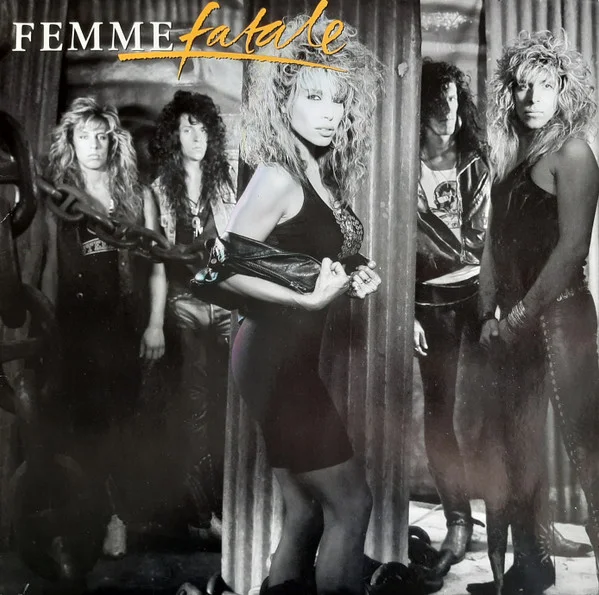
There is a structural pattern the late-1980s major-label rock infrastructure produced more often than its later mythology has acknowledged, and Femme Fatale are one of the cleanest examples. A band gets signed. A debut gets released. It sells respectably without quite reaching the tier that justifies sustained investment. The label, choosing between developing the full band and extracting whatever residual value the lead singer’s identity might generate, chooses the singer. The planned second album — material already written, lineup still intact — gets shelved. The band dissolves. The singer is offered a solo contract she declines. Within twelve to eighteen months the entire apparatus has redirected its attention elsewhere, and the musicians continue their working lives at smaller scale, most of them still working in 2026 on the nostalgia circuit that has sustained the late hair metal economy for nearly three decades.
What’s distinctive about the Femme Fatale version is how completely the marketplace had identified its real interest from the start. The band that signed to MCA Records in 1987 was a five-piece — Lorraine Lewis on vocals, Bill D’Angelo on lead guitar, Mazzi Rawd on rhythm guitar and keyboards, Rick Rael on bass, Bobby Murray on drums — but the apparatus the label built around them never functioned as if all five members were the product. The press photos centered on Lewis. The videos centered on Lewis. The interviews centered on Lewis. The decision MCA would eventually make — to continue with Lewis as a solo artist rather than fund a second album for the full configuration — was, in retrospect, one the label had been working toward since the signing ink was dry. The band’s trajectory was the trajectory of a singer with a backing band the label considered structurally optional, and when financial pressure increased, the band became optional in the contractual sense too.
This is the second installment of the magazine’s One and Done section, which engages with bands whose entire meaningful commercial existence was effectively a single record. The Femme Fatale story carries a specificity the broader category doesn’t always: the band did not simply fail to break through. In a substantial sense it was never given the chance to be a band in the first place. MCA had identified Lewis as the commercial asset before the album was recorded, and the eighteen months of activity that followed were, from the label’s view, largely a test of whether the singer could be cleanly separated from the band she’d brought from Albuquerque. The evaluation concluded separation was preferable to continuation. Lewis declined. The label moved on. The band dissolved. The sequence is one of the more revealing case studies of how late-1980s major-label gendered commercial logic actually operated at the level of one specific band.
The Setup: Albuquerque to Los Angeles
Femme Fatale formed in 1987 in Albuquerque, New Mexico — an origin point that matters, because it positioned them outside the Los Angeles club-circuit infrastructure that produced most of the late-period hair metal acts this magazine has covered. Bands like Tuff, Vain, and Warrant had navigated the Sunset Strip system from inside, accumulating regional reputations across years of club work before the contracts arrived. Femme Fatale arrived from outside it, in mid-1987, on a far more compressed timeline. The original configuration — Lewis, D’Angelo, Rawd, Rael, Murray — had been working as a regional act in the small but genuine New Mexico hard rock market: local venues, regional radio, mid-tier touring. What it lacked was access to the major-label infrastructure that Los Angeles concentrated, and the mid-1987 relocation was the standard bet of the decade — leave the scene where you have an audience, move to LA, showcase for industry attention, hope someone invests.
The showcase worked, and the MCA signing happened almost immediately. The executive who championed the band was Howard Kaufman, whose reputation as a manager — he would go on to handle Eagles, Fleetwood Mac, and others through HK Management — was already established by 1987. The deal was committed but not patient. The band had written about fifteen songs by the time the signing was complete, recorded ten for the debut, and Lewis has been candid about the dynamic: “it’s kind of ridiculous that we didn’t spend more time developing, but MCA wanted us, and who were we to say, ‘We need more time to grow as a band.’ Hell no, we jumped right in, and you would have done the same.” Signing a band was not, by itself, a commitment to development. The label wanted product; the band would provide product; whether the band had finished becoming itself first was, from the label’s view, secondary.
The 1988 sessions made the structural divide visible in the production credits. Jim Faraci — later a producer for Ratt and L.A. Guns, a specialist in hair metal arrangement — produced tracks 2 through 10. David N. Cole produced track one, “Waiting for the Big One,” the song MCA had identified as the album’s commercial vehicle, and which was written not by the band but by Rick Neigher and Cole — outside material brought in specifically for its potential. The lead single existed on one side of a structural line; the rest of the record on the other. The two sides were related, but doing different commercial work.
The Album
Femme Fatale was released in November 1988 and peaked at number 141 on the Billboard 200 in 1989 — well below MCA’s expectations, though not, in absolute terms, catastrophic. It sold roughly 200,000 to 225,000 copies in the United States, depending on the source: enough to demonstrate genuine interest, not enough to justify the sustained investment comparable bands were receiving.
The content is more interesting than the reception suggested. “Waiting for the Big One,” the opener and lead single, is a deliberately commercial late-period song built around a chorus designed for maximum radio penetration, carried by Lewis’s voice — technically capable across a substantial range, delivered with the dynamic control the era’s most successful female-fronted songs required. The video got substantial MTV rotation through late 1988 and early 1989, and the song appeared on the soundtrack to License to Drive, the 1988 Corey Haim and Corey Feldman vehicle, adding visibility through the film’s broader audience. “Falling In and Out of Love” — not the Lita Ford song of the same name from 1992 — was the second single and reached the upper portion of MTV’s daily countdown; it works in a different register, a more straightforward arena-rock construction with Lewis sitting slightly lower and the band given more space than the lead single allowed, and it stands as one of the more genuinely successful late-1988 hard rock singles by a female-fronted band.
The deeper tracks reveal both the band’s capabilities and the limits the compressed timeline imposed. “My Baby’s Gun,” “Back in Your Arms Again,” and “Rebel” complete the first side — “Rebel” in particular has a stronger arrangement than the standard template, the instrumental performances given room the lead single’s calculation had foreclosed. The second side — “Fortune and Fame,” “Touch and Go,” “If,” “Heat the Fire,” “Cradle’s Rockin’” — is more uneven, some tracks working cleanly, others sitting closer to the generic mid-1988 template. The overall shape — strong opening, capable middle, less distinctive close — is the shape of a record made faster than the band wanted, with material that hadn’t quite finished developing committed to vinyl because the label’s timeline demanded album product. What the album does not contain is the second-tier hit that would have justified sustained promotion. The MTV airplay for both singles was real but limited; neither reached the heavy rotation of a “Cherry Pie” or an “Edge of a Broken Heart.” Two MTV-visible singles plus a number-141 peak was, by the era’s calculation, the profile of a band that had performed at the lower end of expectations, not one that had broken through.
The Tour, the Manager, the Label
The supporting tour ran from late 1988 through most of 1989, its centerpiece a substantial U.S. arena run opening for Cheap Trick — the kind of opportunity mid-tier bands competed for, three months of arena-level exposure and nightly performance under real pressure. Lewis has called it transformative: they watched Robin Zander from the side of the stage every night, learned how the touring economy worked at a level they hadn’t reached, and came back, by her account, “a unified, stronger band.” Early-1989 U.K. dates followed, where Kerrang! put the band on its January 1989 cover with an interview and pin-up feature — modest in scale but warm enough to suggest real cross-Atlantic potential if MCA chose to develop it.
What happened during the same period determined everything. Andrea Accardo, the band’s co-manager (alongside Howard Kaufman through Front Line Management) and, by Lewis’s accounts, their primary day-to-day champion — the person most committed to the band as a band, against the narrower calculation visible in MCA’s marketing from the start — was diagnosed with brain cancer during the tour. As her condition deteriorated through 1989, the band lost the internal advocate most consistently arguing for sustained investment in the full group. Lewis has described one incident in detail: during an MCA meeting arranged to discuss the band’s trajectory — one at which the label’s preference for keeping Lewis solo had begun to surface — Accardo had what Lewis called “an episode” and excused herself; when she didn’t return, Lewis found her unconscious on the bathroom floor, bleeding from her head, no longer able to recognize her. Accardo was hospitalized and diagnosed with cancerous tumors in her stomach and brain. The diagnosis was terminal, and she died within months. Losing her — as a manager and, Lewis has been consistent, as a close friend — removed the band’s strongest internal advocate at the exact moment MCA’s calculation was shifting against them.
That shift was the second structural event. Having watched the album underperform and the tour produce respectable but not transformative momentum, the label reconsidered what it wanted from the project and concluded, by some point in 1989, that its interest was in Lewis as a vocalist rather than in Femme Fatale as a band. At the meeting where Accardo collapsed, the position became explicit: MCA would continue to support Lewis’s career if she would operate as a solo artist with new backing musicians. She declined — a decision that has been one of the consistent themes of her interview record across thirty-six years. She would not abandon the musicians she’d brought from Albuquerque, the ones who had relocated and built the live unit with her, in exchange for a more favorable contract. MCA’s response was the predictable corporate one: enthusiasm diminished, the promotional investment evaporated, and the planned second album was put on indefinite hold.
The band kept working through 1989 into 1990, writing and recording new material — some of which would surface decades later, in 2014, as the long-shelved second album One More for the Road on the small Nashville label FnA Records — with the original lineup intact. But the structural reality had changed. Without sustained support, without a path to a second release, with their primary manager dying and the genre’s broader trajectory turning against them, the band’s continuing existence became unsustainable. By mid-1990 Femme Fatale had effectively dissolved, and the brief major-label moment was over.
What Followed: The Dispersal
Lewis spent the immediate aftermath exploring directions. She contributed “Chains” to the soundtrack of the 1991 film Don’t Tell Mom the Babysitter’s Dead, a small visibility tied to the late-period soundtrack economy bands at this tier relied on, and in 1992 formed a Christian metal band, Mercy, with guitarist Erik Levy; the Mercy self-titled debut arrived in May 1993, twelve tracks of Christian-themed hard rock in a substantially different commercial space, and the project had effectively ended by late that year. Through the 1990s and 2000s she pursued solo projects to modest reception, did session work, and contributed to the tribute-album projects the nostalgia economy generated in volume — the working musician’s life bands at her tier came to expect once the major-label apparatus stopped supporting them. The other members — D’Angelo, Rawd, Rael, Murray — each continued making music in various configurations, none producing anything comparable to the brief Femme Fatale peak.
Lewis’s career took a distinctive turn in 2013, when she reactivated the Femme Fatale name with a substantially different lineup: guitarist Courtney Cox (no relation to the actress, a substantial late-period player later known through The Iron Maidens), bassist Janis Tanaka (formerly of L7 and Pink’s touring band), and drummer Athena Lee (sister of Mötley Crüe’s Tommy Lee), with Nita Strauss (later of Alice Cooper’s band) eventually joining on guitar. The original musicians were not invited back; the new lineup of younger, technically accomplished female players brought their own contributions rather than serving as replacements. From 2013 to 2019 it operated as a touring concern — performing the original album live and building a live presence in the nostalgia economy — but never produced a new studio album, a fact Lewis has been honest about: it was a touring band, not a recording band.
In January 2019, Lewis was announced as the new lead vocalist for Vixen — the band whose retrospective the magazine has planned for Issue 04 as part of the broader female-voiced editorial commitment, and which carries a specific irony here. Vixen and Femme Fatale had been understood, in 1988 and 1989, as the two leading female-fronted glam metal acts, competing for the same limited radio and MTV resources; Vixen’s trajectory had been stronger (their 1988 debut went platinum where Femme Fatale’s sold around 200,000), but both occupied the same cohort. Three decades later, Lewis joined her former direct competitor, replacing original vocalist Janet Gardner, who had stepped down to focus on a solo career, and became the singer responsible for performing the very catalog that had been her competition. She served from January 2019 through 2024 — a productive arrangement for both, giving Vixen a credible vocalist and Lewis a touring platform larger than her own Femme Fatale work could provide — before leaving in 2024 under circumstances not fully detailed publicly, consistent with the standard tensions of bands operating across decades with shifting lineups. Her departure cleared the way, in 2025, to reactivate Femme Fatale again with new material — the band’s first significant new recording since the original project ended in 1990, now operating as Lewis’s primary vehicle with various supporting musicians.
The Broader Pattern
What the Femme Fatale story documents is something specific about how the late-1980s major-label apparatus engaged with female-fronted rock at the genre’s peak. It signed the bands, marketed them, and funded their debuts. What it did not consistently do was treat them as bands. The gravitational pull was always toward the singer — the visually identifiable frontwoman whose image could be marketed independently of the configuration, whose voice could be deployed across whatever production the label deemed appropriate, and whose contractual identity could be separated from the band’s when the calculation made separation preferable.
Lewis has been direct about the underlying constraint: the radio formats of the late 1980s simply did not play much female-fronted rock, and the acts competing for that limited airplay — Vixen, Lita Ford, Doro, Femme Fatale — were operating in a structurally smaller commercial space than the male-fronted bands their labels developed alongside them. The competition for that smaller space produced exactly the pressures the Femme Fatale story shows: the preference for the singer over the band, the willingness to abandon the band when expectations went unmet, the gendered logic that treated the frontwoman as the asset and the band as overhead. The pattern was not unique to them. It shaped Vixen, where Jan Kuehnemund’s role as the band’s actual creative engine was consistently underweighted in favor of the collective visual identity; Lita Ford, whose solo career was substantially built through partnerships with male producers and songwriters that the marketing obscured; and, in a different register, Heart, whose 1980s peak was built around Ann Wilson’s voice with the band increasingly positioned as backing musicians regardless of its real creative dynamics.
What distinguishes Femme Fatale within that pattern is the moment the logic became visible. Most bands in the cohort met the gendered pressure gradually and at lower intensity — accumulated decisions, slow shifts in support, the calculation working itself out across a catalog. Femme Fatale met it in a single meeting.
That clarity is what makes the story documentary rather than merely typical. Most bands in the same position reached the same outcome through a less legible sequence of events. Femme Fatale reached it through one specific, identifiable corporate decision.
What the Album Means Now
Listened to in 2026, Femme Fatale sounds genuinely better than its 1988–89 reception suggested. It is not a forgotten classic — the songwriting limits of the compressed timeline are audible across the second half, and the absence of a hit beyond the two singles is a real structural problem — but the strongest tracks (“Waiting for the Big One,” “Falling In and Out of Love,” “Rebel,” “Touch and Go”) are accomplished late-1988 hard rock that deserves more attention than it gets, with Lewis’s vocals consistently strong and the band’s playing demonstrated cleanly given the modest budget. The 2022 Rock Candy Records reissue brought it back into circulation for the first time since release, with four bonus tracks including material from the abandoned second-album sessions, and was warmly received within the small dedicated audience that still engages with the genre — an audience that is real, and small, the reissue producing no broader cultural moment. The 2014 release of the shelved second-album material as One More for the Road, through FnA Records, gave fans the recordings MCA had abandoned: competent late-1989 and early-1990 hard rock whose editorial significance outruns its musical significance, documenting what the band’s second record would have been, neither transformatively better nor worse than the debut, the closing chapter of a recording career cut off mid-sentence.
The One and Done Frame, Continued
Like the Tuff piece that inaugurated this section, this one engages with a band whose meaningful major-label existence was a single record. Everything since — Mercy, the solo work, the 2013–2019 reactivation, the Vixen tenure, the 2025 reactivation — has operated outside that framework. But where Tuff documented a band that arrived at the genre’s peak too late to capitalize on it, Femme Fatale documents one that arrived with a different structural disadvantage: being female-fronted in a radio environment that disproportionately favored male-fronted material, and then encountering the specific corporate decision to treat the singer as the asset and the band as overhead. They were small enough to be discardable when the calculation shifted, talented enough to deserve far more development than they got, and unlucky enough to meet the exact combination of label pressure, a manager’s terminal illness, and a turning cultural moment that produced the brief peak and the long dispersal.
The album was never supposed to be the only one. The marketplace decided, through the logic the late-1980s apparatus operated under, that it would be — and the band had no say. The one choice that was Lewis’s to make, she made: she would not trade her bandmates for a better contract. Thirty-six years on, she is still building a musical life around the single record the label permitted, and the record itself turns out to be better than it was ever allowed to be. That is the whole of it. The band was discarded before it was given the chance to become one, and the music it did make is sitting there for whoever wants to find it — the document of a band the marketplace noticed just long enough to decide it would rather keep the singer.