Retrospective
Don't Know What You Got: Cinderella and the Voice That Disappeared Overnight
In four years, they made three records that travel further than almost any of their commercial peers managed in entire careers — from teased-hair glam metal to dustbowl blues-rock, with one of the genre's strongest songwriters at the center of the journey. Then his voice stopped working, and the journey ended. A featured retrospective on the Philadelphia band whose creative trajectory was one of the cleanest of the era and whose ending was one of its quietest tragedies.
There is a kind of band-history piece the standard rock-criticism vocabulary has trouble accommodating — the band whose trajectory was substantial enough to matter, whose development across multiple records was unusually coherent, and whose ending was structurally tragic in ways the conventional commercial-decline narrative cannot capture. Cinderella are one of the cleanest examples. The Philadelphia band’s three core albums — Night Songs (1986), Long Cold Winter (1988), Heartbreak Station (1990) — represent one of the most genuinely accomplished creative arcs of the late hair metal era, traveling across four years from teased-hair glam to a fully realized blues-rock that connected as comfortably to Aerosmith and Humble Pie as to anything the Sunset Strip was producing. Tom Keifer, the band’s vocalist, primary songwriter, and creative center, showed an unusually clear-eyed sense of where the band needed to go. The body of work sold somewhere between fifteen and twenty million copies worldwide, and it was, on any reasonable measure, the work of a band whose long-term future was as promising as that of any of its peers.
Then, in late 1991, on the tail end of the Heartbreak Station tour, Keifer’s voice disappeared overnight. The diagnosis took two years, and the condition turned out to be paresis — partial paralysis — of his left vocal cord, a neurological problem in which his brain had simply stopped sending the signal that produced the vocal capability his career had been built around. There was no medical cure and no surgical fix, only the prospect of years of therapy with speech pathologists and vocal coaches, with no certainty the original voice would ever return in usable form. The doctors first told Keifer he would never sing again; they were eventually proven wrong, as he developed, through patient work, a modified technique that let him keep performing. But the timing could not have been worse. The two years required to identify what was wrong coincided exactly with the moment Nevermind had made hair metal commercially untenable, and by the time Keifer could record again, the audience that had bought Heartbreak Station had largely moved on. The album the band managed to finish in 1994 — Still Climbing — sold poorly and was effectively the last meaningful Cinderella record.
The band did not collapse from internal warfare or substance abuse or commercial calculation gone wrong. They were taken out, structurally and at the worst possible moment, by their lead vocalist’s physical inability to continue. The closing chapters — the Still Climbing sessions, the brief Sony signing, the litigation, the long inactivity — operated under conditions no band could have navigated. It is one of the few late-period hair metal stories in which the band itself bears almost no responsibility for the outcome, and one of the saddest.
The Earliest Era, and the Lineup Mercury Insisted On Replacing
Cinderella formed in 1983 in Clifton Heights, a small town outside Philadelphia, around the partnership between vocalist Tom Keifer and bassist Eric Brittingham. Keifer, born January 26, 1961, had been playing regional cover bands since his early teens, working five nights a week in Philadelphia and southern New Jersey clubs while still in high school, and by the time he formed the band he had a working musician’s experience most of the genre’s twenty-two-year-olds did not. The original lineup also included guitarist Michael Schermick — later using the stage name Michael Kelly Smith — and drummer Tony Destra. Across 1983 and 1984 the four-piece built a regional reputation playing original material at a moment when most of the scene was getting by on cover sets, and its early aesthetic was harder and less glam than the eventual debut would suggest. The surviving demo material — the indie 45 of “Shake Me” backed with “Somebody Save Me,” with Destra on drums — connects as much to British heavy metal as to the emerging American template.
The standard account of 1985 — that Smith and Destra “left to form Britny Fox” — is correct in the narrow sense and misleading in the broader one. The departures were not voluntary. By the documentary record assembled across later interviews, including Keifer’s own, Mercury Records demanded the dismissal of Smith and Destra before the band would be permitted to record its major-label debut, on the reasoning that the label wanted to “highlight Keifer and Brittingham” as the commercial centerpiece. The band did what bands in their position did: they accepted, and Smith and Destra were dismissed in 1985, not by choice but because Mercury insisted. Tony Destra would die in a car accident on February 8, 1987, before Britny Fox’s debut was even released — meaning one of Cinderella’s two original musicians did not live to see either his replacement band’s commercial moment or his original band’s. He was thirty-two. He had played on the early demos that attracted Mercury’s interest in the first place, and was discarded by the label’s calculation in the way musicians at his stage frequently were; the grace of enjoying the reward his original band’s success produced, even at a remove, was never available to him.
Smith, with vocalist “Dizzy” Dean Davidson and bassist Billy Childs, formed Britny Fox in 1985 in direct response to the dismissal. They signed to Columbia, released a self-titled debut in 1988 that reached number 31 on the Billboard 200 and went gold, and ran three studio albums before the genre’s collapse ended them — a separate story the magazine may engage with later. What matters here is that Britny Fox existed because Mercury had decided Cinderella’s commercial proposition would be cleaner without two of its four original members. Drummer Jim Drnec briefly replaced Destra, and the guitarist the band settled on was Jeff LaBar, from the broader Philadelphia circuit — who won the audition over both Snake Sabo, later of Skid Row, and Reggie Wu, later of Heaven’s Edge. The lineup of Keifer, Brittingham, LaBar, and Drnec began the Night Songs sessions in late 1985.
The Two Approaches, and the Signing
Before Mercury, there had been another door. By Keifer’s accounts — given most clearly in a 2014 interview — Cinderella had been approached by Gene Simmons of Kiss, who by the mid-1980s had a substantial parallel career developing new bands (Black ‘N Blue, Keel, House of Lords out of Gregg Giuffria’s project, Wendy O. Williams’s solo work) and had tried to get Cinderella a deal with Polygram. The band was not interested. Keifer’s reasoning has been consistent: they did not want to be a Gene Simmons project, did not want the commercial positioning his other signings received, did not want their direction shaped by his calculation. The decision was, in retrospect, fortunate — the Simmons-developed bands produced respectable but limited trajectories, and the bands that chose not to be developed by him sometimes did better.
What happened instead was Jon Bon Jovi. In 1985, while recording 7800° Fahrenheit, he caught a Cinderella show at the Empire Rock Club in Philadelphia and was impressed enough to recommend the band to Derek Shulman, the Mercury A&R executive who had signed Bon Jovi in 1983. The recommendation produced the introduction, and the introduction the negotiations. What the standard account glosses over is how reluctantly Shulman engaged at first: his initial response was to offer a six-month development deal, the standard way labels managed risk on uncertain signings. The Cinderella camp negotiated, and after extensive back-and-forth Shulman agreed to a full signing — a complete album budget and the marketing commitment Mercury reserved for its more confident bets. The contractual structure (Mercury as the label, Polygram as parent) mattered: Polygram-owned labels released most of the era’s major hair metal and AOR catalog, Bon Jovi and Def Leppard among them, and by 1985 the apparatus had one of the most capable promotional pipelines available to a new band. Cinderella entered through it, and the Night Songs sessions began shortly after.
Night Songs (1986)
Night Songs was recorded across late 1985 and early 1986 at a remarkable spread of studios — Bearsville in Woodstock, Kajem in Gladwyne, Warehouse and Sigma Sound in Philadelphia, The Sound Factory in Hollywood — and mixed at The Record Plant in Los Angeles. The producer Mercury assigned was Andy Johns, the British engineer whose CV by 1985 was extraordinary: he had engineered Led Zeppelin IV, and worked with the Rolling Stones, Free, and Television. Johns was not a hair metal specialist; he was one of the most capable rock producers in the industry, and his assignment signaled what Mercury thought the band could be — not a quick product but something worth serious investment.
Two further lineup facts shaped what the record actually was. Drummer Jim Drnec was replaced — again, by some accounts, at Mercury’s insistence — and the session drummer who played most of the album was Jody Cortez, brought in as a professional to deliver what the record required. The drummer credited on the cover and in the liner notes, however, was Fred Coury, the former London drummer who joined specifically to be photographed and to tour. Lead guitar, too, was not always LaBar’s: three tracks — “Back Home Again,” “Nothin’ for Nothin’,” and “Push, Push” — feature lead work by session musician Barry Benedetta, with LaBar handling the rhythm and much of the lead elsewhere. The same production calculation drove both substitutions: Johns and the Mercury apparatus wanted specific sounds, and brought in the players who could deliver them.
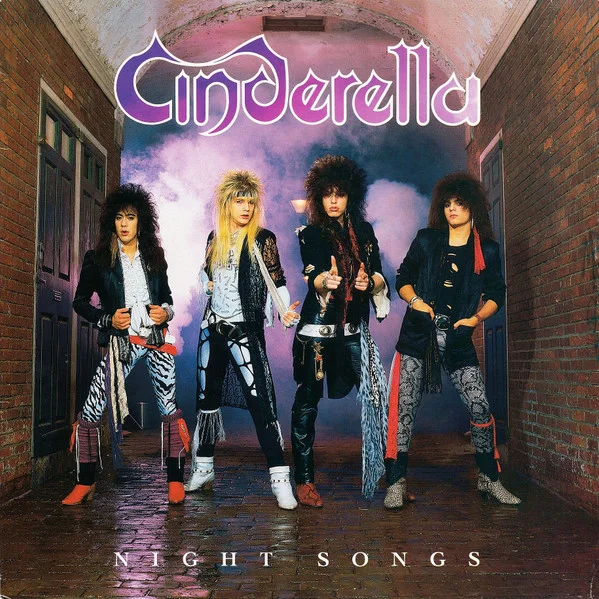
The album was released June 9, 1986 (Mercury worldwide, Vertigo in the UK), its cover photograph — four band members in a pink, fog-shrouded alley, teased hair and, as one retrospective put it, “their frilliest leather and lace regalia” — communicating with maximum efficiency exactly the glam positioning Mercury had constructed, and becoming the visual identity Keifer would most consistently work to distance the band from. Commercially it built slowly. It entered the Billboard 200 in July in a modest position; “Shake Me,” the August leadoff single, failed to chart as a single but reached Billboard’s Album Rock Tracks chart. What changed everything was the second single. “Nobody’s Fool,” released in October with a video that earned heavy MTV rotation, broke the Hot 100 in November and climbed through the winter to number 13 in February 1987 (and number 25 on Mainstream Rock), driving the album to number 3 on the Billboard 200 on February 7, 1987. It was certified platinum in December 1986, double platinum in February 1987, and eventually triple platinum by May 1991, with over three million U.S. sales — at its peak selling fifty thousand copies a week. A third single, “Somebody Save Me,” reached number 66 in May 1987, and the supporting tour took the band out opening for Bon Jovi on the Slippery When Wet world tour — the Empire Rock Club discovery now paying off in arena-level visibility.
Listened to in 2026, Night Songs is substantially better than its surface positioning suggested. The arrangements are tighter than the template typically allowed, Keifer’s raspy delivery — “the ability to shatter glass with his raspy wail,” one profile put it — is already his signature instrument, and beneath the pink fog there are blues-rock fundamentals the next records would draw on more explicitly. It is not the band’s best work, but it is far better than its presentation implied, and it laid the groundwork for what followed.
Long Cold Winter (1988)
What Cinderella did with their second record is the central editorial fact about the band. The standard calculation for a band whose debut had gone triple platinum on glam metal would have been to make the same record again — same producer, template, identity. Mercury would have welcomed it, and most of the band’s peers were doing exactly that. Cinderella did something else. Long Cold Winter, released July 5, 1988, was a deliberate pivot toward a bluesier, 1970s-influenced vocabulary — closer to early Rolling Stones, Rocks-era Aerosmith, Humble Pie, Bad Company, and Deep Purple than to the glam template that had defined the debut. The reasoning was creative, not commercial: Keifer had grown uncomfortable with the “slick, processed ’80s sound” of the debut and wanted to move toward the older, more analog records that had actually shaped his songwriting.
The sessions took place across 1987 and 1988 at Bearsville (basic tracks) and Kajem (overdubs), with Andy Johns producing and Keifer and Brittingham now sharing co-producer credit; the mix was handled by Steve Thompson and Michael Barbiero, the partnership behind records by Metallica, Guns N’ Roses, and Tesla. Two personnel facts are worth pausing on. Fred Coury, credited on the Night Songs cover and a tour fixture, was largely replaced on the actual recordings: Johns wanted different drummers and brought in Cozy Powell (Rainbow, Whitesnake) and Denny Carmassi (Heart, Montrose), who played substantial portions while Coury played a smaller share and remained the visible drummer in videos and live shows. Keifer was diplomatic about it later — Johns wanted “different drummers,” Coury “was very young,” “we spotted a bit of, shall we say, inexperience in Fred,” and “Fred took that experience and learned from it” — framing that does not entirely hide what happened. The second fact is the expansion of the recording team well beyond the four-piece: Paulinho Da Costa on percussion, John Webster on keyboards, Rick Criniti on piano, synth, Hammond B3, and vocal arrangements, Jay Levin on pedal steel — the textures a record reaching for early-1970s blues rock required and the standard template did not.
The album opens with “Bad Seamstress Blues / Fallin’ Apart at the Seams,” split between a slow acoustic blues introduction and a propulsive electric rocker, signaling before it has quite begun that this is a different kind of record. “Gypsy Road,” the July 1988 lead single, reached number 51 on the Hot 100; the August follow-up, “Don’t Know What You Got (Till It’s Gone),” was the commercial centerpiece, peaking at number 12 in November — Cinderella’s highest-charting single, the song that defined them for the broader pop audience. Restrained for an era power ballad, piano-driven, building through distinct movements, it was by general agreement one of the more accomplished ballads of the period. “The Last Mile” (number 36, January 1989) and “Coming Home” (number 20, March 1989, with prominent 12-string and a more accessible arrangement) completed a four-single run that signaled Mercury’s continued commitment. The album went double platinum on over three million U.S. sales, and the supporting tour ran 254 shows across more than fourteen months, including an August 1989 appearance at the Moscow Music Peace Festival alongside Ozzy Osbourne, Scorpions, Mötley Crüe, Bon Jovi, and Skid Row — Cinderella appearing as one of the headliners. The visual identity, meanwhile, had shifted from the pink fog toward what one retrospective called a “more all black and blue jean look,” a deliberate signal, substantially Keifer’s, of the sonic change. Long Cold Winter sold less than Night Songs had, but the band that emerged from it was no longer a glam metal band in any meaningful sense. It was a blues-rock band that had been a glam metal band and had decided to be something else.
Heartbreak Station (1990)
If Long Cold Winter was a transition, Heartbreak Station was where the transition arrived. Released November 19, 1990 and recorded across that year at Bearsville, House of Music in West Orange, Kajem, and Studio in the Country in Bogalusa, Louisiana, it was the full realization of the blues-rock direction. Andy Johns did not return; Keifer co-produced with John Jansen, a change that reflected his growing confidence and his desire to push further from the mid-1980s aesthetic Johns was steeped in. The album incorporated instrumentation the band had never used — horns, dobro, mandolin, slide guitar, pedal steel, mouth harp — drawing on country-rock and Delta blues vocabularies older than the late hair metal cohort generally engaged. It opens with “The More Things Change” before settling into deeper material, and the title track is its emotional centerpiece: Keifer’s vocal on “Heartbreak Station” is among the most affecting of his career, the restrained arrangement and pedal steel giving his voice room to do what it does best. “Shelter Me,” the lead single, peaked at number 36 in February 1991; the title song reached number 44 in April. Neither produced the breakthrough the earlier singles had.
The album peaked at number 19 on the Billboard 200 — well below Long Cold Winter and far below the number 3 of Night Songs. It went platinum in February 1991 but no further, and the downward arc was now visible: triple platinum, double platinum, platinum. What the arc documented, though, was more interesting than decline. Heartbreak Station was, by any honest assessment, a better album than its reception — more accomplished, more sophisticated, with Keifer’s songwriting substantially developed across four years. It sold less because the audience was beginning to fragment between those who followed the band into bluesier territory and those who did not, and because the marketplace’s interest in the genre was waning even before Nevermind made the decline definitive. It was the right album for the band to have made. It was not the right album for the marketplace to receive in late 1990.
The internal dynamics were increasingly fraught. Fred Coury left after the album was completed but before the tour concluded, joining Arcade, the band former Ratt vocalist Stephen Pearcy formed as Ratt fragmented; the drum chair cycled through Kevin Valentine, then session player Kenny Aronoff, then Kevin Conway. But what happened to the band on that tour was more than any personnel change. Late in 1991, before scheduled Japanese dates, Keifer woke one morning and could not sing. The voice that had carried “Don’t Know What You Got” and “Nobody’s Fool” had simply stopped working. He later described the onset to the Pasadena Star-News: “The onset of the problems was pretty sudden, almost overnight. It was towards the end of the tour. We only had a few weeks left when I noticed that my voice just started breaking and cracking, more in the middle register of my voice, and I couldn’t control the notes.”
What followed was two years of investigation, made difficult because the standard vocal-cord ailments — the inflammation and tissue damage a laryngoscope can see — were absent. The problem was neurological: Keifer’s brain had stopped sending the signal that controlled his left vocal cord. The condition, paresis, is one of the harder vocal disorders to diagnose precisely because it cannot be seen — the cord looked normal while the functional capability had collapsed. The eventual diagnosis was definitive but offered no straightforward recovery: no cure, no surgery to restore the original capability, only therapy that might, over years, teach his cords to compensate. Six surgeries did follow, but for what Keifer called “collateral damage” — hemorrhages and cysts from the strain of trying to sing through the paresis — not for the underlying neurological problem, which surgery could not touch. The recovery path was therapy, the therapy took years, and the band’s original trajectory was, in any meaningful sense, over.
What the Voice Loss Actually Meant
At the moment of the voice loss, Cinderella had just completed three consecutive multi-platinum albums on an unusually coherent creative arc. The band was at the peak of its powers, and the record that would have followed Heartbreak Station in 1992 or 1993 — the full continued development of the blues-rock direction — was one the band was structurally prepared to make.
The two years required to diagnose the condition coincided exactly with the Nevermind-era reorganization that made the band’s music untenable. By the time Keifer could record vocals again, through the modified technique he had developed, the audience that had bought Heartbreak Station was no longer the one the marketplace was watching. The window in which Cinderella could have made a fourth album under the conditions their first three had operated within had closed.
This is the structural tragedy, and it is genuinely different from the collapses that took the band’s peers. Mötley Crüe collapsed because they fired Vince Neil and the marketplace rejected John Corabi as his replacement. Warrant collapsed because the genre’s moment ended and their infrastructure could not adapt. Bon Jovi survived by deliberately reinventing themselves with Keep the Faith in 1992. Cinderella did not get to choose how they would respond to the reorganization. The band’s frontman lost his voice, and the window during which they might have done the work of reinvention was precisely the window during which he could not sing. By the time he could, the moment had passed.
Still Climbing (1994)
The record the band managed to complete after Keifer’s partial recovery was Still Climbing, released November 8, 1994, recorded that year at Kajem and Devonshire in Los Angeles, with Duane Baron and John Purdell co-producing alongside Keifer. Kenny Aronoff played most of the drums, with Coury on the closing track “Hot & Bothered” (which had appeared on the Wayne’s World soundtrack in 1992, the band’s most prominent visibility during the long gap) and Ray Brinker on portions. The most important fact about the album is that Keifer’s vocals were assembled in pieces: the paresis was still substantially active, and the therapeutic work had restored just enough capability for him to record through extensive editing and overdubbing — the kind of patient piecing-together that let the final tracks sound like a Cinderella album even though the sessions had required a far more compromised instrument than the earlier records had. The result leans back toward the Night Songs hard rock template rather than the blues-rock direction, and it is, by any honest assessment, the worst Cinderella record — not because the band was creatively incapable of better, but because the conditions had foreclosed the trajectory the first three records had been building.
Commercially it was catastrophic: one week on the Billboard 200, peaking at number 178, then gone. Mercury gave it almost no marketing, having redirected its attention toward signings aligned with the post-grunge moment; MTV did not play the videos, radio did not play the singles, and the label dropped the band. Cinderella went on what its communications called “hiatus” in 1995 — no formal breakup, just a working concern that stopped working. Touring and recording opportunities dried up, the members went their separate ways, and Keifer relocated to Nashville in 1997 to work as a songwriter, eventually getting cuts on albums by Andy Griggs and Lynyrd Skynyrd.
Reunion, Sony, Litigation
The reunion arc was more complicated than the standard pattern, and the complications were structural. With the Mercury contract concluded and Keifer’s therapy advanced enough to permit live performance, the band reactivated across 1996 and 1997 — Mercury issuing the greatest-hits Once Upon A… in 1996, the standard catalog-management move for a dropped band — and by 1998 was touring the U.S. with the classic lineup of Keifer, LaBar, Brittingham, and a returned Coury. A Key Club show in Los Angeles became Live at the Key Club, released in 1999 on Cleopatra Records, the band’s only release between Still Climbing and the 2009 archival Authorized Bootleg: Live at the Tokyo Dome.
The most consequential development was Sony. In 1999 the band was signed by John Kalodner, the legendary A&R executive behind Aerosmith’s revival, AC/DC’s Back in Black, Foreigner, and an enormous catalog — exactly the kind of executive interest that should have given Cinderella a substantial second act. It did not materialize. Sony dropped the band almost immediately, before any new material was recorded, and what followed was three years of litigation, from 2000 to 2002, over the abandoned project — a dispute that prevented the band from signing elsewhere and prevented Keifer from recording under his own name throughout. By the time it concluded, the moment that had been available in 1999 and 2000 had passed. The band never signed another major label, and the record the Sony deal had theoretically been built around was never made. Keifer would much later build a solo career on smaller labels — The Way Life Goes (2013) and Rise (2019) on Cleopatra, substantial work that deserved more attention than it got — but those were not Cinderella records. The band that made Night Songs, Long Cold Winter, and Heartbreak Station has produced no new studio material since 1994, and across the thirty-two years through to 2026, none ever came.
Coda
The Cinderella that has existed since the early 2000s has been a touring concern only. The band reactivated across the decade — a 2005 VH1 Classic Rock Never Stops tour with FireHouse, Ratt, and Quiet Riot, and a particularly successful 2006 tour with Poison marking the twentieth anniversaries of both bands’ debuts, averaging twenty thousand a night — and toured intermittently through the early 2010s, interrupted by Keifer’s continuing vocal issues, most prominently a 2008 hemorrhage that cancelled a planned tour with Warrant, Lynch Mob, and Lynam and kept him from performing for the better part of a year. By 2017, Keifer was publicly stating there were “no plans” for new Cinderella material, citing issues between the band members that were “beyond repair” — the specifics undetailed, the likely causes the ordinary accumulated tensions of decades of complicated circumstances.
Then, on July 14, 2021, Jeff LaBar died at the age of 58. The guitarist who had won the audition over Snake Sabo and Reggie Wu in 1985, who had been the band’s constant through every studio album it ever made, died of what was reported as natural causes; his son Sebastian discovered him in his apartment. He had released a solo album, One for the Road, in 2014. The same day, the band’s longtime touring keyboardist Gary Corbett also died — a coincidence in the strictest sense, but a heavy one for the dedicated audience, two musicians from the band’s continuing concern gone on a single day. The Cinderella that remained — Keifer, Brittingham, Coury — would never play with either again. Brittingham has continued in various projects, including a long stretch as touring bassist for Bret Michaels; Coury has built a successful career as a producer with his own studio; Keifer continues to perform the Cinderella catalog with the modified technique he developed across thirty-five years of therapeutic work.
The catalog remains — somewhere between fifteen and twenty million records across four studio albums, available to whoever finds them. Heard forty years after Night Songs, the body of work Cinderella made between 1986 and 1990 stands as one of the more genuinely accomplished the era produced: an unusually coherent arc from glam to blues-rock, unusually strong songwriting, and a vocal instrument, for the brief period it functioned at full capability, among the most distinctive of its generation.
What we do not have is the fourth album — the record that would have shown a fully mature blues-rock band, freed from the glam vocabulary of its origins, with Keifer’s voice at its performing peak. It is one of the great absences in late-period American hard rock: the record the band was structurally prepared to make, that the marketplace would have welcomed had the timing been different, and that a neurological condition made impossible. The band did everything it would have needed to do to continue. It had the direction, the songwriting, the audience, and in Keifer one of the genuinely accomplished singers of his generation. What it did not have, after late 1991, was a voice that kept working. That was not anyone’s fault — not substance abuse, not overuse, not any of the causes the standard vocabulary makes sense of. Keifer’s brain simply stopped sending the signal to his left vocal cord.
Don’t know what you got till it’s gone. The line, from the band’s biggest hit, has accumulated a more accurate meaning than its lyric ever intended. The voice that delivered it disappeared, almost completely, in 1991, and the band the voice had been carrying disappeared with it. What we have is the catalog made before the disappearance. What we don’t have is everything they would have made after — and that absence, not any failure of the band’s, is the real shape of the Cinderella story. The records exist, and they reward the attention. The story of how they came to be the only Cinderella records the world will ever have is the one worth telling.