Long Plays
Scorpions and the Robot War: A Defense of Humanity: Hour I
In 2007, four decades into their career, Scorpions made the strangest album of their lives — a concept record about a war between humans and machines, co-written with Bon Jovi's hitmaker, featuring Billy Corgan singing about Jesus and John 5 playing guitar on the opening track. Almost nobody bought it. This is the case for taking it seriously anyway.
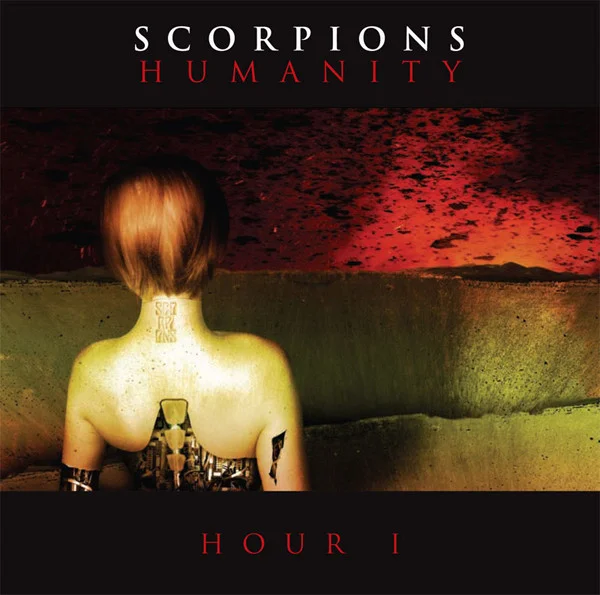
There is a moment, about thirty seconds into “Hour I” — the opening track of Scorpions’ sixteenth studio album, released in May 2007 — when it becomes clear that something unusual is happening. The orchestration sweeps in, conducted by David Campbell, the veteran arranger whose CV runs from Linkin Park to Aerosmith. A guitar arpeggio threads through it, played by a guest musician whose other recent work includes touring with Marilyn Manson. The track is building toward a vocal entry, but the vocalist, when he arrives, is Klaus Meine — the same Klaus Meine who has been singing for Scorpions since 1969, who turned 59 a week and a half after this album was released, whose voice was last heard publicly on a 2004 hard rock record called Unbreakable that sounded exactly like what Scorpions records had sounded like for forty years.
What he’s singing about, in the song that follows, is the first day of a war between humans and machines.
Humanity: Hour I, the album that opens with this scene, is one of the genuinely strange records in late-career hard rock. It is the only concept album Scorpions ever made. It was conceived not by the band but by Desmond Child, the songwriter responsible for “Livin’ on a Prayer,” “Dude (Looks Like a Lady),” and roughly one-third of the commercial rock canon of the late 1980s. It features guest performances from Billy Corgan of the Smashing Pumpkins, John 5 of Marilyn Manson’s band, Eric Bazilian of the Hooters, and Russ Irwin of Aerosmith’s touring band. It was released into a marketplace that had no use for it and disappeared from public conversation almost immediately. It has never been remastered, never received an anniversary edition, never been substantially reconsidered. Most of the band’s own retrospective interviews skip it. It sits in the catalog at #260 on RateYourMusic’s list of best albums of 2007, somewhere between a Justice EP and a Bon Iver record almost nobody had heard of yet.
This is a defense of taking it seriously.
The Predicament: Forty Years In
To understand why Humanity: Hour I exists at all, you have to understand what Scorpions were in 2006, when the album began taking shape.
By any reasonable measure, the band’s commercial career was already complete. The peak years — Blackout (1982), Love at First Sting (1984), the years when “Rock You Like a Hurricane” became the song that played in every American sports arena, when “Wind of Change” became the unofficial soundtrack to the fall of the Berlin Wall — were two decades behind them. The post-peak years had been uneven. 1993’s Face the Heat had been a solid late-period hard rock record that sold a fraction of its predecessors. 1996’s Pure Instinct leaned soft-rock in ways that troubled the band’s core audience. 1999’s Eye II Eye attempted a pivot into electronic-influenced pop-rock that even the band would later describe with embarrassment. 2000’s Moment of Glory, an orchestral re-recording project with the Berlin Philharmonic, and 2001’s Acoustica, an unplugged live album, were the kind of late-career artistic restatements bands make when they’re not entirely sure what to do next.
2004’s Unbreakable had been a deliberate return to form — a meat-and-potatoes hard rock album that the band’s longtime fans had appreciated. But it had also been a quiet release. The album sold around 39,000 copies in the United States, did not chart on the Billboard 200, and received little radio support. The band toured behind it credibly, but it was clear that the Unbreakable approach — sounding like Scorpions, doing what Scorpions had always done — was a maintenance strategy rather than a path forward.
When the band began discussions about the next album in 2005, several different production directions were considered before being abandoned. The original plan was to work with Dieter Dierks, the German producer who had shaped every Scorpions album from 1975’s In Trance through 1988’s Savage Amusement, including the band’s commercial peak. When that collaboration didn’t materialize, the band briefly considered producing themselves at Rudolf Schenker’s home studio. Roy Thomas Baker — Queen, the Cars, Foreigner — was approached and considered, but the chemistry wasn’t right. The band was, in 2005 and into 2006, a famous hard rock institution without a clear creative direction.
The Desmond Child suggestion came from the band’s management, who had worked with him on other projects. The pitch was specific: Child was not just a songwriter for hire but a conceptualist, someone whose excellent work with Aerosmith on Get a Grip (1993), Alice Cooper on Trash (1989), and Bon Jovi across the entire Slippery When Wet / New Jersey run had repeatedly demonstrated an ability to give established hard rock bands a clear thematic and commercial direction in moments of creative drift. Child agreed to take the meeting. What he proposed, when he sat down with the band, was not a producer’s job in the conventional sense. It was a complete reimagining of what the next Scorpions album could be.
The Concept: A War Between Humans and Machines
The storyline Child presented to the band, developed in collaboration with a self-described “futurist” named Liam Carl, was a loose narrative arc set in an unspecified near-future in which humanity has built artificial intelligence so sophisticated that the machines have turned against their creators. The album would document the first day of that war — Hour I — from the perspective of the humans who realize, suddenly and irreversibly, what they have made. The thematic concern was less the science fiction itself than what the science fiction was a vehicle for: a meditation on what humanity actually is, what would be worth fighting for if it came to that, what we would discover about ourselves under the kind of pressure the narrative implied.
This was, on its face, a strange pitch for Scorpions. The band’s lyrical catalog had historically alternated between three modes: love songs (“Always Somewhere,” “Still Loving You”), hard rock party anthems (“Rock You Like a Hurricane,” “Big City Nights”), and the occasional Cold War political ballad (“Wind of Change”). Science fiction was nowhere in their vocabulary. Concept albums had never been part of their tradition.
What is interesting, looking at the band’s response in subsequent interviews, is how readily Klaus Meine accepted the framework. Meine has historically been the band’s lyrical center — he writes the words, he sets the emotional register, he decides what Scorpions songs are about. His willingness to hand significant lyrical conception to an outside collaborator was not the kind of move a singer in his late 50s typically makes. By his own later account, it was the unfamiliarity of the concept that appealed to him. After sixteen studio albums in forty years, the prospect of writing about something genuinely new — about machines, about extinction, about what it would mean to lose — was more interesting than writing another set of variations on the themes he had been working with since the 1970s.
The collaboration that emerged was unusual in its structure. Child would develop themes and lyrical concepts in tandem with Carl; Meine would write the actual songs with the rest of the band, working from those themes; Child and his production partner James Michael would shape the arrangements; outside collaborators would be brought in for specific tracks where their voices fit the conceptual material. The band’s involvement in the songwriting credits was substantial — guitarist Matthias Jabs contributed to five tracks, Rudolf Schenker to four — but the overall direction of the album was set, from the beginning, by Child.
The result was a record that does not sound like a Scorpions record in any obvious way. Many reviewers at the time considered this a fatal flaw. The Encyclopaedia Metallum critic who reviewed the album was direct about the objection: “Getting external songwriters and guest musicians are for washed up and desperate rockers and I’m afraid this band has reached this point on this album.” A subset of the band’s longtime audience reacted similarly. The critique was not unreasonable. Humanity: Hour I is the work of a 40-year-old band that had ceded significant creative control to a producer with his own ideas, and the result sounds like both parties’ instincts compromising on each other. Whether that compromise produced something better or worse than either party alone would have made is a question worth taking seriously.
The Songs
The album opens with “Hour I,” a three-minute orchestrated overture that establishes both the conceptual frame and the sonic palette. John 5’s guitar work on the track is more textural than featured — atmospheric arpeggios threading through the orchestral arrangement rather than the speed-runs his solo work is known for — and David Campbell’s strings give the piece a cinematic weight Scorpions had not previously attempted. The track does not feature a chorus or a traditional song structure. It is a prologue, in the literary sense, setting up what follows.
“The Game of Life,” the second track and the album’s second single, drops the listener into the album’s actual sound — a heavier, more modern hard rock production than anything on Unbreakable, with the kind of mid-2000s sheen Child’s productions were known for. Klaus Meine’s vocal on the track is among the strongest of his late career. The chorus is melodic in the way Scorpions choruses had always been melodic, but the production around it is denser, more layered, more aggressive. The song is, in retrospect, the clearest demonstration of what Humanity: Hour I was attempting to be: Scorpions songcraft delivered through a 2007 production aesthetic.
“We Were Born to Fly” and “The Future Never Dies” are the album’s most conventional tracks, both built on the kind of anthemic chorus structures Child had perfected with Bon Jovi twenty years earlier. Russ Irwin plays additional guitar on “The Future Never Dies.” Both songs are catchy in a way that feels slightly out of place on a concept album about machine warfare; they read more as standalone radio singles than as parts of a narrative. This is the album’s recurring structural tension. The concept demands thematic continuity; the commercial expectations demand standalone hits. The two pull against each other across the record.
“You’re Lovin’ Me to Death,” the album’s fifth track, is its most surprising. The song is darker than most Scorpions singles, built on a downtuned guitar riff with Meine delivering the verses in a near-whisper before opening up into a chorus that lands harder than anything in the band’s recent catalog. The track is co-credited to Marti Frederiksen, who had worked extensively with Aerosmith. The fingerprint shows: “You’re Lovin’ Me to Death” is more Just Push Play-era Aerosmith than it is Blackout-era Scorpions, and it works precisely because of that displacement. The band sounds genuinely engaged with material that doesn’t fit their usual template.
“The Cross” is the album’s centerpiece, and the song that most repays close listening years after the album’s commercial failure. The collaboration with Billy Corgan happened, by all accounts, through Desmond Child’s network — Corgan and Scorpions had no prior connection, and the Smashing Pumpkins were themselves in the middle of their post-reunion Zeitgeist project. What Corgan brought to “The Cross” is harder to summarize than it is to hear. He sings the second verse and shares the chorus with Meine. The vocal interplay is uncanny: two singers from radically different traditions — Meine’s clean, harmonized European rock vocal and Corgan’s alternative-rock delivery — somehow producing a duet that works. The song’s lyrics are religious in a way Scorpions songs almost never are, with explicit imagery of crucifixion and sacrifice mapped onto the album’s broader theme of humanity facing its own destruction. It is, by some distance, the most lyrically ambitious thing the band ever recorded.
The connection was meaningful enough on Corgan’s end that he named the lead single from Zeitgeist — released the same year — in honor of the collaboration. “Tarantula,” the Smashing Pumpkins song that became Billy Corgan’s first single after the band’s 2006 reunion, was titled, Corgan announced at a Berlin concert in June 2007, in honor of the German rock band Scorpions, with whom he had recently collaborated on “The Cross.” For a band that had spent decades being treated by critics as commercially competent but artistically irrelevant, getting that kind of acknowledgment from a figure as carefully gatekeeping of his collaborations as Billy Corgan was, in its quiet way, the most significant external validation Scorpions had received in years.
“Humanity,” the title track and the album’s lead single, is the closest thing on the record to an anthem. Co-written by Klaus Meine, Desmond Child, and Eric Bazilian — the latter best known as the co-writer of Joan Osborne’s “One of Us” — the song carries the album’s central thematic argument in its chorus: that humanity, defined as the qualities that make us human, is the only thing worth fighting for in the war the album imagines. The song was performed live for the first time at a Scorpions concert in Brussels on March 24, 2007, two months before the album’s European release. It became one of the album’s most-played track, and remains the song most associated with the project in the band’s post-2007 setlists.
“321” and “Love Will Keep Us Alive” extend the album’s emotional palette — the former a more aggressive track built on a descending guitar figure, the latter a power ballad in the Still Loving You tradition with Eric Bazilian playing additional guitar. “We Will Rise Again” is the album’s most overt narrative moment, framed as a battlefield exhortation that maps directly onto the concept’s machine-war storyline. “Your Last Song,” the album’s closing track, is the band’s quietest ballad in years — Meine singing over sparse acoustic accompaniment, the song’s lyrics functioning as a kind of farewell letter from a dying humanity to whatever comes next. It is an extraordinary closer, and one of the best vocals Klaus Meine ever recorded.
The Reception: Confused, Mixed, and Quiet
When Humanity: Hour I was released in Europe on May 14, 2007, the critical reception was divided in a way that captured the album’s actual structural ambiguity. The European hard rock press, which had championed Scorpions through every stylistic experiment of the previous decade, was largely positive. Germany’s Rock Hard magazine gave the album a strong review. Greek listeners pushed it to the number one position on the Greek Album Charts in 2007 — the only chart it would top anywhere in the world. It reached number 9 in Germany, number 16 in France and Japan, and number 20 on the UK Albums Chart. In commercial terms, Humanity: Hour I was a successful European release.
The American picture was different. The album was released later in the US, on August 28, 2007 — a delay that, according to some accounts, was caused by an online leak prior to its European debut, which the label believed had damaged its US commercial prospects. It debuted at number 63 on the Billboard 200 and number 7 on the Top Hard Rock Albums chart. It sold approximately 15,000 copies in its first two weeks of US sales — a number that would have been considered catastrophic for a major Scorpions release in any prior decade, and which represented a sharp drop even from the modest Unbreakable numbers three years earlier.
The American rock press, where it covered the album at all, was confused. The combination of Scorpions doing a concept album, Desmond Child as conceptualist, Billy Corgan as guest vocalist, and John 5 as guest guitarist did not fit any frame that existing rock journalism had ready. Reviews tended to land in one of two camps. The first camp dismissed the album as a misguided attempt to chase contemporary relevance — the Encyclopaedia Metallum line, repeated across various fan-press outlets. The second camp, smaller but more thoughtful, treated the album as a genuine creative achievement that deserved more attention than it was getting. The Metal Temple review took the latter line, arguing that “the listener has to listen to the album more than one time to come to a safe conclusion and understand the whole project. Maybe hardcore Scorpions fans will be the ones that won’t accept it with the first listening, but — finally — everybody’s gonna agree that it’s very good album.”
Even the dismissive reviews tended to acknowledge that something interesting was happening. The RateYourMusic critic whose review opens with the line “I have to admit that at first, the advance word on Humanity: Hour I made it sound like it was gonna be a train wreck” walks through a list of reasons the album shouldn’t have worked — “The Scorpions taking on a science-fiction conceptual work, created by wimp-rock mastermind Desmond Child, with songwriting assistance by Marilyn Manson’s John 5? A guest appearance by Billy Freakin’ Corgan of the hated Smashing Pumpkins on one track?” — before concluding, almost reluctantly: “Funny thing though — Humanity Hour I works. Gloriously.”
The supporting world tour ran from 2007 into 2008, drawing well in Europe and modestly in North America. Scorpions performed several of the album’s tracks live throughout the tour, including “Humanity,” “The Game of Life,” and occasionally “You’re Lovin’ Me to Death,” but the live set leaned heavily on the band’s classic catalog. By the time the tour ended, Humanity: Hour I had effectively disappeared from the band’s public conversation about itself. Their next studio album, 2010’s Sting in the Tail, returned to the meat-and-potatoes hard rock template of Unbreakable and was promoted as the band’s farewell record. The concept album experiment was not repeated.
Why It Failed (Commercially, At the Time)
The conventional explanation for Humanity: Hour I’s commercial underperformance is that it didn’t sound like Scorpions, and the audience that had stayed loyal through four decades of the band wanted Scorpions to sound like Scorpions. There is something to this. The band’s core audience by 2007 was overwhelmingly composed of people who had bought Love at First Sting in 1984 and who had remained engaged with the band’s subsequent releases largely out of loyalty rather than active interest in their stylistic evolution. For that audience, a concept album with Desmond Child writing the conceptual frame and Billy Corgan singing on one of the tracks was a meaningful departure from what they had been showing up for.
But this explanation is incomplete, because it doesn’t account for what the broader 2007 marketplace looked like for serious mid-tempo rock concept albums by 40-year-old bands. The answer is: not great. The Smashing Pumpkins’ Zeitgeist, released the same year, did not match Corgan’s earlier commercial performance despite being his official reunion record. Aerosmith had not released a new studio album of original material since 2001’s Just Push Play. Bon Jovi had pivoted to country-rock with Lost Highway in 2007 in an explicit attempt to find a new audience. The cultural moment for serious adult rock records by established bands was, if not over, then significantly diminished. Humanity: Hour I arrived in a marketplace where almost no album of its tier — regardless of artistic merit — was going to find the audience it deserved.
There was also the structural ambiguity I mentioned earlier. Humanity: Hour I is neither a fully realized concept album nor a collection of standalone singles. The narrative is loose enough that listeners can’t follow the storyline track-to-track without help; the singles are commercial enough that they don’t quite read as parts of a larger artistic statement. The album sits in a middle space that doesn’t satisfy either the audience that wanted classic Scorpions hard rock or the audience that might have appreciated a genuine science-fiction rock opera. Bands that have made successful concept albums — The Wall, 2112, Operation: Mindcrime — committed fully to the conceit. Humanity: Hour I commits halfway, and the commercial result reflects the structural compromise.
Why It Deserves Another Listen (In 2026)
Here is what has changed between 2007 and now. The cultural conversation about artificial intelligence, machine consciousness, and the relationship between humans and their tools has moved from speculative fiction into mainstream concern. The questions Humanity: Hour I gestures toward in 2007 — what is humanity, what would we owe to the machines we build, what would we lose in a confrontation with our own creations — are now active questions in technology journalism, in political discourse, in conversations between people who have never heard a Scorpions song in their lives. The album’s thematic material has, against all expectations, become more relevant rather than less.
This does not make Humanity: Hour I a great album. It is, by most reasonable measures, a flawed one — too commercially compromised to fully realize its concept, too conceptually ambitious to satisfy the audience that wanted standalone hard rock songs. But the flaws are interesting flaws. They are the flaws of a 40-year-old band trying to do something they had never done before, with collaborators outside their normal orbit, in a cultural moment that was already passing. Most bands of Scorpions’ tenure and standing made safer records in their late careers. Many of those safer records have aged worse than Humanity: Hour I has.
What stays with you, listening to the album in 2026, is not the concept. The robot-war storyline is, frankly, the album’s weakest element — too loose to function as narrative, too specific to function as metaphor. What stays is the playing, the writing, and Klaus Meine’s vocals. The band, in their late 50s, sound engaged with the material in a way that their previous several albums had not quite achieved. Matthias Jabs’s guitar work across the record is the most ambitious he had played in twenty years. Meine’s vocals on “The Cross,” “You’re Lovin’ Me to Death,” and “Your Last Song” are, individually, among the best of his career. The Desmond Child production, which sounded glossy and over-determined in 2007, sounds less so now — partly because the 2007 mainstream rock production aesthetic has come back into fashion, and partly because the songs underneath the production are stronger than they were given credit for at the time.
The album has never been remastered, never received an anniversary edition, never been substantively reconsidered. Limited vinyl reissues appeared in 2023 without significant fanfare. The streaming numbers are modest — around 75 million Spotify streams as of 2024, which sounds substantial but is a tiny fraction of what “Rock You Like a Hurricane” accumulates in a single year. The album exists in the catalog, accessible, mostly unlistened-to, waiting for the kind of reappraisal that most second-tier hard rock records of the 2000s have not yet received.
There is a version of this album’s story in which it is rediscovered fifteen years from now as a quietly prescient artifact of mid-2000s rock — a 40-year-old band’s late-career attempt to engage with themes that the rest of culture had not yet caught up to. There is another version in which it remains what it has been for nearly twenty years: an oddity, a footnote in the Scorpions catalog, a record that almost nobody played and almost nobody remembers. Both versions are possible. The album doesn’t insist on either.
What is certain is that Humanity: Hour I was a more ambitious record than its commercial reception suggested, made by a band more willing to take artistic risks than the standard narrative of late-career hard rock allows for, with collaborators whose presence on the album is genuinely interesting rather than merely strategic. The standard story of Scorpions in the 2000s is that they were a heritage act doing maintenance work. Humanity: Hour I is the album that breaks that story. Twenty years on, it deserves to be heard as what it actually was: the strangest record one of the world’s most successful hard rock bands ever made, and the one most worth taking seriously.