Long Plays
The Hottest Cold Streak: Foreigner's Unusual Heat and the End of an Era
After thirteen years and seven multi-platinum albums, Foreigner's voice walked out. The band that remained — Mick Jones, three sidemen, and an Atlantic Records frontman named Johnny Edwards — made a record that should have worked. It peaked at number 117 on the Billboard 200, the worst chart position of the band's career, and effectively ended Foreigner's run as a commercial force. A long play on the album that exposed exactly what Foreigner had always been — and what it could not be without Lou Gramm.
There is a specific kind of band the late-1970s and early-1980s American music industry produced in unusual abundance, and Foreigner is one of the cleanest examples of the type. Built — and “built” is the right word — by Mick Jones in New York in 1976, the band was a deliberately engineered transatlantic project: three British musicians and three American ones, assembled with the explicit commercial goal of making music that would work on AOR radio on both sides of the Atlantic. The name was a marketing decision before it was an identity. By his late twenties, after a decade and a half as a working musician across Europe, Jones had absorbed an unusually clear-eyed understanding of what professional rock-and-roll actually was in 1976. It was not, primarily, an art form. It was a commercial product, made by skilled craftsmen, for an audience that wanted specific musical experiences delivered with consistency and quality. The bands that succeeded at this work were the ones that understood it as work.
Foreigner succeeded enormously. Between 1977 and 1987 the band released six studio albums, all of which reached the top twenty of the Billboard 200, four of which went multi-platinum, and which together produced more than a dozen top-twenty singles on the Hot 100. “Feels Like the First Time,” “Cold as Ice,” “Hot Blooded,” “Double Vision,” “Dirty White Boy,” “Head Games,” “Urgent,” “Waiting for a Girl Like You,” “Juke Box Hero,” “I Want to Know What Love Is,” “That Was Yesterday,” “Say You Will,” “I Don’t Want to Live Without You” — the run of songs that became inescapable on American rock radio is genuinely extraordinary, and the consistency with which Jones and his co-writer Lou Gramm delivered the material over a decade was unmatched among the band’s cohort. Journey produced more obvious anthems. Boston had a more distinctive sonic identity. Toto had more accomplished individual musicianship. Foreigner did none of those things better than its competitors. What it did better than anyone was deliver the goods, year after year, in a vocabulary that AOR radio could play and Top 40 could cross over to.
And then, in May 1990, Lou Gramm announced he was leaving the band.
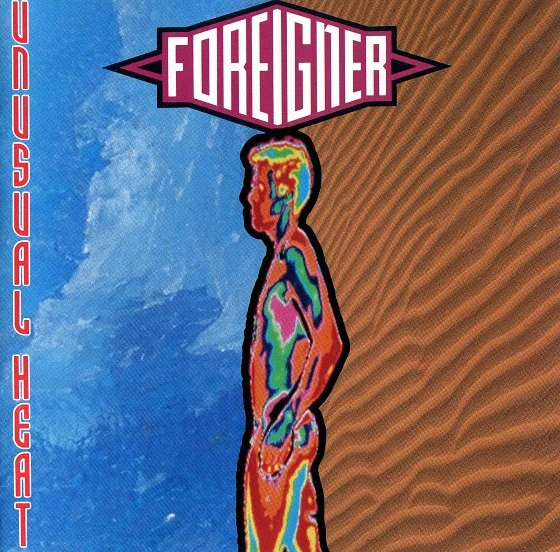
The album Foreigner made next was Unusual Heat, released June 24, 1991 — the band’s seventh studio album and the first recorded without Gramm. Its lead singer was a thirty-year-old veteran rock vocalist named Johnny Edwards, recruited from another Atlantic hard rock act, Wild Horses. Its producer was Terry Thomas, a British musician whose CV then consisted mostly of work with the glam-rock act Charlie and a handful of mid-tier hard rock credits. The album was a deliberate attempt to prove Foreigner could keep functioning as Foreigner without the voice that had defined it since 1977.
It peaked at number 117 on the Billboard 200 — by a wide margin the worst chart performance of the band’s career, and the record that effectively ended Foreigner’s run as a maker of hits. The trajectory it initiated has, with one minor exception, held for thirty-five years: not since Inside Information in 1987 has a Foreigner studio album reached the top forty. The band still tours and still releases new music sporadically. It has become, in the long-running phrase, a legacy act. But the Foreigner that produced hit singles ended, definitively, with Gramm’s departure. This is the story of the album that documented that ending — why it failed in exactly the way it did, and what its failure reveals about what Foreigner had actually been when it was working.
The Unusual Band Foreigner Already Was
The standard description, “successful 1980s arena rock band,” undersells how genuinely unusual Foreigner’s operating model was. Mick Jones — the band’s founder and the one constant through every lineup since 1976 — was not a typical 1970s rock musician in any way that mattered to how the band would function. He was English, raised in West London, playing guitar professionally from his late teens. He moved to Paris in 1964 to play with Sylvie Vartan, became musical director for Johnny Hallyday, France’s biggest rock star, and spent the late 1960s and early 1970s as a journeyman session and live player across Europe. He reformed Spooky Tooth with Gary Wright, played with the Leslie West Band, and served briefly as A&R at a British label. By 1976, relocating to New York to assemble what became Foreigner, Jones was thirty-one and had been a professional musician for nearly fifteen years — and had developed, through that long apprenticeship, a particularly clear-eyed view of what made commercial rock actually work.
The band he designed was a six-piece built around functional roles. Jones on lead guitar and as principal songwriter. Ian McDonald, the former King Crimson multi-instrumentalist, on keyboards, saxophone, flute, and rhythm guitar, bringing harmonic sophistication. Al Greenwood on keyboards and synthesizers, supplying the texture 1976 rock production was beginning to require. Dennis Elliott, from the Ian Hunter–Mick Ronson Band, on drums, bringing the disciplined timekeeping AOR arrangements demanded. Ed Gagliardi on bass, chosen after auditioning thirty other players. And, crucially, Lou Gramm on vocals.
Gramm was twenty-six. He had spent the preceding years in a Rochester, New York band called Black Sheep, which recorded two unsuccessful albums for Capitol in 1974 and 1975 before a truck accident that destroyed its equipment effectively ended it. Jones had been handed Black Sheep’s first album by Gramm himself at a Spooky Tooth show in Rochester in 1975, had liked it, and had remembered; when he started building Foreigner, he called. The audition was a formality. The hiring was, in retrospect, the single most important decision Jones made in the band’s construction. The Foreigner sound that dominated American rock radio for a decade was, in nearly every meaningful way, Mick Jones’s songwriting craft delivered through Lou Gramm’s voice. Take out the voice and you have a substantially different — and substantially less commercial — band.
The name worked the same calculating way. Jones, McDonald, and Elliott were British; Gramm, Greenwood, and Gagliardi were American; whatever country the band was in, half of them were foreigners. In 1976, when American rock radio was increasingly programmed against British rock and vice versa, a band that could plausibly claim both was strategically positioned in a way a band claiming one was not.
The commercial results were enormous. The debut, released March 1977, sold roughly five million copies in the United States; Double Vision (1978) seven million; Head Games (1979) five million; 4 (1981) six million; Agent Provocateur (1984) three million; Inside Information (1987) one million. Cumulatively: around eighty million records worldwide, thirty-eight million in the United States — a place among the best-selling rock acts of the era that the band’s muted critical reputation has tended to obscure. Foreigner were not the most respected band of their cohort. By the relevant commercial measures, they were among the most successful.
What the standard narrative misses is the discipline of the operation. Foreigner did not have the kind of internal dynamic that produced messy multi-year creative collapses. Jones ran the band like a well-organized professional partnership: he wrote the songs (almost always with Gramm), produced the records (almost always with an outside collaborator), ran the sessions, and made the strategic calls. The other members executed their assigned parts. McDonald and Greenwood both left in 1980, replaced by session players as needed; the lineup contracted to a four-piece — Jones, Gramm, Elliott, and bassist Rick Wills, who had joined in 1979 to replace Gagliardi — and stayed there. On record, the band increasingly leaned on session keyboardists, guitarists, and backing vocalists. The Foreigner of 4, Agent Provocateur, and Inside Information was, functionally, Mick Jones’s production project with Lou Gramm singing on it.
It worked because Jones and Gramm collaborated effectively. The songs they wrote together were better than the songs either wrote alone; the vocals Gramm delivered on Jones’s compositions were among the most consistently effective rock vocals of the era; and eight platinum-or-better albums in ten years vindicated the model. What the model could not handle was the partnership coming apart.
The Slow Disintegration of Jones and Gramm
The Jones–Gramm relationship deteriorated gradually across the 1980s, in a way the band’s continued success during the deterioration largely obscured. The conventional account puts the clear fracture at the 1984 Agent Provocateur sessions and the pivot toward synthesizer-heavy production. The more accurate framing — supported by Gramm’s own extensive testimony over four decades — places it earlier, in a creative disagreement present almost from the beginning. He was a rock singer who had joined what he believed would be a rock band. Jones, by Gramm’s account, increasingly wanted softer, synthesizer-based, ballad-heavy material oriented toward what would become adult contemporary radio. In a 2026 interview with Goldmine, Gramm put the tension in characteristically blunt terms: “As great as a guitar player that Mick Jones is, there was a point in time in Foreigner’s history when he started to become enamored with synthesizers. I’m a guitar lover. I like synthesizers to augment the guitar sound, but Mick was starting to write songs that were synthesizer and keyboard based. Most of the keyboard songs were mid-tempo or ballads and I was becoming very frustrated with the direction that we were taking at that point in time, because I joined a rock band.”
Jones’s side, where he has articulated it, is less direct but equally consistent: his instincts pulled the band toward the material that actually produced hits. “I Want to Know What Love Is” reached number one on the Hot 100 in February 1985 precisely because it was the kind of song Gramm had been resisting, and a band dominated by Gramm’s harder preferences would, on this argument, have been substantially less commercial. There is something to it. That single became Foreigner’s only number-one and established the band as a Top 40 force in a way their rock-radio hits had not.
But there is a counter-argument, captured by what happened next. In 1987, frustrated with Jones’s growing dominance, Gramm released his solo debut, Ready or Not. Its lead single, “Midnight Blue,” was — by his own account — a guitar-driven rocker he had first offered to Foreigner; Jones declined to include it on the album then in production, so Gramm took it for himself. “Midnight Blue” reached number five on the Hot 100, became the most-played song on rock radio in 1987 by Billboard’s year-end tallies, and outperformed every single from the contemporaneous Foreigner album Inside Information. The song Gramm had wanted Foreigner to record had become a bigger hit than anything Foreigner recorded that year — the implication being that his instincts were not just defensible but commercially correct, and it sat heavily on the relationship. Inside Information produced two top-ten singles (“Say You Will” at six, “I Don’t Want to Live Without You” at five) but sold a million copies, down sharply from the previous album’s three, and Gramm’s dissatisfaction grew audible: he has admitted to deliberately under-singing “I Don’t Want to Live Without You,” a song he considered emblematic of the direction he wanted abandoned.
The relationship frayed through 1988 and 1989. Gramm’s second solo album, Long Hard Look (1989), produced another top-five hit in “Just Between You and Me.” By early 1990, with no Foreigner album planned and both men committed to separate work, Gramm decided to leave; the announcement came in May. He formed Shadow King with his old Black Sheep bassist Bruce Turgon and a young guitarist named Vivian Campbell, who two years later joined Def Leppard; the band released one self-titled album on Atlantic in 1991, drew respectful reviews, failed commercially, and disbanded.
Jones, meanwhile, was left with a band that was no longer a band — himself, Wills on bass, Elliott on drums, the keyboard work long since outsourced to session and touring players, and the single most distinctive element of the band’s identity gone. Atlantic, having supported eight albums, was contractually expecting a ninth. Jones decided to continue, and the decision was more defensible than the eventual outcome would credit: Foreigner had been his project from the start, the name and catalog and commercial identity were substantially his, and disbanding to start over under a new name would have surrendered enormous accumulated value. He chose to find a new singer.
Johnny Edwards and the Sound of Reasonable Continuity
Johnny Edwards was, in 1990, a thirty-year-old American rock vocalist with a steadily working but low-visibility career: a brief stint touring with Montrose, time in a band called Buster Brown around the turn of the 1980s, two mid-1980s albums on Capitol with the Carmine Appice–led King Kobra, and, most relevantly, the lead vocal slot in Wild Horses, an Atlantic hard rock act whose debut was in production just as Jones went looking.
The choice revealed how Jones understood the problem. Wild Horses’ actual musical fingerprint had limited overlap with Foreigner’s; what Edwards offered was range, technical capability, and — most importantly — a tonal quality that could plausibly substitute for Gramm’s. He was not Lou Gramm, and not, in any sense that mattered, a comparable artistic figure. He was a competent vocalist who could hit the notes and deliver the songs with enough authenticity to make the recordings functional. Terry Thomas, brought in to produce, was unusually candid about the assignment in 2018:
The Journey comparison is exact. When Steve Perry left Journey later in the decade, the band recruited Steve Augeri specifically because his voice could approximate Perry’s, and continued the practice with Arnel Pineda, the current singer, famously discovered on YouTube performing Perry-style covers. A band whose identity is substantially defined by a vocal sound can survive the loss of the original voice only by replacing it with a sound-alike. The problem is that the audience can usually tell the difference. Listeners who had spent thirteen years hearing Gramm sing “Cold as Ice” and “Urgent” and “I Want to Know What Love Is” were not going to mistake Edwards for him. His voice was similar enough to fit the template, and different enough that no one who had ever heard Foreigner would miss the substitution.
The record that resulted — Unusual Heat, cut in late 1990 and early 1991 at studios in New York and England, produced by Thomas and Jones — is, on its own terms, better than its reception suggests. The songs are competent, the production professional, Edwards’s performances technically accomplished, the arrangements faithful to the AOR vocabulary the band had spent a decade establishing. Released under any other name, by any other band, with any vocalist other than an obvious Gramm-substitute, it might have been received as a credible debut from a new arena-rock act finding its footing. Released as a Foreigner album with Edwards trying to sound like Gramm, it was received as exactly what it was: a band attempting to continue without the element that had made it a band.
The Album, Track by Track
Unusual Heat opens with “Only Heaven Knows,” a mid-tempo rocker whose riff connects clearly to the back catalog and whose vocal is the album’s clearest demonstration of Edwards’s range and tonal likeness to Gramm. It does what an opening track was meant to do — establish that this configuration could still make a Foreigner-style song — and nothing more; it is competent work that nobody in 1991 particularly needed to hear.
“Lowdown and Dirty,” the lead single, was the strongest commercial play. It reached number four on the Billboard Mainstream Rock chart — the band’s best single placement there since “Say You Will” in 1988 — but failed to cross to the Hot 100. The split is the album’s commercial story in miniature: rock radio would still play Foreigner in 1991, the broader pop audience would not. The song itself is a tight, blues-inflected rocker that briefly suggests what a harder-rocking Foreigner might have sounded like — the version Gramm had been arguing for all decade.
“I’ll Fight for You,” the second single, attempted the conventional Foreigner power ballad — dynamic build, soaring chorus — and failed to chart on the Hot 100 at all. It exposes the central problem with Edwards’s contribution. He can hit the notes the arrangement requires; what he cannot do is deliver the emotional register Gramm brought to comparable songs. Where Gramm’s vocals on “I Want to Know What Love Is” or “Waiting for a Girl Like You” carried a yearning vulnerability that made the songs work, Edwards’s here is accomplished but inert — sung correctly, not memorably.
“Moment of Truth,” “Mountain of Love,” “Ready for the Rain,” and “When the Night Comes Down” fill the middle, and they carry a meaningful credit shift: most of the album’s songwriting went to Thomas and Edwards rather than Jones, whose name is often simply added. The Foreigner catalog through 1988 had been overwhelmingly Jones-and-Gramm material; on Unusual Heat, the voice of the band’s primary songwriter is largely absent from the actual songwriting. “Safe in My Heart” is the album’s clearest gesture at recreating “I Want to Know What Love Is” — a piano ballad with extended dynamics — and several retrospective reviews call it the strongest track, the place Edwards comes closest to making the record work on Foreigner’s own terms. It is not bad. But “I Want to Know What Love Is” had Lou Gramm; “Safe in My Heart” has Johnny Edwards trying to sound like Lou Gramm, and the audience hears the difference. The title track closes the record with a ballad running past five minutes, reaching for the kind of emotional climax the band had built into its earlier closers; the execution is professional and the result unremarkable.
That is the album’s real failure — not that any song is bad, or the production incompetent, or the playing diminished, but that nothing on the record makes the case that this Foreigner needs to exist. The audience that wanted Foreigner had six previous albums, all widely available, all featuring Gramm, all containing the material it actually wanted. The audience that did not care about Foreigner had no reason to start here. The album occupied a commercial position with no natural buyer.
The Commercial Verdict
Unusual Heat peaked at number 117 on the Billboard 200, the band’s worst placement to date by a wide margin. Every prior studio album had reached the top twenty: the debut at four, Double Vision at three, Head Games at five, 4 at number one (six weeks atop the chart in 1981), Agent Provocateur at four, Inside Information at fifteen. This was not a decline so much as a categorical break with the band’s entire commercial history. The RIAA certified it for nothing; every previous studio album had gone at least platinum, five of six multi-platinum, while Unusual Heat moved fewer than the 500,000 copies gold required. Neither single made the Hot 100; “Lowdown and Dirty” took its number four on Mainstream Rock without broader impact.
Contemporary reviews were uniformly poor — Entertainment Weekly gave it a D, Rolling Stone was dismissive — and the more attentive rock press kept naming the same problem: the album sounded like Foreigner without sounding like Foreigner, and Gramm’s absence was conspicuous enough to overwhelm whatever the new lineup offered. The retrospective verdict has softened only marginally; a few dedicated AOR critics argue the record holds genuinely strong material that has aged better than its reception, but the broad consensus has treated it for three decades as the obvious low point — the album that didn’t work, the record most of the audience never heard.
The supporting tour ran through late 1991 into 1992 to competent playing and substantially smaller crowds in downgraded venues. The setlist still leaned heavily on Gramm-era material — there was no realistic alternative — which meant Edwards was being asked to perform, nightly, songs the audience had heard Gramm sing for fifteen years. The comparison was unforgiving.
By spring 1992, Jones and Gramm had quietly begun talking again. The proximate occasion, by various accounts, was the Los Angeles riots of late April and early May 1992: both men were independently affected, reached out, and began mending the relationship. By summer Gramm had agreed to return for a compilation with three new tracks; The Very Best…and Beyond arrived that October. Edwards had been quietly let go and Thomas was no longer producing. The Edwards era had lasted roughly twenty-four months from hiring to dismissal. He has continued to work as a professional vocalist since, but never again on anything near Foreigner’s scale.
Why It Didn’t Work
The conventional explanation is simple: Gramm’s voice was Foreigner’s commercial identity, and removing it removed the band’s viability. That is correct as far as it goes, but it underestimates how completely the identity had been tied to the specific collaboration between Jones and Gramm rather than to either man alone.
Gramm’s solo career, between 1987 and 1991, produced real success but nothing near Foreigner’s scale. Ready or Not (1987) went gold; Long Hard Look (1989) went gold; neither reached platinum; Shadow King (1991) failed despite good reviews. Whatever Gramm’s voice contributed to Foreigner was not, by itself, enough to produce Foreigner-scale results on material he wrote and chose. Jones’s contributions were no more sufficient in isolation. His pre-Foreigner work with Spooky Tooth and the Leslie West Band had never approached that scale, and the Unusual Heat sessions — Jones and Thomas with Edwards out front — produced a record that was technically competent and commercially inert. His songwriting craft, applied to a vocalist other than Gramm, did not produce the same outcomes.
What Foreigner had been, at its peak, was a specific chemistry between two musicians whose strengths combined into something neither could produce alone: Jones wrote songs Gramm could sing; Gramm sang songs Jones could write; the negotiation between Jones’s commercial instincts and Gramm’s rock-vocalist ones occupied a space neither could hold by himself. Unusual Heat is where that becomes empirically demonstrated. The album Jones could make without Gramm was not, in any commercially meaningful sense, a Foreigner album. It was a Mick Jones project with another singer on it.
A contextual factor compounded the problem. Unusual Heat came out on June 24, 1991, with the alternative-rock wave already gathering: Pearl Jam’s Ten had appeared the previous month, Nevermind would consolidate the shift three months later, Achtung Baby was being readied for November. Even a fully functional Foreigner with Gramm would have faced a far harder market than at any point in the previous decade. Foreigner without Gramm — competing against both the new wave and years of better Foreigner records already in the catalog — had no realistic path. That the band returned to Gramm the moment the failure was clear suggests Jones, after the fact, agreed: the reconciliation that produced The Very Best…and Beyond and the 1994 album Mr. Moonlight was, commercially, the only available correction.
What the Failure Reveals
There is a particular lesson here about how commercial rock bands actually work, and it is worth taking seriously precisely because the album that delivers it is not very good.
For most of its run, Foreigner was treated by the rock press as a corporate-rock project — professional, competent, commercially successful, and ultimately inessential, the kind of band whose hits you knew without ever caring about the band. The implicit charge was that the success came from Jones’s calculation rather than from any real chemistry: a well-engineered product rather than a band. Unusual Heat complicates that verdict from an unexpected direction, because it is exactly the record the dismissive reading would have predicted. Professional production. Competent songwriting. A vocalist chosen for tonal similarity to the established sound. Material built for AOR radio. Every element the critics had cited as evidence of inauthenticity is present in even higher concentration than on the actual hit records — and the album fails. The audience the critique assumed had been buying a formula did not, when handed the formula without Gramm, keep buying.
What that reveals is that Foreigner’s success had never been the formula. It revealed what Foreigner had actually been: a real, if unglamorous, artistic partnership. It revealed what Gramm had actually contributed, and what Jones could and could not do on his own. And it revealed how dependent the commercial life of a long-running AOR band could be on the specific chemistry of its creative pair — even when that chemistry had been treated, by the band and its critics alike, as incidental to the result. The records the partnership made were real songs that audiences connected to for reasons that went past formula compliance, and Unusual Heat is the proof by subtraction: remove one half of the engine and the result does not follow. Something else had been doing the work.
That is why the album earns the Long Plays treatment despite not being good. Foreigner has run for thirty-five years since. Gramm rejoined for Mr. Moonlight in 1994, which sold modestly; he left, returned, and left again in 2003, and has not been a member since. The current Foreigner, fronted since 2005 by Kelly Hansen — recruited with Gramm’s blessing — tours profitably and has released occasional new material (most recently Can’t Slow Down in 2009) that comes nowhere near the Gramm-era scale, while Jones himself has been mostly off the road since 2011 with health issues. The band traveling under the name in 2026 contains one original member, occasionally, and otherwise consists of skilled professionals performing the Gramm-era catalog for audiences who want to hear it performed.
This is what legacy-act rock looks like in the late stages of the form. The brand has value, the hits still get played, and the band has structurally accepted that the work it makes now is no longer the work that defined it. Unusual Heat is the album that started that state — the document of a band trying, with sound strategic logic and competent execution, to continue without the partnership that had made it. The attempt failed, and in failing it proved the partnership had been the thing all along.
Foreigner’s decade-long run of hits ended, definitively, in the summer of 1991, and the band has never again come close to it. Looking back, that run turns out to have been not just a feat of commercial engineering but an artistic accomplishment — a real collaboration that produced real songs — even if the two men most responsible for it did not always know that while it was happening.