Retrospective
The Crumbling Empire: Queensrÿche After 1990
In 1990, Queensrÿche made the album most progressive metal bands spend their careers chasing. Triple platinum, a top-ten single, Grammy nominations, and the kind of critical respect their genre rarely earned. Then, for the next two decades, they slowly came apart. A retrospective on the long unraveling of a band that did everything right at the wrong moment — and never recovered from being good enough to succeed.
On September 4, 1990, Queensrÿche released Empire. The album would be certified triple platinum in the United States. Its lead ballad, “Silent Lucidity,” reached number nine on the Billboard Hot 100 and number one on the Mainstream Rock chart, and earned Grammy nominations for Best Rock Song and Best Rock Vocal Performance by a Duo or Group. The supporting tour ran for nearly two years across arenas and festivals on three continents, and ended in late 1991 with Queensrÿche holding a position no progressive metal band had quite held before: commercial enough to sell millions, serious enough that the rock press wrote about them as a band that mattered.
What followed, across the next twenty-two years, was one of the strangest sustained collapses in late-period rock. Not a sudden implosion, the way grunge dispatched the hair metal bands of Queensrÿche’s commercial cohort. Not an artistic flameout, like the ones that ended Pink Floyd’s classic period or Genesis’s prog era. Something slower, more granular, more interpersonal — a band that kept showing up to make records, kept losing members, kept making records fewer people bought, until one night in São Paulo in April 2012, the singer spat in the guitarist’s face and the thing finally stopped being a band that could be salvaged. Two years of lawsuits followed. By April 2014 there were two organizations touring under the name Queensrÿche, and a King County Superior Court judge in Washington State was being asked to decide which of them had the right to use it.
This is the longer, stranger story the band’s own members have told in retrospect: not that grunge killed them, or that Chris DeGarmo’s 1997 departure was the fatal wound, but that the cracks were already visible during the Empire tour itself, and the next two decades were the slow working-out of structural problems that Empire’s success had only deferred. It is the story of a band that succeeded at the wrong moment, in the wrong way, and then spent twenty years trying to figure out what to do with the success. It is also, along the way, an argument that a few of the records made during that decline — Promised Land above all, and American Soldier in its own strange way — are better than the verdict they received.
How They Got There: The Long Climb to Mindcrime
The band that signed to EMI in 1983 was a five-piece from Bellevue, Washington, formed out of two earlier bands called The Mob and Cross+Fire: Geoff Tate on vocals, Chris DeGarmo and Michael Wilton on guitars, Eddie Jackson on bass, Scott Rockenfield on drums. Tate, recruited only at the demo stage from a Seattle-area band called Myth, was the late addition to a lineup that had been together longer; the chemistry worked anyway. The 1983 EP Queensrÿche, recorded for a few thousand dollars and released independently before EMI picked it up, established a sound that fit none of the available genre boxes — heavier than the AOR of its moment, more melodic than the thrash emerging from the Bay Area, more structurally ambitious than either. The term “progressive metal” was still five years from common use; in 1983, Queensrÿche were doing something that did not yet have a name.
The first two albums, The Warning (1984) and Rage for Order (1986), were respected but did not sell. Rage for Order in particular has aged into a cult classic — its dense, keyboard-heavy production and dystopian themes made it the record musicians of the next generation pointed to when explaining where their bands came from. But in 1986, in commercial terms, Queensrÿche were in trouble, and EMI was, by some accounts, considering dropping them.
The album that changed everything was Operation: Mindcrime, released May 3, 1988. Tate and DeGarmo had been developing the concept during the Rage for Order tour, beginning with the extended piece “Suite Sister Mary” and expanding into a full-album narrative; it crystallized when Tate, on a tour stop in Quebec, encountered a fringe separatist group and was struck by what it suggested about extremism, manipulation, and the way ideology can turn an ordinary person into a weapon. The result followed a fictional drug addict named Nikki, recruited into a revolutionary cell by a manipulative figure called Doctor X, used as an assassin, and broken by the murder of Sister Mary — a nun and former prostitute written as both his redemption and his deepest loss.
It was the breakthrough. The album reached number 50 on the Billboard 200; “Eyes of a Stranger” and “I Don’t Believe in Love” gave the band their first significant American chart entries; it went gold in early 1989 and platinum two years later. In January 1989, Kerrang! ranked it number 34 on its list of the 100 greatest heavy metal albums of all time, a remarkable position for a record eight months old, and it would in time be regarded as one of the great concept albums in any rock genre, set beside The Wall, Tommy, and 2112. Producer Peter Collins — the English-born producer whose work with Rush on Power Windows and Hold Your Fire had earned him a reputation for sophisticated, layered rock — shaped its sound at Kajem/Victory Studios in Pennsylvania and Le Studio in Quebec. He would return for Empire in 1990 and Hear in the Now Frontier in 1997, functioning for that decade as a sixth member of the band’s creative process.
What Mindcrime proved mattered more than the chart numbers: that the band could be serious and commercial at once, that the genre’s usual tradeoff between ambition and audience size need not apply to them. It set the expectation for what came next.
Empire: The Peak That Set Up the Fall
Empire, released September 4, 1990 and recorded at Vancouver Studios with Collins again producing, was the band’s deliberate attempt to do what Mindcrime had done — make a serious progressive metal record — while opening the sound out for a broader audience. The concept-album structure was abandoned; the songs were shorter, the hooks more immediate. The arrangements remained dense and ambitious and recognizably Queensrÿche, but the album was built to be heard in pieces rather than as a single sixty-minute experience.
The strategy worked spectacularly. Empire reached number seven on the Billboard 200 and would be certified triple platinum, the highest commercial peak of the band’s career. “Silent Lucidity” — a soft, acoustic-driven ballad written entirely by Chris DeGarmo and built around an orchestral arrangement by Michael Kamen — became a genuine pop crossover, reaching number nine on the Hot 100 and number one on Mainstream Rock, with Grammy nominations for Best Rock Song and Best Rock Vocal Performance by a Duo or Group at the 1992 ceremony. (It lost both, the latter to Aerosmith’s “Janie’s Got a Gun.”) “Jet City Woman,” “Best I Can,” and the title track all earned significant rock-radio rotation, while longer pieces like “Della Brown” and “Anybody Listening?” showed the band had not traded ambition for accessibility.
The tour ran from October 1990 through late 1991, moving from theaters to arenas to major festival slots, headlining venues across the UK, Germany, the Netherlands, and Scandinavia, and bringing the band through American major-market arenas as headliners for the first time. In November 1991 they performed Operation: Mindcrime in its entirety at a sold-out Hammersmith Odeon in London, released as Operation: Livecrime on CD and long-form video. The “classic album performed in full” format, now standard for legacy acts, was novel in 1991; Queensrÿche were among the first bands to recognize their own catalog as an asset to be programmed.
By the end of 1991 they had achieved more, commercially, than any progressive metal band before them. They had also, by their own later accounts, been exhausted by it. Geoff Tate, in a 2010 interview with V13.net, described what the success actually felt like: “TV shows. Award ceremonies. Action-figure dolls. That kind of stuff. People camping out in front of your house at all hours of the day and night. Kind of weird, you know. When you look at those shows on TV, you think, ‘Oh, wow, this is really glamorous and cool.’ But when you’re actually at ‘em, at the show itself, it’s so false and pretentious, and the people there are not nice.” The framing is consistent across interviews from many periods: Empire-level fame did not feel like what success was supposed to feel like; it disoriented the band rather than rewarded them.
There was a second, harder-to-discuss layer of strain. Multiple members would later place the start of the band’s interpersonal fracture in this period. The five families had historically been close — an “extended Queensrÿche family,” as the band put it — and divorces in the early 1990s, new partners, and the standard pressures of sustained touring accumulated. By 1993, when work began on the Empire follow-up, the five-person unit that had built Mindcrime and Empire was no longer quite that unit. This is the part the conventional narrative skips: the cracks did not begin with DeGarmo’s 1997 departure. They began during the Empire tour, and the next twenty years did little more than excavate them.
Promised Land: The Album That Documented the Crisis
Promised Land, released October 18, 1994, is the most distinctive record Queensrÿche ever made and the one contemporary critics least understood — the document of a creative unit working through a serious internal crisis in real time and producing something remarkable in the process.
The process itself was deliberate and unusual. The band decamped to Bainbridge Island, west of Seattle, to a recording facility built specifically for the project. Collins did not produce; Promised Land is credited to “Queensrÿche and James Barton,” with Barton as engineer and co-producer. Removing the Collins layer was intentional. The album they wanted to make was about what success had done to them, and an outside producer with an external sense of what a Queensrÿche record should sound like was not what they wanted in the room.
The songs were darker than anything they had recorded. “I Am I,” the lead single, opened with a sitar-tinged Eastern arrangement before becoming a song about identity dissolution. “Bridge,” written by DeGarmo, was a direct address to his father, who died during the recording. The title track was an extended meditation on what Tate would call the metaphor of “the American Dream of prosperity, materialism and the happiness one derives from the ownership of things” — and on reaching that promised land to find it empty. “Out of Mind” addressed mental illness directly; the instrumental opener, “9:28 a.m.,” set a mood of suspended interiority the rest of the record never quite released. In 1995, Tate described the register he had been chasing: “It’s weird, but I’ve always wanted to create an album that had the same kind of feeling throughout the entire record, where it didn’t jump around through all kinds of different moods and emotions but it just kept this aura of the same feeling throughout the whole record. I tried doing that for years and years and years, and finally achieved it, I think, with the album Promised Land.” The achievement is real: it is the most tonally consistent record the band ever made. It is also a record that takes commitment to engage with. Critics called it slow or indulgent; what they were responding to was its refusal to break its own spell with the radio-friendly singles that had defined Empire.
Commercially it did better than its eventual reputation suggests. Promised Land debuted at number three on the Billboard 200 — the band’s highest-ever peak, higher than Empire — sold over a million copies in the United States, sent “I Am I” to number eight on Mainstream Rock, and reached number 13 on the UK Albums Chart, their best international showing. But its trajectory was the inverse of Empire’s: where Empire entered modestly and built, Promised Land entered high and fell. The album that should have given the band a sustainable middle career became, instead, their last commercial peak.
A later DeGarmo comment changes the standard reading of the record. In retrospective remarks after his departure, he described his state of mind during the sessions:
The conventional story dates the band’s structural failure to DeGarmo’s 1997 exit. By the account of its principal songwriter, the album the standard story treats as the late masterpiece was already the work of a unit whose creative engine was weighing whether to walk away. Read that way, Promised Land’s difficulty — its insistence on its own mood, its refusal of easy entry points — was not only an artistic choice but a documentary one.
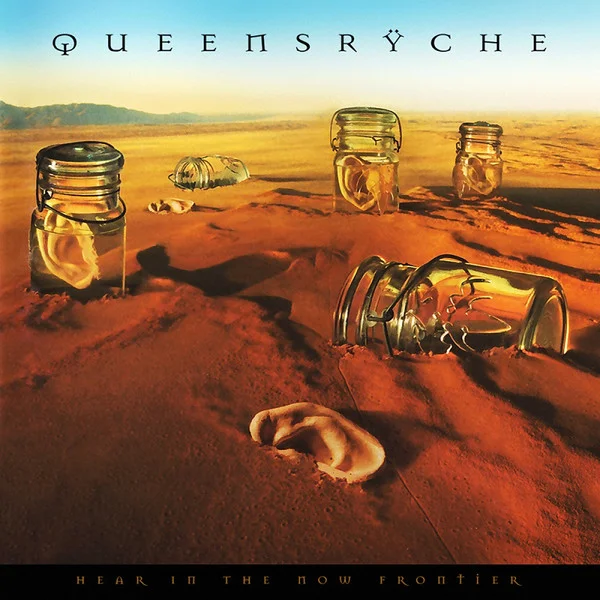
Hear in the Now Frontier: The Album of the End
The Promised Land tour ran through 1995 and into 1996. By the time sessions for the next album began, several things had shifted at once, none in the direction the band needed. Hear in the Now Frontier was recorded at Sixteenth Avenue Sound in Nashville and Studio Litho in Seattle, with Collins producing his third and final Queensrÿche album. The Nashville location — associated with country and AOR rather than progressive metal — reflected a deliberate move further outside the band’s standard environment, one that was, by most accounts, partly DeGarmo’s. His growing influence on the band’s direction had become a point of internal disagreement during Promised Land; here, the disagreement effectively became the album’s structure.
The writing credits tell the story. Of thirteen tracks, DeGarmo received credit on twelve, primary or sole on eight. Tate received lyric credit on fewer than half. Michael Wilton, a substantial contributor to Mindcrime and Empire, got a single co-write. Eddie Jackson got none. Scott Rockenfield got two, on songs primarily written by Tate. In compositional terms the album was effectively a DeGarmo solo project with the rest of the band performing on it — and it moved the sound markedly toward the alternative-rock and post-grunge aesthetic of its 1997 moment: simpler arrangements, shorter songs, the intricate harmonized guitar work largely replaced by cleaner, more direct rock, with reviewers noting parallels to Pink Floyd’s later, sparser work and to the country that surrounded the recording.
Track ten, “All I Want,” is the only Queensrÿche studio recording in the catalog with a lead vocal by someone other than Tate. DeGarmo sang it — brief, melodic, introspective in a way the rest of the album is not — and many critics have read it as his resignation letter, the song where he stepped out from behind Tate’s voice to say something he could not say in the band’s usual configuration.
The reception was muted in a way no Queensrÿche record had been since Rage for Order. The album reached number nineteen on the Billboard 200, a sharp drop from Promised Land’s number three; lead single “Sign of the Times” took modest rotation without cracking the Hot 100; “You” reached number eleven on Mainstream Rock. Reviews split between honest evolution and lost identity, and the retrospective consensus, as summarized by Encyclopaedia Metallum, calls it “the first true misstep of their career” — fair, though it gives perhaps too much credit to the idea that it was a misstep rather than the working-out of contradictions the band had carried for years.
Then came compounding bad luck. Mid-tour in 1997, EMI America declared bankruptcy and was merged into Virgin Records America, leaving Queensrÿche without functional label support months from the end of their commitments; they financed the rest of the tour themselves, a hit their reduced commercial position made worse. By the tour’s end DeGarmo had decided to leave, though it was not announced until January 28, 1998. The standard story credits the EMI collapse and the album’s reception. The more accurate one, drawn from DeGarmo’s own comments and from interviews the rest of the band gave during the later litigation, is that this was the working-out of a decision he had been weighing since Promised Land. The bankruptcy was not the cause; it was the trigger that turned a long-standing question into a final answer.
DeGarmo then did what very few musicians at his level ever do. He did not start a side project, pursue a solo career, or join another band. He left music. By 1999 he had qualified as a professional charter pilot — the career he had wanted since childhood and set aside for Queensrÿche. For two decades his musical activity was minimal and uncommercial: a brief stint as a backup guitarist on a Jerry Cantrell tour, one further Queensrÿche contribution under circumstances we will return to, and, recently, small unpromoted music with his daughter Rylie DeGarmo under the name The Rue. The walking-away is the part the rest of the band has said, in various interviews, they could never quite forgive. Tate in particular has been candid about the frustration. The departure was not just a personnel change; it was an indictment of what the band had become, delivered by its most important songwriter in the most permanent way available to him.
Q2K and the New Configuration
The Queensrÿche that emerged was no longer the band that made Empire. Tate, Wilton, Jackson, and Rockenfield remained. The replacement guitarist was Kelly Gray — a Seattle producer (Candlebox, Dokken) and, more relevantly, the guitarist in Myth, the early-1980s Seattle band Tate had sung in before Queensrÿche. The relationship was older than the band itself, and it had logic: Gray was competent, known, and — crucially — someone whose presence shifted the internal dynamic toward Tate. Where DeGarmo had been a creative counterweight with songwriting authority and an independent vision, Gray entered as Tate’s chosen collaborator. The configuration of power inside Queensrÿche had been rewired.
Q2K, released September 14, 1999 on Atlantic (who signed the band after EMI’s bankruptcy), was the result. It was self-produced — the first Queensrÿche studio record without an external producer of significant standing — with writing credits distributed across the lineup rather than dominated by any individual, a deliberate change from Hear in the Now Frontier meant to present the new configuration as a real band rather than a Tate solo project. The execution was mixed. “Breakdown,” the lead single, has a strong chorus and a Wilton arrangement that reaches back toward the band’s earlier sound; “The Right Side of My Mind” works as mid-tempo modern rock; “Falling Down,” “Burning Man,” and “Beside You” show flashes of the layered approach the band built its reputation on. It is not the disaster its sales suggest. But its identity is hard to locate — most of Q2K sounds like competent late-1990s mainstream rock that happens to be performed by Queensrÿche, rather than like a Queensrÿche record. The album reached number forty-six on the Billboard 200, the singles took limited play, and the tour put the band in clubs and theaters in markets where they had headlined arenas a decade before.
Gray’s tenure was brief; by 2001 the relationship had deteriorated and he was gone, later resurfacing as the engineer on 2009’s American Soldier. What Q2K established was less a musical direction than a pattern: the band would keep recording, guitarists would cycle through, each album would carry less of the original lineup’s creative DNA than the last, Tate’s role would expand, and the rest would be increasingly cast as sidemen on their own records. None of it was decided at a single moment. It was the cumulative result of individually defensible decisions that produced a Queensrÿche no longer resembling the band that made Empire.
Tribe: The Brief, Doomed Return
In 2002 the band — now a four-piece — left Atlantic and signed with Sanctuary, a UK label built on the premise that classic-era acts could generate steady, modest sales from a dedicated core even as their broader visibility faded. Queensrÿche fit the model. The problem was that they did not have enough material; Gray’s departure, the band’s diminishing coherence, and what would later be described as “strained internal relationships” had left the four members unable to write a full album on their own, with the deadline approaching.
So a phone call was placed to Chris DeGarmo. He agreed, somewhat reluctantly, to contribute. He wrote the music for “Falling Behind,” “Doin’ Fine,” and “Art of Life,” co-wrote “Desert Dance” and “Open,” recorded guitar parts, sat for a photo shoot, and discussed joining the European leg of the tour. Then, before the sessions were complete, he left — again, the reasons never fully detailed but consistently framed as the same dynamics that had driven him out in 1997, unchanged. He had come back expecting the environment to have evolved. It had not. Mike Stone, a session guitarist already working with the band, finished the recordings and stayed on as the permanent replacement.
What Sanctuary did next was one of the small dishonesties the music business specializes in. The press materials for Tribe — released July 22, 2003 — described DeGarmo’s involvement as a “reunion,” implying the Tate–DeGarmo partnership had been substantially restored, when in fact he had contributed to five tracks and left before completion. It did not work: Tribe did not chart meaningfully, sold roughly 75,000 SoundScan units in the United States over several years — a fraction of Q2K’s already-diminished numbers — and the single “Open” reached number 38 on Mainstream Rock before vanishing. The album itself is better than that. DeGarmo’s contributions are audible; “Falling Behind,” “Open,” and “Art of Life” carry a harmonic sophistication the rest of the record lacks, and the whole is more interesting than Q2K. It is also a record that documents the absence of the band that should have made it — the five-person Queensrÿche gestured at through DeGarmo’s compositional ghosts, then gone. Tribe would be the last Queensrÿche album anyone could plausibly connect to the original creative unit.
Operation: Mindcrime II — and the Strange Question of Who Actually Made It
In April 2006, Queensrÿche released Operation: Mindcrime II, a direct sequel to the 1988 breakthrough and the most aggressively marketed Queensrÿche release in over a decade. The narrative picked up Nikki eighteen years later — out of prison, seeking revenge on Doctor X, ultimately consumed by the quest — with Ronnie James Dio guesting as Doctor X and Pamela Moore returning as Sister Mary. The legacy positioning and the Dio spot converted into sales: the album debuted at number fourteen on the Billboard 200, the band’s highest position since Promised Land twelve years earlier. Critically it was savaged. Pitchfork and Rolling Stone did not review it; the metal press that had championed the original treated the sequel with embarrassed dismissal; the fan response was sharply split between its ambition and its inferiority to the original on essentially every axis.
What no one knew until 2012, when court documents surfaced during the Tate firing, was how it had actually been made. The producer was Jason Slater (Snake River Conspiracy, Third Eye Blind), and in a sworn declaration he revealed the recording had not been a band project in any conventional sense: substantial instrumental tracks were played by studio musicians, Scott Rockenfield did not play on the album at all, Eddie Jackson’s bass was minimal, Wilton contributed some guitar, and the compositional and recording center was Tate, Slater, and Mike Stone. That a founding drummer did not appear on a 2006 Queensrÿche album was, by any conventional measure, an admission that whatever Queensrÿche was in 2006, it was not the band the audience thought it was. The number-fourteen success — the highest in twelve years — was achieved by a recording in which two-fifths of the original lineup had been functionally replaced by session players. Mindcrime II was, in effect, a Geoff Tate solo project marketed under the band name, and the pattern it set would define the rest of the Tate era.
Take Cover and American Soldier: The Slow Drift
In November 2007 came Take Cover, an album of covers — Black Sabbath’s “Neon Knights,” U2’s “Bullet the Blue Sky,” Buffalo Springfield’s “For What It’s Worth,” Pink Floyd’s “Welcome to the Machine,” Crosby, Stills, Nash & Young’s “Almost Cut My Hair,” Queen’s “Innuendo,” and two selections from Jesus Christ Superstar, “Heaven on Their Minds” and “Gethsemane.” It was the band’s commercial nadir: no meaningful chart position, uniformly negative reviews, even sympathetic critics calling it a career low. Its defenders pointed to the Superstar tracks, where Tate’s vocals were genuinely strong; its detractors pointed to the basic indignity of a band that had made Mindcrime and Empire reduced, two decades later, to a covers record.
What followed in 2009 was, in its strange way, the most interesting late-career Queensrÿche album. American Soldier, released March 31, was a concept record about the experiences of American military veterans across multiple wars, rooted in Tate’s own family history. His father, Perry, had served in Korea and never discussed it; in the mid-2000s Tate began interviewing him, and the conversations expanded into a years-long project of interviewing veterans of World War II, Korea, Vietnam, and the Gulf, Iraq, and Afghanistan conflicts, with audio fragments of their testimony embedded throughout the record. Its emotional center, “Home Again,” is a duet between Tate and his then-teenage daughter Emily about a father returning from war to a family changed in his absence — it works because it is genuinely autobiographical and because Emily’s vocal is unaffected in a way adult studio singers rarely manage.
American Soldier drew better reviews than any Queensrÿche album of the previous decade and reached number twenty-five on the Billboard 200, the band’s best showing since Mindcrime II. It would be Tate’s last meaningful artistic moment with the band before the breakup. It was also, by most accounts, almost entirely his: Slater produced again, Gray engineered, the original members appeared in varying degrees, but the direction, the conceptual frame, and the distinctive elements — the veteran interviews, the Emily duet, the autobiographical material — were unambiguously Tate’s. The pattern from Mindcrime II was now complete. By 2009 the Queensrÿche recording entity was, in effect, Geoff Tate’s solo career operating under the band’s name.
The 2011 Album That Broke Things: Dedicated to Chaos
Dedicated to Chaos, released June 2011, was a deliberate stylistic experiment — funk influences, electronic textures, songs unlike anything the band had recorded — sold on the idea of a band refusing to be locked into a single genre. The fan response was the most negative in the band’s history. The album reached number forty-three on the Billboard 200 and disappeared within weeks; by year’s end it was being discussed not as a record but as a referendum on whether the Queensrÿche name still meant anything. Internally, the sessions had produced substantial conflict, with Wilton, Jackson, and Rockenfield reportedly resisting several of Tate’s decisions, and the tour drew the smallest crowds since the Q2K era.
In April 2012, in private discussions among the four members other than Tate, a decision was reached: Tate’s wife Susan, the band’s manager, was fired, as was his daughter, the fan club manager. The decisions were communicated to the Tate family on April 14, 2012. Two days later, on April 16, Queensrÿche took the stage at the Espaço das Américas in São Paulo. By multiple consistent accounts from the four other members, Tate confronted Wilton physically before the show, spat in his face, and threatened him; onstage he behaved erratically, at one point swinging a microphone stand near Wilton and Jackson. The incident — known in fan communities, with grim humor, as “Operation: Knifecrime,” though no weapon was involved — was witnessed by the crew and the audience.
São Paulo did not by itself end the band; it eliminated any remaining possibility of continuing with Tate. Within weeks Wilton, Jackson, Rockenfield, and Parker Lundgren — who had replaced Mike Stone on second guitar in 2009 — were quietly auditioning vocalists for what they assumed would be a new project. They recruited Todd La Torre, formerly of the Florida progressive metal band Crimson Glory, and performed under the name Rising West in June 2012 to gauge whether their audience would accept a singer other than Tate. On June 5, 2012, Geoff and Susan Tate filed suit in King County Superior Court seeking the rights to the Queensrÿche name, on the theory that Tate, as the band’s lead vocalist and public face for three decades, had standing to claim it. The four others countersued. Both sides alleged misconduct, and the battle ran for nearly two years.
The Two Queensrÿches
Between June 2012 and April 2014, there were two organizations touring under the name. The first, fronted by Tate with a rotating cast of replacements, played smaller venues and released Frequency Unknown in April 2013, an album whose cover art prominently featured the letters “F.U.” — widely read as a message to his former bandmates — and which reached number eighty-two on the Billboard 200 to nearly uniform pans. The second, fronted by La Torre with the Wilton–Jackson–Rockenfield lineup plus Lundgren, played the venues that had traditionally hosted Queensrÿche tours and released a self-titled album in June 2013 that reached number twenty-three and drew the best reception any Queensrÿche record had received since Promised Land. The disparity was decisive: the La Torre version was outselling and outdrawing the Tate version in every measurable category, and by the time the case neared its 2014 trial date the marketplace had effectively answered the question the court was being asked to decide.
The settlement was announced April 28, 2014. Tate surrendered all rights to the name; the four remaining members, with La Torre and Lundgren, would continue as the sole entity touring and recording as Queensrÿche. In exchange, Tate retained exclusive rights to perform Operation: Mindcrime and Operation: Mindcrime II in their entirety live — letting him keep capitalizing on the band’s most identifiable property as a solo artist. Both sides called the resolution “amicable.” The financial terms were undisclosed, but by various accounts the Tate family received a substantial payment for the name. Whatever the figure, it ended Tate’s involvement with the band he had fronted for over thirty years.
What Came After
Todd La Torre has now fronted Queensrÿche for fourteen years, across four studio albums: Queensrÿche (2013), Condition Hüman (2015), The Verdict (2019), and Digital Noise Alliance (2022). None has approached the peaks of Empire or Promised Land, but all have substantially outperformed the late-Tate releases, drawn the most positive fan response since the 1990s, and pulled the band back toward its progressive metal foundation — heavier arrangements, more harmonized guitar, less of the experimentation that marked the 1990s and 2000s output.
The original lineup kept fracturing in smaller ways. Scott Rockenfield, the band’s drummer since its 1980 formation, took a leave of absence in 2017 for the birth of his child and did not return; his departure became its own legal dispute, with Rockenfield suing Wilton and Jackson over financial and operational matters before a settlement, and he has not played on a Queensrÿche record since Condition Hüman. By 2026 the lineup is Wilton, Jackson, La Torre, Lundgren, and drummer Casey Grillo.
Geoff Tate has continued to tour as a solo artist, frequently performing complete renditions of Operation: Mindcrime and Empire under the settlement, and releasing albums under both his own name and the band name Operation: Mindcrime — the latter constructed to let him use a name tied to his Queensrÿche legacy without violating the 2014 terms. The records have not achieved commercial significance, but the live shows still draw committed audiences where his voice remains a draw.
Chris DeGarmo has, by his own consistent choice, stayed outside the active industry, working as a professional charter pilot. His recent music — The Rue, with his daughter Rylie — is small-scale and uninterested in commercial visibility. He has not commented publicly on the post-2012 situation in any substantial way, and multiple reunion overtures have reportedly produced no movement.
What Actually Happened
The standard narrative identifies discrete moments of failure: the Hear in the Now Frontier drop, DeGarmo’s 1997 exit, the Take Cover covers album, the Dedicated to Chaos experiment, the 2012 firing. Each is real; none, by itself, explains the arc.
The more accurate story is structural. Queensrÿche succeeded between 1988 and 1991 in a way their internal organization was never built to sustain. The five-person partnership that produced Mindcrime and Empire worked when the band was a struggling outfit EMI didn’t know what to do with. It worked less well once they were an arena headliner with a top-ten single and Grammy nominations. The success exposed problems — interpersonal tension, asymmetric creative contributions, divergent visions of what the band should become — that lower stakes had let them avoid solving.
What is most striking is how little of this had to do with grunge, or with the broader collapse of late-1980s hard rock. Queensrÿche were not a hair metal band, and were not especially displaced by the alternative revolution: Promised Land sold over a million copies in 1994, well after grunge had supposedly killed the genre they operated in. The decline through the late 1990s and 2000s was real, but its rate and shape were not determined by the marketplace — other progressive metal bands, Dream Theater most prominently, kept producing commercially viable work through the same years. Queensrÿche’s trajectory was driven by Queensrÿche’s specific internal problems.
Their most thoughtful members have acknowledged as much. Tate, years after the firing, was uncharacteristically blunt about what the band had been: “It never was a brotherhood. It was a bunch of kids that got together and achieved success at an early age. We got used to that success and continued doing the things we did to get that success. We found comfort in our way of working. It’s just that simple. We were never close. We never hung out doing stuff and sharing life.” The framing is too harsh — the affection between certain members, particularly Wilton and Rockenfield, is documented elsewhere — but the underlying claim holds. Queensrÿche was a working unit, not a friendship. DeGarmo’s account locates the dysfunction at Promised Land; Tate’s locates it at the founding. Both are probably right. Dysfunction was always there, as it is in any collaboration. What changed between 1990 and 1992 was that it now had to operate under conditions the original configuration had never been designed to absorb.
On Listening to These Records Now
There is a temptation to hear the post-Empire catalog entirely through the lens of the breakup, grading each album against Mindcrime and finding it wanting. That is not, in the end, a productive way to listen.
Promised Land is, by any honest measure, one of the most artistically successful albums in the catalog; that it documents a unit already in crisis is part of what makes it powerful, and it rewards slow, repeated listening in a way few records of its era do. It is also, as Tate has said in many interviews, his own favorite Queensrÿche record — a judgment its commercial and critical reception never matched.
Hear in the Now Frontier is more interesting than its dismissal suggests; the Nashville environment, DeGarmo’s compositional dominance, and the post-grunge adjustments add up to a record with its own coherence as a document of where his writing was pulling, and “All I Want” is genuinely affecting once you understand what it is doing within his departure. Tribe holds the last meaningful DeGarmo contributions — “Falling Behind,” “Doin’ Fine,” and “Open” are the strongest things on an otherwise uneven record — and works as a coda to the original lineup’s creative period, even though that lineup no longer existed by the time it was released.
American Soldier is the most ambitious album of Tate’s late period and the one most worth taking seriously. The veteran interviews are not gimmicks; the Emily Tate duet is not a vanity feature. Its engagement with American military history, refracted through Tate’s father and daughter, produces something Mindcrime had only gestured at — a concept album whose frame is autobiographical rather than fictional, and whose emotional weight is therefore much harder to dismiss. The other late-Tate records — Mindcrime II, Take Cover, Q2K, Dedicated to Chaos — are of varying interest, but none is a record of the band that made Empire; they are records made under conditions of progressive structural breakdown, and they sound different once you hear them that way.
The La Torre records have done something quietly remarkable: they have let Queensrÿche continue as a serious musical entity at a level no other late-career classic-era band has quite managed. Condition Hüman (2015) is, by some measures, the heaviest and most progressive Queensrÿche record since Empire, and Digital Noise Alliance (2022) is a coherent statement from a band that, by any reasonable expectation, should have stopped a decade earlier. La Torre’s range, which approaches Tate’s peak in a way no other replacement managed, keeps the classic catalog performable live as few legacy acts can.
Whether this counts as Queensrÿche, in the sense the Empire-era band did, has no objectively correct answer. The five-person partnership that defined the band’s identity has not existed since 1997 at the latest. The current lineup has two of the five originals and a singer with no creative history before 2012; by strict definitions of band identity, it is a different band under a familiar name. By looser ones, it is the most direct living continuation of what Queensrÿche was — still playing the catalog, still writing toward the progressive metal foundation, still operating at a seriousness the late-Tate records often did not. Whether that is enough is a question each fan answers alone.
The Final Recovery That Wasn’t
If the post-Empire story resembles anything, it is not the collapse of another rock band but the slow dissolution of a long marriage that should never have lasted as long as it did — performed in public, with everyone aware the unit had stopped functioning, and continuing because continuing was easier than stopping. The 2014 settlement documents were, in their dry procedural way, divorce papers. The two competing Queensrÿches of 2013 were the brief period when both parties tried to claim the house and the children. The current configuration is the family that emerged: a recognizable continuation of the original household, not pretending to be it.
What the band made between 1988 and 1991 was extraordinary. Operation: Mindcrime, Empire, and Operation: Livecrime are three of the most accomplished progressive metal records in any catalog, made by a band at the peak of its powers in a configuration that produced something larger than the sum of its parts. The standard reading is that the slow decline is the interesting part — the tragic arc of a great band losing itself. But a great band losing itself is the most standard story there is. The genuinely unusual thing about Queensrÿche is that they kept showing up to make records about it, in real time, for twenty years after the original configuration had effectively ended. Promised Land is the record of the band starting to lose itself; Hear in the Now Frontier, the record of DeGarmo losing the band; Q2K and Tribe, of the band trying to function without its primary songwriter; Mindcrime II, of Tate operating as the sole authorial voice; American Soldier, of Tate using the band’s name to make what is functionally his solo masterpiece; the 2013 Queensrÿche and what followed, of the band reconstituting itself as a different band under the same name.
To hear that twenty-year sequence as a single extended work — which, in retrospect, is what it has become, whether or not anyone involved intended it — is to encounter something almost no band has produced: a sustained, self-aware, real-time record of a creative unit coming apart, album after album, across more than two decades, while continuing to make music about the very thing happening to it.
The Crumbling Empire is the right name for it. The empire was real; so was the crumbling; both took twenty years. The records remain, and they ask to be heard on the terms they were made under rather than the ones they were received on. Heard that way, the decline stops sounding like a long defeat. It starts sounding like the longest, strangest thing the band ever wrote.