Retrospective
Rock Soldier: Ace Frehley's Post-KISS Decade and the Band That Was Best When It Was Least His Own
The standard history files Ace Frehley's three post-KISS records as a redemption arc — a wreck cleans up, comes back strong in 1987, fumbles in 1988, reclaims himself in 1989. The facts are right and the reading is wrong. Frehley's Comet charted highest when it was least Frehley's own work, made its most competent record in the moment everyone calls its collapse, and sold least once it finally sounded like nobody but Ace. The decade didn't return the Spaceman to himself. It proved the Spaceman was a brand other hands could carry — and that 'Frehley's Comet' could be a band or a Frehley vehicle, never both.
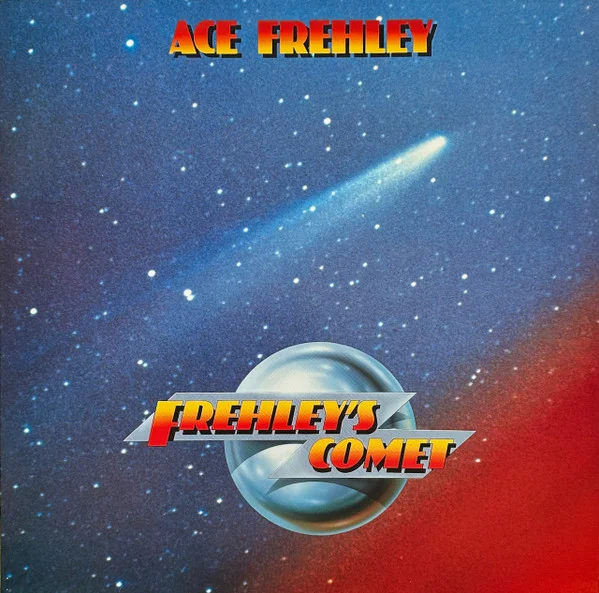
The received account of Ace Frehley’s 1980s is a recovery story. He walks out of KISS in 1982 a burnt-out casualty, vanishes for five years, comes roaring back in 1987 with a hit comeback record, overreaches on the 1988 follow-up when his band gets too slick and too democratic, then steadies himself in 1989 by returning to his roots — setting up the reunion that would make everyone rich in 1996. At the level of individual facts, this account is accurate. The dates are right, the chart positions are right, the lineup changes happened in roughly that order.
It is also reading the evidence exactly backwards. Lay the three records next to their chart numbers and the romance inverts: the album hailed as the triumphant return charted highest and contains the least of Frehley’s own songwriting; the album remembered as the collapse is the most competently made of the three; and the record where he finally sounds like nobody but himself sold the worst. The decade did not deliver Ace Frehley back to his authentic self. It demonstrated something stranger and more useful — that the Spaceman was a brand other people could carry, and that the project called Frehley’s Comet could be a real band or a Frehley solo vehicle, but the market would only ever pay for one of them.
The exit, and the shadow it cast
By his own account, leaving KISS was a survival decision dressed as a financial catastrophe. Frehley told the story many times, most fully to Rolling Stone: he was sitting in his lawyer’s office as the band closed a new recording deal, and he was driving home to Connecticut each night wanting to put his car into a tree. The number he walked away from was, in his telling, enormous. Because the contract was contingent on at least three original members remaining and Peter Criss had already been pushed out, Frehley’s resignation tripped a clause that, as he described it, cut the deal roughly in half — a loss he later said his old partners never quite forgave. The figures here are Frehley’s own recollection rather than independently documented contract terms; treat them as directionally true and emotionally exact rather than as audited fact. His summary of the choice needs no padding: “you cannot spend money six feet under.”
What is documented is the structure that followed. Frehley retained a quarter share of the KISS partnership until 1985 and collected his cut of Lick It Up and Animalize without playing a note on either. The arrangement functioned as a paid layoff with a non-compete attached — he had little financial reason to rush a solo record into a market he wasn’t ready for, and a real incentive not to. So the wilderness years were less a disappearance than a holding pattern, and the timing turned out to be a gift. When he finally surfaced, the glam-metal economy he was built for was cresting.
The other event of the layoff became raw material. In May 1983, drunk behind the wheel of his DeLorean after a minor collision near White Plains, Frehley fled a traffic stop and led police up the Bronx River Parkway at speeds the wire report put at ninety miles an hour, clipping four cars before abandoning the vehicle on foot. He posted five hundred dollars’ bond and made international headlines. He would put that night to work in a way that tells you exactly how his comeback was assembled.
The comeback somebody else built — Frehley’s Comet (1987)
Released April 27, 1987 on Megaforce through Atlantic, Frehley’s Comet peaked at number 43 on the Billboard 200, climbed to 38 in Canada, and turned its lead single “Into the Night” into a number 27 Mainstream Rock track. It nearly became Megaforce’s first gold record. The Spaceman brand, five years dormant, plainly still sold. Every account treats this as the proof of Frehley’s resilience.
Look at who actually made it. The co-producer was Eddie Kramer, the engineer behind the most revered KISS records and Frehley’s platinum 1978 solo album — the disciplinarian in the room. The band was loaded with players who could carry weight: bassist John Regan, drummer Anton Fig (the uncredited hands on KISS’s Dynasty and Unmasked), and newcomer Tod Howarth, a melodic-rock specialist out of 707 who brought high harmonies and a second lead voice. And the songs were, to a striking degree, not Frehley’s. Of the ten tracks, only “Dolls” and “Stranger in a Strange Land” are solo Frehley compositions. The rest are covers and co-writes: “Into the Night” came from Russ Ballard, who had already handed Frehley “New York Groove”; “We Got Your Rock” was a 1983 cast-off that had passed through Rik Fox’s band SIN; “Calling to You” was a relyriced 707 song Howarth carried in with him; “Breakout” was a rewrite of a discarded KISS demo, co-credited to then-current KISS drummer Eric Carr.
Even the album’s most personal moment was supervised. “Rock Soldiers,” the autobiographical opener, turns the DeLorean chase into a survival myth — wrong way down a one-way street, a rallying cry for the hard-rock faithful. It is the most Ace-Frehley thing on the record, and it was co-written with Chip Taylor, the professional songwriter behind “Wild Thing” and “Angel of the Morning.” His confessional needed a hired pen. None of this is a knock on the music, which is good; it is the point. The 1987 comeback worked because it was a brand expertly scaffolded by other people, and it was honest enough about that to put the proof in the opening track.
A stopgap live EP, Live+1, reached number 84 in early 1988 and bought time. Then Atlantic asked for the time back.
The album where the band won — Second Sighting (1988)
The standard verdict on Second Sighting is that it killed the momentum: too polished, too melodic, too much Howarth, not enough Spaceman. All true, and all beside the point. The record’s failure is usually pinned on its quality. The structural story is the opposite.
Frehley’s Comet had landed the opening slot on Iron Maiden’s 1988 Seventh Son of a Seventh Son arena tour, and the label wanted product in stores to ride it. The band came off the road with little written and went straight into Mediasound with the clock running. Kramer — the discipline — was gone. Frehley arrived sick with bronchitis and, by the accounts of the people in the room, deep in a relapse; bassist John Regan described him as a handful when he was drinking and frequently not up to the work. Executive producer Eddie Trunk’s memory of the sessions is a single image that has outlived the record: Frehley trying to track a solo with a bagel in hand, dropping a clot of cream cheese into his pickups. Trunk took it as confirmation the project was doomed.
Into that vacuum stepped Howarth, who had the work ethic and the material Frehley didn’t. He wrote or co-wrote most of the album, sang most of it, and played guitar parts fans assumed were Frehley’s. The result is a clean, keyboard-lit melodic-rock album — and by the band’s own internal measure, a good one. Trunk admitted Howarth was the better singer outright. The lead single, “It’s Over Now,” is a Howarth power ballad with Howarth front and center in the video, working a headless Steinberger while the man whose name was on the marquee stood off to the side. Second Sighting peaked at number 81 and the singles missed entirely. In August 1988 the band fell off the Maiden tour, citing money.
Hear what that sequence actually says. The one time Frehley’s Comet stopped being a Frehley vehicle and behaved like a band — followed its strongest writer, let its best singer sing — it made its most accomplished record and the audience refused it. They had not bought a ticket for a competent melodic-rock band. They had bought the Spaceman, and the Spaceman was barely on it.
The vehicle restored — Trouble Walkin’ (1989)
The lesson the label drew was unambiguous: kill the band, sell the man. The Comet name was retired, the next album was credited to Ace Frehley alone, and the mandate was that Frehley write and sing everything — which left Howarth no reason to stay, and he didn’t. In his place Frehley reassembled the architecture of his best work: Kramer back in the chair, Fig back on drums, original Comet guitarist Richie Scarlet back on rhythm.
Released October 13, 1989, Trouble Walkin’ is the fan favorite, a meat-and-potatoes hard-rock record that sounds like 1970s KISS in a way nothing since had. It is also the most thoroughly Ace-branded of the three, and it was stocked with nostalgia as strategy. Skid Row’s Sebastian Bach, Rachel Bolan and Dave Sabo sang backup. More pointedly, Peter Criss turned up to add percussion and vocals — two alienated KISS founders aligning in the open, in silent competition with the unmasked band Simmons and Stanley were running down the hall. That competition has its perfect artifact in “Hide Your Heart,” a Paul Stanley co-write with Desmond Child and Holly Knight that KISS had passed over and Stanley then shopped widely; in 1989 a cluster of artists cut it, and Frehley’s version reached stores four days before KISS released their own on Hot in the Shade. He could not get out from under the band even when he beat them to the same song.
And the most-Ace record of the decade stalled at number 102 on the Billboard 200 — the lowest of the three. There is the legend’s logic, running exactly backwards. The album most assembled by other hands charted highest; the return to pure Ace sold least. Trouble Walkin’ is remembered as the reclamation, but structurally it is the re-imposition of the solo-vehicle shape the brand required — the project forced back into a Frehley costume because that costume was the only thing the market had ever been willing to pay for.
What the decade documented
So the three records are not a fall and a recovery. They are one demonstration, repeated until it took: KISS’s own statement at his death last October called Frehley “an essential and irreplaceable rock soldier,” and the phrase is exactly right in a way the band may not have intended. The Spaceman was a role — a sound, a swagger, a face — durable enough that Kramer and Ballard and Howarth and a Brill Building songwriter could all hold a corner of it, and strong enough to outsell the actual band underneath it every time the market was made to choose. Frehley understood this earlier than his biographers did. He dissolved the Comet himself at the end of 1988, before anyone forced him to. He had figured out what the brand was worth and what the band wasn’t.
He had written the survival anthem about himself decades before anyone needed to eulogize him, and the comet on the cover was always what its name half-admitted — a solo flight wearing a band’s name, burning brightest with the most hands on it.