Retrospective
Hit Me with Your Best Shot: Pat Benatar, Neil Giraldo, and the Twenty-Two-Year Hall of Fame Wait
She was eligible for the Rock and Roll Hall of Fame in 2000. She was inducted in 2022. The twenty-two-year delay was not, by her own subsequent account, an accident — she had been turning down individual induction since the institution first became willing to consider her, refusing to accept the honor unless her musical partner and husband of forty years was inducted alongside her. The standard rock-history vocabulary has consistently positioned her as a solo MTV pop-rock vocalist whose commercial peak ended around 1985 and whose subsequent career has been a slow nostalgia-circuit decline. The accurate version is more interesting, substantially better documented, and centers a creative partnership the broader rock-criticism vocabulary has spent four decades failing to recognize.
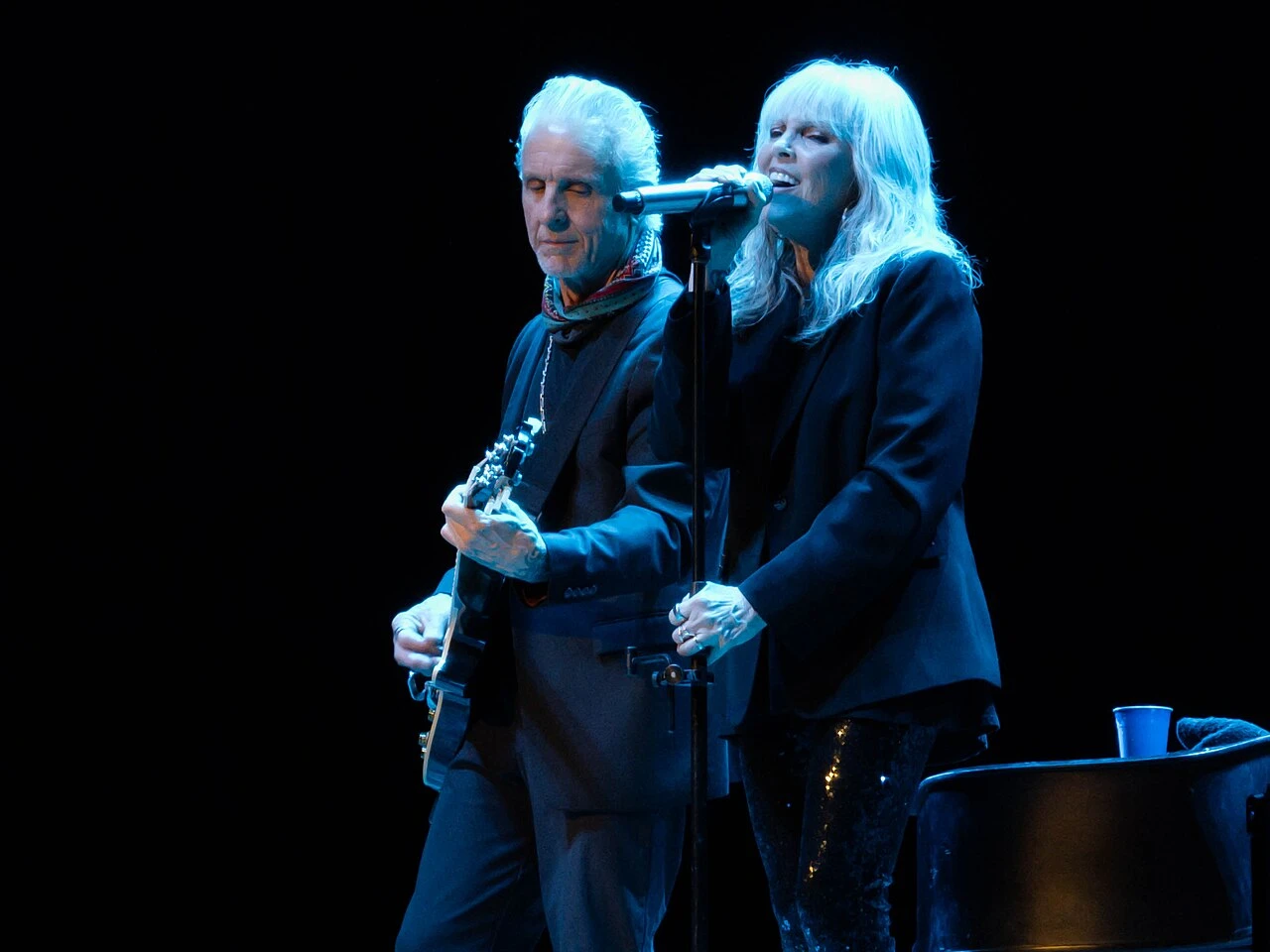

The standard rock-history version of Pat Benatar runs roughly like this: a powerful-voiced female vocalist whose four consecutive platinum-or-better albums between 1979 and 1982 made her one of the most visible artists of the early MTV era; whose trajectory diminished across the mid-to-late 1980s; who ended her major-label career with a 1991 swing-blues departure critics called creative suicide; and who has spent the three decades since on the nostalgia circuit, valued mainly as a video-era artifact. The framing is accurate at the level of individual facts. It is also, in essentially every measure of what the catalog contains and what the partnership at the center of it accomplished, wrong about what the career has been.
The corrective reading begins with a date: November 5, 2022. That night, at the Microsoft Theater in Los Angeles, Benatar was inducted into the Rock and Roll Hall of Fame by Sheryl Crow. She was sixty-nine. She had been eligible since 2000 — twenty-two years earlier — and the delay was not the institution’s doing. It had been willing to induct her individually for most of those years; she had refused. She would not enter without Neil Giraldo: her musical partner since 1979, her husband since 1982, the guitarist and producer on every album she has ever made and the co-producer of all but two. As she told Billboard in May 2022, after the joint induction was announced, she had spent twenty-five years lobbying to get him the credit he was due.
This retrospective engages with the catalog the partnership produced across roughly twenty-four years and eleven studio albums, and with the fact that it has been miscategorized at three levels. In authorship, the vocabulary has treated Benatar as a solo artist with a backing band, when the arrangement was a genuine partnership in which Giraldo’s work on arrangement, production, and composition runs across the whole catalog. In genre, it has positioned the work as commercial pop-rock with occasional ambitions, when the catalog actually spans hard rock, new-wave-inflected pop, synth-heavy AOR, atmospheric adult contemporary, jump blues, alternative rock, and chamber rock. In chronology, it has placed the peak at 1980–1985 with everything after as decline, when the catalog produced substantive work through 2003 and the post-major-label period contains some of the partnership’s best music.
This is not a claim that Benatar has been underappreciated commercially. She sold over thirty-five million albums worldwide, won four consecutive Grammys for Best Female Rock Vocal Performance between 1980 and 1983, had two number-one albums and fifteen Top 40 singles. What the corrective reading addresses is the editorial reception — the persistent positioning of Benatar as an MTV-era curiosity not quite warranting the engagement male artists of comparable visibility received automatically. The catalog rewards that engagement, the partnership deserves the kind of recognition the vocabulary has reserved for Lennon–McCartney or Jagger–Richards or Plant–Page, and the twenty-two-year Hall of Fame wait was a specific example of the failure to take the work seriously.
The Setup: Brooklyn, Stony Brook, Richmond
Patricia Mae Andrzejewski was born in Brooklyn on January 10, 1953, to Polish and Irish-Dutch parents, raised in suburban Lindenhurst on Long Island. Her mother, Mildred, had been a trained opera singer who gave up the career to raise her children, and Patricia inherited the instrument — roughly four and a half octaves of classically-trained mezzo-soprano that the eventual rock catalog would use in ways the training had not anticipated. The familiar framing that she “left Juilliard for rock and roll” misrepresents what happened: she trained as a coloratura through high school, was accepted to Juilliard, then decided before starting that a classical career was not what she wanted, and enrolled at SUNY Stony Brook for health education instead. After one year, at nineteen, she dropped out to marry her high school sweetheart, Dennis Benatar, a U.S. Army draftee stationed at Fort Lee, Virginia from 1973. She took his surname — which she kept professionally despite their 1979 divorce — and a job as a bank teller near Richmond.
The Richmond period ran about three years. A 1973 Liza Minnelli concert shifted her thinking; she quit the bank, took work as a singing waitress at a flapper-themed club called The Roaring Twenties, and joined a lounge band, Coxon’s Army, fronting a configuration that expanded to ten pieces and became a fixture at Sam Miller’s basement club, recording a 1974 single, “Day Gig,” for limited local release. By 1975, with Dennis discharged, the couple relocated to New York. There she found Catch a Rising Star, the First Avenue comedy club whose amateur nights launched Larry David, Billy Crystal, and Robin Williams, among many others; her rendition of Judy Garland’s “Rock-a-Bye Your Baby with a Dixie Melody” earned a callback from owner Rick Newman, who became her manager. She performed there for three years, recording Pepsi jingles and doing occasional theater between sets — including a 1976 production of Harry Chapin’s The Zinger on Long Island, alongside Beverly D’Angelo and Christine Lahti.
The defining pre-recording moment came on Halloween night, 1977. Benatar attended a costume contest at Cafe Figaro in Greenwich Village dressed as a character from the 1953 B-movie Cat-Women of the Moon — black spandex, boots, dramatic eye makeup — won it, and went back uptown to Catch a Rising Star still in costume to play her set. The response was different. The costume, and the persona it unlocked, drew an engagement her previous performances had not, and she kept the look. The spandex-and-eyeliner identity that would define the commercial-peak years emerged from a single Halloween costume, not a marketing plan. She has been direct about what it did; in her 2010 memoir Between a Heart and a Rock Place, she wrote: “I had newfound bravado, a sexual swagger that wasn’t there before.” By spring 1978 she was headlining a four-night run at Tramps in Manhattan that drew label representatives, and Chrysalis Records co-founder Terry Ellis signed her shortly after.
The Catalyst: Neil Giraldo, Spring 1979
What Chrysalis had signed was a powerful-voiced vocalist with a developing persona and a commercial-pop reference catalog. What it did not have was a configuration around her capable of the harder sound she wanted. The label’s calculation positioned her as an Olivia Newton-John successor and paired her with producer Mike Chapman, whose CV — Sweet, Suzi Quatro, Blondie, the Knack — made him right for the artist Chrysalis thought it had signed, and wrong, by her own account, for the one it actually had. As she told Pollstar in November 2022: “I knew what I wanted — this screaming vocal couldn’t work over piano or acoustic guitar. It had to be an electric guitar that just burned through everything, that I could go head-to-head with as a singer.”
What she found, through Chapman’s introduction in spring 1979, was Neil Giraldo. He was twenty-three — born December 29, 1955 in Cleveland to Sicilian-American parents, playing guitar since six, gigging since his early teens. In 1977 he had relocated to New York and beaten roughly two hundred guitarists for a spot in Rick Derringer’s band, touring behind 1978’s If I Weren’t So Romantic I’d Shoot You and contributing to 1979’s Guitars and Women, on which he played piano as well as guitar. By spring 1979 he was looking for a partnership in which his work as arranger, songwriter, and producer would not be subordinated to an existing bandleader’s name. The introduction happened at SIR Studios; Giraldo did not bring a guitar to the meeting, sitting at a piano to talk through her direction, and when he eventually plugged in and struck a single chord, Benatar experienced an immediate creative recognition — the screaming vocal needed exactly the muscular, melodic, harmonically rich guitar he could provide. The partnership was creative within minutes and personal within months; they married in 1982, by which point it had already produced three multi-platinum albums.
What the standard framing has undersold is the arrangement they set from the start. They were not a vocalist and her hired guitarist; they had agreed, before any records existed, that they were equal creative partners, sharing both direction and financial outcomes. Giraldo’s contributions across the catalog — arrangement, production, co-songwriting on essentially every original, multi-instrumental work on guitar, piano, and bass — were exactly what the vocalist-plus-band framing kept obscuring. The label tried repeatedly to position him as ancillary. The artist refused to allow it, and the 2022 induction was the institutional recognition of what the working arrangement had been all along.
In the Heat of the Night (1979): Finding the Configuration
In the Heat of the Night, released in November 1979 and produced mainly by Peter Coleman with Chapman, captured the partnership finding its sonic identity in real time. Some tracks worked the late-1970s commercial-pop template Chrysalis had signed her for; others pushed harder into the rock vocabulary she and Giraldo were developing. The defining track was the third single, “Heartbreaker” — written by Cliff Wade and Geoff Gill, not by Benatar or Giraldo, and a failed 1978 single for British singer Jenny Darren before they transformed it.
Giraldo’s opening attack — those three seconds of sixteenth-note guitar — was, in retrospect, the moment the catalog’s sonic vocabulary was established, and it is where Holly Gleason’s 2022 Hall of Fame essay began. The song reached number 23, pushed the album to platinum, and carried it to number 12 on the Billboard 200, where it stayed through 1980. Heard in 2026, the album is a band finding itself: “Heartbreaker” announcing the harder direction, the Giraldo composition “We Live for Love” pulling toward new-wave pop, the cover of John Mellencamp’s “I Need a Lover” showing the vocalist’s range, “If You Think You Know How to Love Me” working the pop register Chrysalis envisioned. The variety was both the strength (clear range) and the limitation (it obscured the identity the partnership would soon consolidate). Encouraged by the response, the label pushed them straight back into the studio.
Crimes of Passion (1980) and Precious Time (1981): The Commercial Peak
Crimes of Passion, released August 5, 1980, was where the partnership consolidated its identity, with Keith Olsen — producer of Fleetwood Mac’s 1975 self-titled peak — bringing polished commercial-rock production to harder material. It reached number two and went four-times platinum, producing “Hit Me with Your Best Shot” (written by Eddie Schwartz, number nine) and the Giraldo composition “Treat Me Right” (number eighteen). Its enduring legacy track was one Benatar co-wrote with her bassist Roger Capps and Coxon’s Army’s pianist: “Hell Is for Children,” a serious engagement with child abuse the partnership researched after a New York Times article — never a single (the subject was deemed too disturbing for radio) but a defining live piece, moving from quiet introduction to explosive climax. The second single, a cover of the Young Rascals’ “You Better Run” (number forty-two), is notable mostly because its video was the second ever played on MTV at the network’s August 1, 1981 launch.
The 1981 follow-up Precious Time, co-produced by Olsen and Giraldo, reached number one — her only chart-topping album — and went double platinum. The lead single “Fire and Ice” (co-written by Benatar, Giraldo, and Tom Kelly) won a Grammy; “Promises in the Dark,” a Benatar–Giraldo co-write, became the emotional centerpiece, six minutes moving from quiet to climax. The album’s cover of the Beatles’ “Helter Skelter” was a deliberate gesture — a tribute to John Lennon, whose Double Fantasy had blocked Crimes of Passion from the top spot in the aftermath of his December 1980 murder. By the end of 1981 the partnership had three consecutive platinum-or-better albums, multiple hits, a major touring trajectory, and defining status in the early MTV moment — and, by Benatar’s later accounts, was exhausted by what that had required.
The Label Conflict: What Chrysalis Was Actually Doing
What the public trajectory of 1979–1981 obscured was the institutional conflict accumulating underneath, which Between a Heart and a Rock Place documents in detail — and which is the central source for understanding what those years actually involved. The label’s framing of the artist, by her account, was relentlessly commercial in ways that conflicted with her direction. Promotional photographs were altered without consent — including one widely-cited incident in which a tank top was airbrushed out and replaced with banner copy across her artificially-enhanced chest. The marketing emphasized her sexual availability over her work. The label objected to the Get Nervous cover, demanding a more conventional glamour photograph, and suppressed her 1985 pregnancy with her first daughter, Haley, on the institutional logic that “mothers aren’t sexy.”
The calculation underneath it was the industry assumption that a female-fronted act had a limited shelf-life and had to be maximally exploited before the inevitable decline. The label pushed the partnership through a year-on-year cycle — album, intensive tour, straight back into the studio — that they came to recognize as destructive; by the Seven the Hard Way sessions in 1985 they had run it for six straight years, and the album’s title named the contract directly: seven albums, seven years, the hard way. The most dramatic incident the memoir records came during sessions after the birth of her first daughter, when the label pushed her back into the studio without recovery time and the accumulated frustration produced a singular act of defiance — Benatar throwing a studio stool through the control-room window. The conditions did not change. The album that emerged documented the strain.
Get Nervous (1982) and the Pivot
Get Nervous, released October 1982 and produced by Giraldo and Peter Coleman, was where the exhaustion became audible in the material — a denser, more synthesizer-heavy approach reflecting both the era’s trends and the partnership’s restlessness. It reached number four, went platinum, and produced two Top 40 singles, “Shadows of the Night” and “Anxiety (Get Nervous).” The cover photograph — Benatar in a straitjacket — was a deliberate statement about the conditions the partnership had been documenting privately; the label demanded a conventional photograph, the partnership refused, and the album shipped with the original, the “Anxiety” video (set in a mental institution) extending the argument. It also marked the point where Giraldo’s role became visible: now formally credited as co-producer, his compositional contributions extensive, the shift in the sonic architecture largely his direction. The working arrangement had consolidated by 1982 into the form it would keep for four decades. The label’s assumptions about the artist did not adjust to match it.
Tropico (1984) and the Deliberate Creative Pivot
The 1983 half-live, half-studio Live from Earth produced “Love Is a Battlefield” (number five, written by Holly Knight and Mike Chapman) and enough momentum to allow a real creative break before the next studio album. Tropico, released October 1984 and produced by Giraldo and Coleman, was a deliberate pivot away from the harder template — denser, more atmospheric, the guitar work scaled back in favor of texture, the compositional ambition higher. The lead single “We Belong” (written by Eric Lowen and Dan Navarro) reached number five and became a defining vehicle, though the album’s deeper material did more interesting work than the single suggested; “We Belong” itself captures the experimentation, its percussion built around a kick drum suspended in the air for a specific resonance. Deeper tracks — “Painted Desert,” “Outlaw Blues,” “Diamond Field” — pushed into territory the partnership had not explored. The album reached number fourteen and went platinum, proving the partnership could change direction without losing support entirely, even as the chart performance dropped. What Tropico documents is a partnership genuinely interested in composition and production beyond the template — the deliberate shift that, in retrospect, was where the commercial calculation supporting the peak began to recede.
Seven the Hard Way (1985) and Wide Awake in Dreamland (1988)
Seven the Hard Way, released November 1985, openly named the contract it was made under. It reached number twenty-six and went gold; the lead single “Sex as a Weapon,” written by Tom Kelly and Billy Steinberg (later the authors of Madonna’s “Like a Virgin” and Cyndi Lauper’s “True Colors”), reached number twenty-eight, and “Invincible,” the theme to the 1985 film The Legend of Billie Jean, reached number ten — the partnership’s last Top 10 single. The deeper problem was that the seven-year cycle had exhausted the partnership’s capacity; the synth-heavy approach hit its peak intensity here, and the partnership would later identify it as the album most shaped by external pressure rather than their own direction.
The follow-up, Wide Awake in Dreamland (July 1988, after a three-year break), was the first album they made substantially on their own terms — produced by Giraldo with Coleman and Don Gehman, recorded mostly at their home studio “Spyder’s Soul Kitchen,” and moving toward a rootsier, Mellencamp-influenced heartland sound. “All Fired Up” reached number nineteen, their last Top 40 single; the album went gold at number twenty-eight. It sounds like working musicians making the music they want rather than delivering a contractual obligation, and its actual quality runs stronger than the chart position suggests.
True Love (1991): The Departure That Wasn’t a Departure
True Love, released April 9, 1991, is the album the vocabulary has called Benatar’s commercial-creative suicide — the abandonment of rock for jump blues and big-band material the audience could not follow. The framing has been near-universal, and it is wrong about what the album was. It was a real undertaking — jump blues, swing, and pre-rock R&B recorded with the Rhode Island horn section Roomful of Blues (founded 1967 by Duke Robillard and Al Copley), including Albert King’s “I Get Evil,” Charles Brown’s “Please Come Home for Christmas,” and B.B. King’s “Payin’ the Cost to Be the Boss,” alongside two Giraldo originals — and it went gold despite the pivot. The context the framing misses is that it arrived roughly two years before the swing-revival movement gathered momentum through Squirrel Nut Zippers, Big Bad Voodoo Daddy, and the Brian Setzer Orchestra; the partnership was working ahead of the moment, not retreating from it. Benatar has cited Linda Ronstadt’s 1983 standards pivot What’s New as a precedent — mid-career changes that could be artistically serious rather than commercially desperate. The album reached number thirty-seven and the tour, horn section in tow, drew real engagement. The partnership had not retreated; it had pivoted into territory its rock audience was not entirely prepared to follow.
Gravity’s Rainbow (1993): The Album the Marketplace Refused
Gravity’s Rainbow, released May 24, 1993, was the partnership’s return to rock with real ambition — and the discovery that the infrastructure was no longer interested regardless of what they made. It was the first album written entirely by the band (Benatar co-wrote seven of twelve tracks, her most extensive contribution to any record), co-produced by Giraldo and Gehman, working funk-rock and alternative territory aligned with the reorganization grunge was consolidating. It reached number eighty-five and was not certified at any level, for brutally specific reasons: Chrysalis was in terminal decline after its 1991 EMI acquisition, its promotional infrastructure gutted; Benatar turned forty that January — the age the industry had treated as disqualifying for female artists since the late 1970s; and pop program directors, by her account, declined to support it on explicitly ageist grounds. Heard in 2026, it is the partnership’s most mature rock statement — the strongest compositional development in the catalog, Giraldo’s most sophisticated production, Benatar reaching into emotional territory the earlier records only approached. It is one of their best records, and it ended their major-label relationship. Chrysalis dropped her after the cycle, and the partnership never recorded for a major label again.
The Independent Period: Innamorata (1997) and Go (2003)
What followed was a sustainable independent practice the major-label years had not permitted. Innamorata (June 1997, on CMC International) was a chamber-rock and adult-contemporary record of acoustic textures and layered strings, quieter and more introspective than anything before it, reaching number one hundred seventy-one — a position that showed how far outside the infrastructure the partnership now operated, and the smaller, committed audience it had kept. Go (August 2003, on their own Bel Chiasso Records) is their most recent album of new original material, working modern post-grunge and alt-pop; reception was mixed, and it reached number one hundred eighty-seven. Twenty-three years have passed since, and there has been no studio album since.
The 2022 Induction and What It Actually Recognized
The Hall of Fame inducted Benatar and Giraldo together on November 5, 2022, alongside Duran Duran, Eminem, Eurythmics, Dolly Parton, Lionel Richie, and Carly Simon. Sheryl Crow inducted them; they played “All Fired Up,” “Love Is a Battlefield,” and “Heartbreaker.” Benatar was sixty-nine, Giraldo sixty-six. The joint induction recognized the structural reality the vocabulary had spent four decades obscuring — Giraldo’s work as guitarist, producer, arranger, and co-songwriter across essentially every track finally acknowledged.
Her twenty-five-year campaign on Giraldo’s behalf was the same campaign she had been waging against Chrysalis since the peak years. The label had tried to make him ancillary; the artist had refused; the institution finally caught up to what the partnership had been saying all along. The collaboration had survived institutional exploitation, sexism, ageism, the reorganization that ended its major-label relationship, and the sustained editorial misrepresentation the vocabulary has historically applied to female artists who refuse its categories.
What the Catalog Actually Is
The corrective reading is straightforward: Benatar is one of the most commercially successful and creatively serious vocalists of her generation, working in genuine partnership with one of the most underrecognized producer-guitarists in American commercial rock, across an eleven-album catalog miscategorized by the critical infrastructure for forty years. The catalog rewards engagement; the partnership warrants the recognition the vocabulary reserves for collaborations it considers more obviously serious. And it is still continuing — Benatar and Giraldo continue to tour, played the 2025 Bryan Adams tour, made their first Austin City Limits appearance in 2024, and have a stage musical in development reimagining Romeo and Juliet through their catalog. The work runs at a reduced commercial scale now, but it is real and ongoing; they have not retired, only moved into the post-major-label register the infrastructure consigned them to after Gravity’s Rainbow, making the music they want on the terms they can set. Contemporary reassessments have begun engaging the catalog more seriously, and younger listeners are approaching it with less of the dismissiveness the original moment generated. The 2022 induction confirmed a reappraisal already underway.
Coda
This magazine’s commitment to the female-voiced commercial-rock catalog — the Vixen retrospective, the Femme Fatale, the upcoming Holly Knight pieces, and now Benatar — is, at bottom, the editorial recognition the broader vocabulary has consistently failed to provide for the women who made the music. The institutional catch-up has been real in some cases (Holly Knight’s Songwriters Hall of Fame induction in 2013, Benatar’s Rock Hall induction in 2022) and incomplete in others — and it is a choice individual publications can make rather than wait for the infrastructure to make for them.
The partnership continues. The 2026 tour Benatar and Giraldo have announced runs through the American Southeast in late January and February before extending into the spring. The artist who threw a stool through a control-room window in the mid-1980s still makes work on her own terms forty years later; the guitarist who left Rick Derringer in 1979 because the partnership on offer was less than the one he could build remains that partnership’s anchor four decades on. It survived the conditions that should have ended it more than once, kept producing after the major-label infrastructure withdrew, and received its recognition in 2022 only because the artist refused to enter the Hall of Fame without the partner the institution had spent forty years failing to see. Her acceptance speech returned, again and again, not to herself but to the collaboration — she looked at Giraldo from the stage and said: “And you… my partner, my love. I’m guessing we could probably have done this separately on our own, in our own ways. But I’m so glad we didn’t.” It was the argument she had been making for forty-three years. The institution had finally caught up