Retrospective
What Warrant Did After the Party Ended
Most hair metal bands of their tier released two or three albums in the 1990s and then disappeared. Warrant released eight, played every genre the decade offered, fought constantly, and produced one of the strangest discographies of any band that came out of the Sunset Strip. A retrospective on the post-Cherry Pie decade — and on three studio records that deserve to be heard for what they actually are, rather than for what their commercial trajectory suggested.
The standard story of Warrant in the 1990s is the standard story of every hair metal band in the 1990s: they were eclipsed by grunge, they tried to adapt, they failed, they faded. This is true as far as it goes, but it doesn’t quite get at what’s distinctive about Warrant specifically. Most of their tier — Slaughter, Trixter, Britny Fox, FireHouse, Danger Danger — responded to the cultural collapse by releasing fewer records, more slowly, with diminishing ambition. Warrant did the opposite. Between 1992 and 2001, they released two genuinely interesting albums of new material, one album-length grunge experiment, one full covers album, and a baffling four compilations — three of which functioned essentially as new product. They released a hits collection without their biggest hit on it. They released a live album when they had only just stopped being a band. They went through six drummers. Their frontman left, returned, left again, fought constantly with his bandmates, drank heavily, divorced, and was — by every account from people who worked with him — the engine and the wreckage of the band at the same time.
This is the story of that decade. Not the standard arc of decline, but a stranger arc: a band that kept showing up for shifts at a job that no longer existed, producing an unusually large body of work that almost nobody was listening to, while the songwriter at its center came apart in a way that would not become fully visible until many years later.
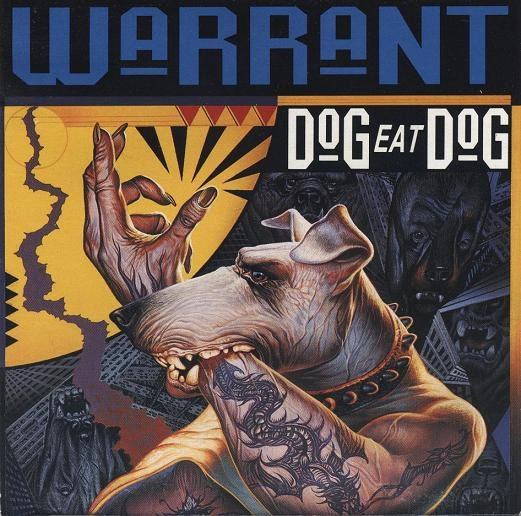
What makes the story worth telling is what the three studio records actually are. Dog Eat Dog is the great misjudged record of late hair metal — the album that should have launched Warrant’s second act and instead got buried under the cultural reorganization happening above it. Ultraphobic is the deceptively complicated grunge record, the one whose actual lyrical content was not market calculation but personal collapse. Belly to Belly: Volume One is the strangest record Warrant ever made — a tonally eerie, structurally weird, lyrically self-aware album that the band released, with a “Volume One” subtitle implying a sequel that never came, into a marketplace that no longer had any reason to notice it existed. Each of these records is doing something specific. None of them have been heard, by most listeners, on the terms they were actually made under.
Dog Eat Dog (1992): The Album That Should Have Mattered
By the spring of 1992, Warrant had three things working in their favor. They had a double-platinum debut behind them (Dirty Rotten Filthy Stinking Rich, 1989) and a double-platinum follow-up (Cherry Pie, 1990). They had a frontman, Jani Lane, who was — when sober and focused — one of the more genuinely talented songwriters in the genre. And they had, in their own private knowledge of where the industry was heading, every reason to suspect the next album would be the most important of their lives.
What they made was a record that, listened to today, sounds like a band who knew exactly what was happening to them and decided to write their way out of it rather than dress their way out of it. Dog Eat Dog, released August 25, 1992, is the album most Warrant fans now consistently rank as their best, and the reasons are audible across its forty-six minutes. The hooks are still there. The choruses are still big. But the band had spent the previous two years watching the cultural ground shift beneath them, and the record was their response: not a grunge album, not a pivot, but a deliberate hardening of what Warrant had always been.
Producer Michael Wagener was the first signal. Wagener had just produced Skid Row’s Slave to the Grind — the 1991 album that made hair metal history by becoming the first heavy metal record to debut at number one on the Billboard 200 in the SoundScan era, and which had done so partly by toughening Sebastian Bach’s band into something darker and more credible than their debut. Bringing Wagener in to replace Beau Hill (who had produced both prior Warrant records) was a clear statement: the band wanted what he had done for Skid Row done for them. The cleaner mixes were gone. The acoustic textures of Cherry Pie were gone. What Wagener delivered, working at Scream Studios in Studio City with overdubs at Morrisound in Tampa, was a sound with weight — guitars pushed harder into the mix, drums recorded for impact rather than polish, vocals that sat lower and angrier than the band had ever sounded.
The songwriting did the rest. Dog Eat Dog is Jani Lane’s record in a way the first two albums were not; he wrote all twelve tracks alone, and the lyrical concerns are unmistakably his. “Machine Gun,” the opening single, was the heaviest thing Warrant had ever released — a grinding mid-tempo riff against lyrics about violence and obsession, with a music video featuring a woman being tattooed with the band animated across her body. It peaked at number 36 on the Mainstream Rock chart. “The Hole in My Wall,” the third single, was a more recognizable Warrant song — voyeuristic, sexually loaded, with the kind of stadium-friendly chorus the band had always written well — but darker around the edges than “Cherry Pie” had been, more aware of its own seediness.
The two tracks that surprised listeners then, and still surprise listeners now, are “April 2031” and “Andy Warhol Was Right.” “April 2031” is a post-apocalyptic ballad — the title refers to the calendar date the song imagines its scenario unfolding on — about a world after nuclear warfare, written from the perspective of someone surveying what remains. “No more children playing / April 2031 / No more need for praying,” the chorus goes, over a sparse, deliberately stark arrangement that has more in common with mid-period Queensrÿche than with anything Warrant had recorded before. It’s the kind of song hair metal bands were not supposed to be capable of writing. “Andy Warhol Was Right” is stranger still: a chilling first-person narrative about a boy who grows up obsessed with fame, who concludes that the only way to become famous is to commit a violent crime, and who does. The song opens with a child’s voice singing the chorus before the band crashes in. It is unmistakably the work of a serious songwriter trying to write about something serious.
“The Bitter Pill,” the second single and what most fans of the album consider its peak, is the most ambitious song Warrant ever recorded. Built around a dual-vocal architecture that captures the internal struggle of a protagonist working through emotional collapse, the song’s central conceit is a German-language operatic interlude in the middle eight — performed by an ensemble credited on the sleeve as the “Moron Fish & Tackle Choir,” which was, by all accounts, a joke name applied to what was actually a small group of session vocalists. The Queen comparison is unavoidable and unforced; the song is reaching for “Bohemian Rhapsody” and reaches further than any of Warrant’s peers would have dared. It also, crucially, works. The operatic break does not feel like a gimmick. It feels like a band who had decided that if this might be their last record on a major label, they were going to use the studio time to try something.
Track by track, Dog Eat Dog keeps swinging in directions Warrant hadn’t previously taken. “All the Bridges Are Burning” addresses drug addiction directly. “Sad Theresa,” the closing ballad and the album’s most lyrically subtle song, builds an emotional arc the band had previously been incapable of sustaining over four minutes. Even the more conventionally Warrant-sounding tracks — “Bonfire,” “Hollywood (So Far, So Good)” — have a darker undercurrent than their Cherry Pie equivalents. The album is not perfect; it has a couple of songs most fans skip, and the front-loading of the heavier material means the second half loses some momentum. But its peaks are genuinely high, and they are the work of a band that had decided to take itself seriously at exactly the moment the culture had decided to stop taking the genre seriously.
The contemporary reviews, where the album received reviews at all, were respectful. Entertainment Weekly gave it a B+, with Greg Sandow noting the band’s surprising ambition. The Dig Me Out retrospective on the album, written decades later, captures what Dog Eat Dog was actually doing: “the band make it clear they were capable of entering Queensrÿche or other previously unexplored territory with ease, whether their fanbase and radio were ready or not.” The AllMusic entry, also retrospective, treats it as a misunderstood late-career masterpiece by a band who had been written off too quickly. The harshest contemporary critics were the ones who simply didn’t review it at all — the music press that had been excited about Cherry Pie in 1990 was, by August 1992, no longer interested in what a band called Warrant had to say.
The commercial story is where the cultural moment becomes impossible to ignore. Dog Eat Dog peaked at number 25 on the Billboard 200, which was lower than its two predecessors but not, in isolation, catastrophic. It went gold — certified by the RIAA on October 21, 1992, for shipments of 500,000 copies in the United States. By any normal standard, this would have been a successful album for a fourth-tier rock band. By Warrant’s standard, having released two consecutive double-platinum records, it was a sharp commercial step downward. And the trajectory was the wrong direction: the album entered the chart in the upper register and fell, rather than building over time the way the first two had done.
The reason it fell is the question the rest of the piece is about. The conventional answer is grunge: Dog Eat Dog came out on August 25, 1992, in the same calendar quarter as Alice in Chains’ Dirt (released September 29), Pearl Jam’s Ten still riding high (released August 27, 1991, but spending all of 1992 selling), and Soundgarden’s Badmotorfinger (October 1991) accumulating its own audience. The radio formats that had previously played Warrant — Mainstream Rock, AOR — were being remade in real time around bands from Seattle, and the marketing dollars and promotional energy that the major labels controlled were following the format shift. Dog Eat Dog was, in this telling, a good album released into a marketplace that no longer wanted Warrant.
This is true as far as it goes. But the more specific story, the one Jani Lane himself told for years afterward, is what made the commercial outcome feel less like bad luck and more like a deliberate institutional choice. During the Dog Eat Dog campaign, Lane walked into Don Ienner’s office at Columbia Records — Ienner had been chairman of the label since 1989 and would remain so until 2003 — and saw a poster of Alice in Chains’ Dirt hanging on the wall behind Ienner’s secretary’s desk. The implication was clear. The label’s commercial energy was already moving toward Seattle. Whatever Warrant had made, however much better it was than what they had made before, was no longer the kind of record Columbia was going to push. Lane recalled the moment in later interviews with a kind of resigned clarity: “Hello, Seattle — goodbye, Warrant.”
The label still released the singles. They still serviced “Machine Gun” and “The Bitter Pill” to radio, still funded the videos, still let the band tour. But the priority had shifted, and a Warrant album in late 1992 was not a priority. The album that the band had made — a darker, more ambitious, more credible record than anything in their catalog — was given the promotional support of a contractual obligation rather than a commercial bet. The result was a record that should have been heard by everyone who had bought Cherry Pie and ended up heard by a fraction of them, while the rest were busy buying Dirt.
Dog Eat Dog was Warrant’s final album for Columbia. It was also the final album to feature the band’s original lineup. By 1994, guitarist Joey Allen and drummer Steven Sweet would both be gone.
The Interregnum (1993-1994): A Band Briefly Not a Band
What happened next is the part of the Warrant story that gets glossed over in most retrospectives, because the year and a half between Dog Eat Dog’s tour ending and Ultraphobic’s recording beginning was a period during which Warrant was not, in any meaningful sense, a functioning band.
Jani Lane left in 1993 to pursue a solo career. The standard account — repeated in every Lane retrospective, including the Loudwire piece written after his 2011 death — is that he intended this departure to be permanent. He had grown tired of the Cherry Pie image, he was frustrated with the label, and he wanted to make music under his own name. The solo career did not materialize; the demos he recorded were not picked up by any label that mattered. Six months later, he was back in Warrant.
But the Warrant he returned to was no longer the Warrant of Dog Eat Dog. By the time the band reconvened in 1994 to make a fourth album, Joey Allen had departed for what would become a decade-long absence, replaced by Rick Steier — a guitarist whose own resume connected to two of the more interesting lost bands of the late 1980s and early 1990s, Kingdom Come and Wild Horses. Steven Sweet was also gone, replaced by James Kottak, formerly of Kingdom Come and McAuley Schenker Group. Columbia had not renewed their contract. Warrant signed with CMC International, an independent label that had positioned itself as a kind of retirement home for hair metal acts that the majors had dropped — Slaughter, Y&T, and other displaced hair metal acts would all eventually land there.
The financial and reputational drop was significant. CMC was a working label, but it was not the label that pushed albums onto MTV or into Top 40 radio. Signing to CMC was, in 1994, an admission that the band’s audience was now a defined and shrinking core rather than a mass market.
Ultraphobic (1995): The Grunge Album That Was About Something Else
Ultraphobic, released March 7, 1995, is the album Warrant fans most often disagree about. Its critics call it the moment the band sold out their identity to chase a trend. Its defenders, who are fewer but include some surprisingly thoughtful readers of the catalog, treat it as a genuinely interesting record that has been judged unfairly because of what it represented rather than what it was. Both sides of the argument tend to miss the same thing: what the album is actually doing, on close listening, is not really a grunge pivot. It is the document of a marriage ending, dressed in the sonic clothes of 1995.
The genre framing came first and has dominated every subsequent reading of the record. The Wikipedia entry on the album, drawing from contemporary press, puts it cleanly: Ultraphobic “openly admitted to a Seattle influence,” with “experimentation with grunge sounds” particularly visible on tracks like “Undertow” and “Followed.” The producer was Beau Hill — who had produced the band’s first two glam-era albums, which made his return for the grunge pivot a strange choice — and the result was a record that sat awkwardly between the two genres. The title track opens with a riff that listeners at the time noted bore a marked resemblance to “Smells Like Teen Spirit.” “Family Picnic,” the lead single, was a darker song about domestic violence, with a music video pitched directly at MTV’s then-current alternative aesthetic.
What Wikipedia’s framing — and most of the contemporary press — missed is that the grunge influence was, in significant part, a sonic vocabulary the band was using to write about something specifically personal. Jani Lane was, during the Ultraphobic sessions in November 1994, going through a divorce from his then-wife Bobbie Brown — the video model who had appeared in the “Cherry Pie” video, become Lane’s public partner across the band’s commercial peak, and was now, on the wrong side of the cultural shift, no longer the symbol of glam metal aspiration she had been four years earlier. The divorce was not an incidental detail. It is, by Lane’s own subsequent accounts, the central event the album is documenting. The grunge textures gave him the sonic permission to write about emotional collapse in a way the Cherry Pie template would not have allowed. The album works, when it works, because the personal material is real.
The opening track, “Undertow,” establishes the album’s pattern. The song is built on a descending guitar figure that, taken in isolation, would sound at home on an Alice in Chains record. The vocal arrangement that sits on top of it, however, is unmistakably Lane — the harmonized backing vocals stacked the way Warrant always stacked them, the melodic lift in the chorus pulling toward classic Warrant songwriting rather than alternative-rock dissonance. The combination is uneasy in a way that turns out to be the album’s distinctive quality. Ultraphobic is not a band trying to sound like Alice in Chains. It is a Warrant record where the underlying songwriting craft is still recognizably Warrant, but the sonic palette has been deliberately moved into territory that allows the lyrical content to land harder than the band’s previous records had permitted.
“Followed,” the album’s third single, demonstrates the same dynamic. The song opens with a sparse, almost industrial-feeling guitar texture; the verse phrasing is more conversational than anthemic; the chorus, when it arrives, is built around a melodic hook that any Warrant fan would recognize as Lane’s writing instincts intact under the alternative-rock veneer. The track is genuinely strong. It is also, by the standards of grunge-era alternative rock, not actually a grunge song — it is a Warrant song wearing grunge-adjacent production.
“Family Picnic,” the album’s lead single, is where the personal material becomes most explicit. The song is about domestic violence — a child’s perspective on a violent father, the small details of household terror, the way the family unit becomes the architecture of harm. The music video, directed in the alternative-rock visual vocabulary of 1995, is the closest Warrant ever came to making an MTV piece that the 120 Minutes audience might have engaged with. The single did not, in the event, get the kind of rotation that engagement would have required — CMC International’s promotional resources were not what Columbia’s had been — but the song itself is one of the strongest lyrical pieces of Lane’s career. It is also, almost certainly, autobiographical in some unspecified way that Lane was, in 1995, not yet ready to publicly unpack.
“Sum of One,” “Chameleon,” and “Crawl Space” make up the album’s middle stretch. The Discogs review that called these tracks the album’s strongest is largely correct. “Crawl Space,” in particular, is a slow, deliberate piece built on a riff that occupies more sonic real estate than most Warrant arrangements had previously allowed. The song’s lyrical content sits somewhere between paranoia and self-loathing — the protagonist hiding from his own life, watching from a position of fearful concealment — and the arrangement matches the mood without ever quite resolving it. The song is genuinely uncomfortable to listen to, in the specific way that good alternative-rock writing of the period could be uncomfortable. It would not have worked at all on a Cherry Pie-era Warrant album.
The album’s second half loses some momentum. “Live Inside of You,” “High,” and “Ride #2” are competent but less distinctive than the first six tracks; the song titles themselves — the single-word, one-word framing that “Followed” and “Crawlspace” had pioneered — start to feel more like genre signaling than like song-by-song decisions. The title track, “Ultraphobic,” recovers some of the album’s edge but doesn’t fully justify its position as the penultimate song.
The closer, “Stronger Now,” is where the album lands. The song is just Lane and a sparse arrangement — minimal drums, restrained guitar, vocal performance carrying nearly all of the emotional weight — and the lyrics are an unflinching address to Bobbie Brown about the end of the marriage. Lane himself, in subsequent interviews, called “Stronger Now” the best song he ever wrote, and described its writing as therapeutic to him. The claim is at least defensible. The song is genuinely affecting in a way that nothing on Dirty Rotten Filthy Stinking Rich or Cherry Pie approached, and the simple decision to end the album on this register — rather than on the more anthemic note a Cherry Pie-era Warrant album would have ended on — is the album’s most honest editorial choice. The grunge textures elsewhere on the record give context for why “Stronger Now” is allowed to be what it is. A song this exposed could not have been delivered through the band’s earlier sonic vocabulary without sounding ridiculous. The new vocabulary made it possible.
The reviews at the time were mixed and dismissive in roughly equal measure. The BraveWords retrospective on the 2025 reissue is representative of the harsher line: “gone are those fun glam metal riffs and solos, hooks, emotional ballads… they changed their sound and style to adapt to the flavor of the week — grunge and alternative, and it’s awful.” A Limelight retrospective from 2017 was somewhat kinder but reached a similar verdict: “it just comes off as pandering to the prevailing musical tides of the time of its release while cynically expecting to keep their initial fan base as well.” A more thoughtful RateYourMusic assessment defends the record: “Ultraphobic is better than you’ve heard. Warrant fans tend to hate on this album, calling it their ‘grunge’ record… which seems to indicate that none of them have actually heard grunge.”
There is something to that last point. Ultraphobic is not, on close listening, actually a grunge record. It is a Warrant record with grunge influences, built around personal material that the band’s previous sonic vocabulary could not have accommodated. The melodies are still Lane’s. The vocal harmonies are still stacked the way Warrant always stacked them. What’s grunge about it is the production texture and a handful of riffs; what’s Warrant about it is everything else. The album lands in the same broad category as Danger Danger’s Dawn, released the same year, and Skid Row’s Subhuman Race, also 1995 — the records that hair metal bands made when the cultural ground had shifted and they were trying, with imperfect success, to find a new place to stand. Of those three records, Ultraphobic is the one that has aged best, partly because the personal material at its center has more documentary weight than the cynical-pivot framing of the standard narrative allows for.
The album sold poorly. CMC promoted it modestly. The band toured small venues. By the time Ultraphobic had run its commercial course, Warrant were no longer competing in the same market as Pearl Jam or Alice in Chains. They were competing in a much smaller market, against other recently-displaced hair metal bands, for an audience of perhaps a few hundred thousand listeners worldwide.
The 1996 Avalanche: Four Releases in One Year
What happened next is genuinely strange and almost entirely undiscussed in the casual literature on the band. In 1996, Warrant released four albums.
The Best of Warrant came out on April 2, 1996, via Sony Music — Warrant’s former major-label home, which still held the rights to their first three albums. It was a standard greatest-hits collection drawn entirely from Dirty Rotten Filthy Stinking Rich, Cherry Pie, and Dog Eat Dog. Ultraphobic, despite being only a year old, was not represented. The compilation also included two bonus tracks: an acoustic version of “I Saw Red” (previously a B-side) and a cover of Queen’s “We Will Rock You” that the band had recorded for the 1992 film Gladiator, which had charted at #83 on the Hot 100.
A month and a half later, on May 13, 1996, Sony released Rocking Tall — a second compilation, drawn from the same three-album period, marketed as either a companion to or alternate version of The Best of Warrant. The track lists overlapped substantially. The Wikipedia entry on Rocking Tall notes that the compilation “does not include ‘Heaven,’ one of the band’s most popular songs,” though later digital releases on streaming services do appear to include “Heaven” — suggesting the original physical release omitted it and subsequent reissues added it back. Either way, the existence of two near-identical Sony compilations within six weeks of each other is hard to read as anything other than a label trying to extract maximum residual revenue from a catalog it no longer planned to extend.
This was all happening, it should be noted, without the band’s involvement. Sony owned the recordings. Warrant was on CMC. The 1996 compilations were Sony product, marketed to the casual fan base who might pick up a Warrant CD at a chain store, while the band itself was operating in a completely different commercial universe with a different label and a different audience.
That different universe produced the year’s third Warrant release. On October 1, 1996, CMC released Belly to Belly: Volume One, the band’s fifth studio album of original material. Drummer James Kottak had departed in March of that year, replaced by Bobby Borg, formerly of Beggars & Thieves. The band billed themselves on the cover as “WARRANT 96,” in an attempt to signal — to the few people paying attention — that this was a new and different band than the one Sony was packaging into compilations.
Belly to Belly: Volume One (1996): The Eerie Record
The first thing worth knowing about Belly to Belly is that its full title is Belly to Belly: Volume One. The “Volume One” subtitle implies a Volume Two that never materialized — and the implication is not idle. The band recorded the album in two intensive bursts: a week of writing in November 1995, another week in January 1996, two weeks of recording, and seven days of mixing. The compressed production schedule and the suggestion of a planned sequel both indicate a band that thought of itself, in late 1996, as having more material to work through than a single album could accommodate. The Volume Two never came. The Volume One sits in the catalog as a kind of suspended sentence — the first installment of a project that the band’s commercial reality made impossible to continue.
The second thing worth knowing is that the album is genuinely strange in ways the standard “they kept doing grunge” framing does not capture. Belly to Belly is not, structurally, a Dog Eat Dog successor or an Ultraphobic successor. It is a record that takes the alternative-rock vocabulary Ultraphobic had introduced and uses it as the launching point for something significantly weirder — a tonally consistent, deliberately eerie, conceptually unified record that sits in the Warrant catalog like a misplaced artifact from a different band. The Amazon reviewer who described the album as “mid-tempo, somber and contemplative, which was the zeitgeist of 1996” captured the surface texture correctly. What this framing misses is that the album is not simply matching the zeitgeist. It is using the zeitgeist’s sonic vocabulary to do something specific.
Guitarist Rick Steier described the album in interviews as a “concept album” following a rags-to-riches-to-rags storyline about fame, fortune, and the examination of one’s value system once the spotlight fades. The framing is partly accurate. The album does have a recurring thematic concern with what comes after success — the title itself, “Belly to Belly,” suggests the proximity of bodies in dance or in confrontation, the closeness of the fall from the height. The two named interludes that punctuate the record’s middle section (“Interlude #1” at 0:11, “Interlude #2” at 0:18) are short atmospheric breaks that signal the album’s structural ambition — albums with named interludes are usually trying to do something conceptual. Belly to Belly is one of them. The conceptual frame is loose enough that listeners cannot quite track it song by song, but tight enough that the album feels, on repeated listening, like a unified statement rather than a collection of tracks.
The opening sequence establishes the album’s distinctive register. “In the End (There’s Nothing)” — the title alone announces the album’s preoccupations — opens with a guitar arrangement that incorporates acoustic textures alongside the heavier electric layers, building a sonic field that is denser and stranger than anything Ultraphobic had attempted. Lane’s vocal is processed with the kind of filters and effects that the album returns to throughout — a deliberate sonic decision that some contemporary listeners found “silly and annoying” and that, in retrospect, reads as the band’s most committed attempt to do something genuinely outside the hair metal vocabulary. The song’s title repeats as a mantra: in the end, there’s nothing. Coming from a band whose previous decade had been spent celebrating excess, the line lands with unusual weight.
“Feels Good,” the second track, is the album’s most direct gesture at the Ultraphobic template — a more conventionally Warrant-sounding song with a hooky chorus. It also reads, on careful listening, as Lane gently mocking the angst of mid-1990s alternative rock. The contrast between the song’s surface accessibility and the surrounding album’s deliberate strangeness creates a tonal joke that runs through several of the album’s tracks. “AYM,” released as the lead single, extends the gag: the song is essentially “Angry Young Man,” and Lane is performing it with enough self-awareness that the listener can hear him commenting on the alternative-rock posture even as he occupies it.
“Letter to a Friend” is the album’s emotional centerpiece, and arguably the most underrated song of Jani Lane’s career. The song is built around a conceit Lane had developed about how romantic relationships should end — that the parties involved should reach an agreement that they no longer get along, rather than dragging the dissolution into prolonged conflict. The lyric works through the conceit with unusual clarity. The arrangement is sparse, mid-tempo, restrained in a way that lets Lane’s vocal carry the song’s emotional weight. The Amazon review that called it “arguably the most underrated song that Lane ever wrote” is not wrong. The track is the album’s clearest demonstration that Warrant in 1996 was capable of work that the standard narrative of hair metal decline does not accommodate.
“Indian Giver,” the album’s third single, is its most distinctive track and the one that has aged with the most surprise. The song is built around what some retrospective listeners have heard as African or world-music percussion textures — a rhythmic complexity that no previous Warrant song had attempted. The arrangement incorporates acoustic guitar, layered backing vocals, and a chorus structure that builds across multiple movements rather than relying on a single repeated hook. The song’s title plays on the colloquial expression about giving something and then taking it back — a thematic preoccupation that connects, loosely, to the album’s broader concern with loss and reclamation. Listened to now, “Indian Giver” sounds less like a hair metal band attempting alternative rock and more like a band reaching for something its existing vocabulary had no precedent for. The reach does not entirely connect. But the attempt itself is interesting, and the song is better than its commercial neglect would suggest.
“Falling Down” and “Solid” extend the album’s mid-tempo, contemplative register. “All 4 U,” the album’s primary ballad, is the track that the band hoped would carry the same kind of crossover potential that “I Saw Red” had carried for them in 1990. The song is genuinely beautiful — Lane’s vocal performance is among the album’s strongest — but no marketing apparatus was going to deliver a 1996 Warrant ballad to the radio audience that might have appreciated it. The song exists in the catalog as a kind of orphaned would-have-been hit, the ballad that would have worked in an alternate timeline where Warrant in 1996 still had a commercial trajectory that could support it.
“Coffee House” is the album’s strangest single track. Built around an acoustic-guitar arrangement and a vocal performance that sits in a lower, more conversational register than Lane typically used, the song reads as either a deliberate parody of the coffeehouse acoustic-singer-songwriter aesthetic that was commercially ascendant in 1996 or as an earnest attempt to occupy that mode — and the ambiguity is, almost certainly, intentional. Lane is performing the coffeehouse song and commenting on it simultaneously, and the resulting tonal instability is the album’s most concentrated example of the eerie quality that runs through the record as a whole.
“Vertigo” and “Room with a View” maintain the album’s deliberate strangeness through the back half. “Nobody Else,” the closing track on the standard release, ends the album on a quieter note than its hair metal predecessors would have permitted — there is no anthemic closer, no big stadium chorus to send the listener out on, just a final song that lets the album’s accumulated mood dissipate rather than resolve.
The album generated three singles — “A.Y.M.,” “Feels Good,” and “Indian Giver” — none of which charted on any chart that meaningfully measured rock radio in 1996. The album did not appear on the Billboard 200. By the end of 1996, Belly to Belly: Volume One had effectively disappeared from the marketplace. The Volume Two that the title implied never came. The audience that might have appreciated what the band was actually doing in 1996 — a small alternative-rock audience that valued conceptual ambition, careful arrangement, and lyrical self-awareness — did not encounter the album because the album was marketed (such as it was marketed) to a hair metal audience that had no use for it. The hair metal audience could not see past the band’s name. The alternative-rock audience never knew the album existed.
This is, in retrospect, what makes Belly to Belly the most interesting record in Warrant’s catalog — not the best (that is Dog Eat Dog), not the most personally significant (that is Ultraphobic), but the most genuinely strange. The album exists. It is available on selected streaming services. It is listened to, by the small audience that has discovered it, with the kind of slow-building appreciation that records of this type tend to accumulate when the original commercial context has fully faded. The “Volume One” subtitle remains, three decades later, an unfulfilled promise — and the unfulfilled promise has become, paradoxically, part of the record’s quiet appeal. The album implies a continuation that the band’s commercial reality never permitted. The implication is its own kind of artifact.
The Live Album (1997)
The fourth 1996 release came a year later, in July 1997, but documents the previous November: Warrant Live 86-97, recorded at Harpos Concert Theatre in Detroit on November 22, 1996, during the Belly to Belly tour. The title’s date range was a marketing fiction — the album was recorded on a single night, not across a decade — and the recording captured what the band was at that specific moment, which was a four-piece-plus-Borg playing to a hard-rock club crowd that was still buying tickets to see “Cherry Pie” and “Heaven” rather than “A.Y.M.” or “Family Picnic.” The live album, for that reason, leans heavily on the early hits. It is, in effect, a fifth 1996 Warrant compilation, masquerading as a document of the current band.
The Quiet Years (1997-1999): The Band Holding Together
By 1997, the lineup had shifted again. Bobby Borg left in October to pursue what would eventually become a career as an author of music industry books. He was briefly replaced by touring drummer Vikki Foxx. The band played the inaugural Rock Never Stops Tour in 1998 — a package tour designed specifically for hair metal nostalgia, featuring Slaughter, Quiet Riot, FireHouse, and Warrant, marking the moment the genre’s commercial future shifted definitively to the nostalgia circuit.
In 1999, Warrant released Greatest & Latest, technically a compilation but functionally something stranger: re-recorded versions of their classic songs (made necessary by the rights-ownership split between Sony and the band) plus three new tracks. The album was the band’s attempt to monetize their own catalog under their current contract, since Sony controlled the original masters. Re-recording the hits became a small cottage industry among displaced 1980s rock bands during this period; Def Leppard would later do their own version. For Warrant, Greatest & Latest was both a financial necessity and a quiet acknowledgment that the band’s commercial identity had collapsed back onto its earliest material. Whatever they had tried to become on Ultraphobic and Belly to Belly had been rejected by the audience. The audience wanted “Heaven” and “Cherry Pie,” and now they wanted them re-recorded.
Guitarist Rick Steier and keyboardist Danny Wagner left the band in January 2000. Keri Kelli came in on guitar, Mike Fasano on drums. The lineup turnover by this point was extreme: of the five musicians who had recorded Dog Eat Dog eight years earlier, only Jani Lane, Erik Turner, and Jerry Dixon remained.
Under the Influence (2001): A Cover Album, Finally
By 2001, the question facing Warrant was not “how do we adapt to the cultural moment” but rather “what do we even do now?” The grunge experiment was over and had failed. The nostalgia circuit was working, but barely paid the bills. Jani Lane’s personal life was deteriorating — he would enter rehab for alcohol abuse two years later — and his relationship with the rest of the band was, by all subsequent accounts, fractious. The Loudwire retrospective on his death describes him during this period as “argumentative and controlling, especially when he was drinking,” with frequent fights about the band’s image and musical direction.
Under the Influence, released June 12, 2001, was Warrant’s response to having nothing left to prove and no commercially viable direction left to pursue. It was a covers album. Eight tracks of glam, classic rock, and hard rock standards — Bowie, AC/DC, Sweet, Mott the Hoople — plus two original tracks (“Subhuman” and “Face”) that functioned as marketing tickets to the rest of the record. Produced by Jerry Dixon and Matt Thorne, released on Perris Records (a tiny indie even by CMC’s standards), the album was a transparent attempt to keep the brand alive without requiring Lane to write a full album of new songs at a moment when he was, by all accounts, in no condition to do so.
The covers are not bad. They’re not particularly interesting either. The album’s most quoted track, the cover of AC/DC’s “Down Payment Blues,” features the band’s then-new lead guitarist Billy Morris on lead vocals, which gives the entire enterprise a slightly Frankenstein quality — a Warrant covers album on which the most prominent voice is not Warrant’s frontman. Lane sang most of the rest, but the project as a whole reads as the work of a band that had stopped expecting to make a record anyone would talk about and had decided to make one anyway, mostly to give themselves something to tour behind.
Under the Influence would be Jani Lane’s last Warrant album. In 2004, after a power-pop solo album that flopped (Back Down to One, 2003) and a brief stint in rehab, he left the band over what the official press release called “personal and creative differences.” He would return briefly several years later, and would die in a Comfort Inn hotel room in Woodland Hills, California, on August 11, 2011, from acute alcohol poisoning. He was 47.
So What Was the 1990s, Then?
Looking at Warrant’s 1990s discography in total — three real studio albums of new material (Dog Eat Dog, Ultraphobic, Belly to Belly: Volume One), one covers album (Under the Influence), two label-driven compilations (The Best of Warrant, Rocking Tall), one band-driven re-recording compilation (Greatest & Latest), and one live album (Warrant Live 86-97) — what emerges is a band that was unusually busy at a moment when most of their peers were going quiet, but whose productivity was almost entirely uncoupled from commercial success.
The conventional explanation for the decline is that grunge killed them. This is partly true, but it doesn’t capture what’s distinctive about Warrant’s specific story. Dog Eat Dog in 1992 was a serious creative move that should have given them a credible path forward into the post-grunge era. Bands that made comparable pivots at comparable moments — Pearl Jam grew from Ten to Vitalogy, Metallica grew from …And Justice for All to the Black Album, Aerosmith grew from Pump to Get a Grip — succeeded. Warrant did not. What separates Warrant from those examples is not the quality of the record but the commercial machinery that was supposed to push it. Columbia had already decided, by 1992, that their bet was on Seattle. The poster on Don Ienner’s office wall was not a coincidence; it was a statement of policy. Dog Eat Dog was not given the promotional weight that would have allowed it to find an audience, because the label had already moved on.
What followed — Ultraphobic’s grunge-vocabulary divorce album, Belly to Belly’s eerie experiment, the cascading compilations, the re-recordings, the covers album — was a band trying to find a commercial home in a landscape that no longer had room for them, while also trying to keep functioning around a frontman who was visibly coming apart. The 1996 release schedule, in particular, makes more sense once you see it not as a coherent strategy but as the simultaneous output of three different commercial actors: Sony Music exploiting an unrenewed catalog (The Best of Warrant, Rocking Tall), the band releasing new material on a small label (Belly to Belly), and the touring economy of the late 1990s requiring product to support live shows (Warrant Live 86-97). Each release made sense on its own terms. The fact that there were four of them in twelve months tells you nothing about Warrant’s strategy and everything about the fragmented economic situation of a hair metal band who no longer controlled their own catalog or commercial trajectory.
The deeper layer of the story is Jani Lane. His 2011 obituaries make clear what was harder to see at the time: that the 1990s were not just a commercial collapse for Warrant but a personal collapse for the man who had written almost every song they ever recorded. The divorce, the drinking, the leaving and returning, the fights over image and direction — all of this was happening simultaneously with the band’s attempts to figure out how to exist in a post-glam world. The two collapses were not separable. Ultraphobic’s darkness was not a marketing decision; it was a documentary record of a marriage ending. Belly to Belly’s rags-to-riches-to-rags concept was not invented for the album; it was a description of what was actually happening to the band, structured as a record. By the time of Under the Influence, the band had effectively decided to stop asking Lane to carry new material because he was no longer able to.
There is a version of this story in which Warrant are a cautionary tale — a band that didn’t know when to stop. There is another version in which they are something more admirable: a group of professional musicians who kept showing up to do the work for almost a decade after the work had stopped paying them, because the work was the thing they knew how to do. The eight albums they released between 1992 and 2001 are not, by any honest measure, eight good albums. Dog Eat Dog is a great record. Ultraphobic is more interesting than its reputation suggests, and its closing ballad is one of the best things Lane ever wrote. Belly to Belly is the strangest record in the catalog and, in its weird ambitious way, one of the most rewarding to engage with carefully. The compilations and the covers album are commercial artifacts of a band trying to stay solvent. But taken together, they constitute a body of work that is significantly more substantial than what most of Warrant’s peers produced during the same period — and the fact that almost nobody was listening doesn’t change the fact that the band kept making it.
Jani Lane is not here to ask about any of this. The remaining members of Warrant, led by Erik Turner and Jerry Dixon, have continued to tour with vocalist Robert Mason since 2008, playing the nostalgia circuit and occasionally releasing new material that the world receives politely and then forgets. The body of work from the 1990s has not been particularly reconsidered or rehabilitated. It sits in the catalog, available on streaming services, mostly unheard. Like most artifacts from a culture’s transitional moments, it remains hard to evaluate fairly, because it requires understanding what the people who made it were trying to do, in a landscape that punished them for trying.
They tried anyway. That, more than the records themselves, is what’s worth taking seriously.