One and Done
After the Hit: Tuff, Stevie Rachelle, and the Singer Who Became the Historian
In 1991, a Phoenix-by-way-of-Hollywood glam band had a power ballad that reached number three on Dial MTV, landing between Metallica and Guns N' Roses. Within eighteen months, Atlantic had dropped them, and the genre that defined their commercial existence was effectively over. The lead singer spent the next twenty-eight years doing something stranger and more lasting than the band's brief commercial moment: he became, from the inside, the single most consistent chronicler of the scene he had briefly belonged to. The first installment of One and Done.
A specific editorial question has been sitting beneath this magazine’s work for several issues without being made explicit: what happens to the people who were in the bands we write about, in the years and decades after the commercial moment that defined them has ended? The Vain piece ends with the band still around, smaller, occasionally touring. The FireHouse piece ends with them still selling records in Asia. The Warrant piece ends with Jani Lane dead. The Lillian Axe piece ends with Steve Blaze still releasing records to the small audience that stayed with him. In most of these cases the post-peak chapter is treated as coda — a brief acknowledgment that the people who made the music kept being people after it stopped selling, with the editorial work focused on the brief window when they were commercially active.
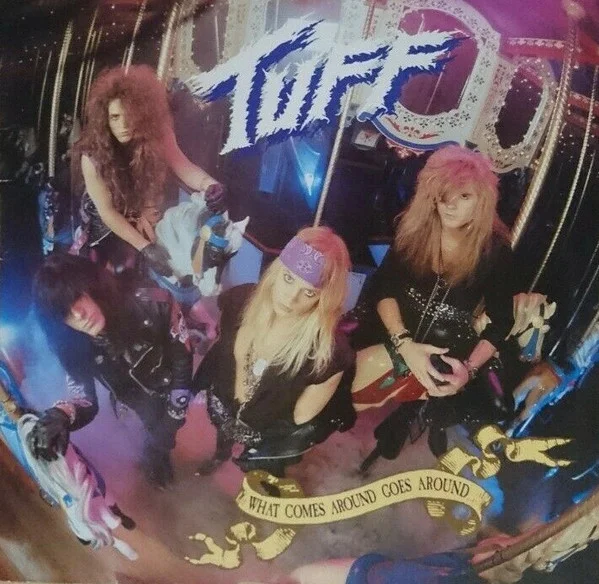
The Tuff story does not work that way; the post-peak chapter is the more substantial part. The band’s actual major-label existence lasted about eighteen months — from May 1991, when What Comes Around Goes Around was released on Atlantic Records, through late 1992, when Atlantic dropped them as the grunge-era reorganization made their position untenable. The career that followed, by contrast, is one of the more genuinely interesting in late-period hair metal — not a second commercial peak, but something stranger and more consequential. Stevie Rachelle became the most consistent insider-chronicler of the scene he had briefly belonged to, through the website Metal Sludge, which he co-founded in September 1998 and has run for the twenty-eight years since.
This is the first installment of the magazine’s One and Done section, which will focus on bands whose entire meaningful commercial existence was effectively a single record. The category needs care, because most of the bands that fit it have additional records that a strict “one album” reading would exclude. Tuff have eight studio albums and a substantial catalog of compilations, demos, and live records. What they have, in the sense the section cares about, is one album that meaningfully entered the major-label infrastructure — What Comes Around Goes Around — followed by a substantial catalog that has existed entirely outside it, sold to a dedicated audience through Rachelle’s own RLS Records, and produced no further peak. We’ll engage with that later catalog briefly. The central work here is the eighteen-month window, and what Rachelle did with the rest of his life afterward.
The Setup: From Phoenix to Hollywood
Tuff formed in Phoenix, Arizona in 1985 as a guitar-and-bass partnership between lead guitarist Jorge DeSaint and Todd Chase — whose actual surname was Chaisson, and who would later use various stage names including CH@SE — with a drummer named Gary Huckaby. The early sound was significantly heavier than the glam template the band would settle into, more straightforward American hard rock than Sunset Strip metal, with the visual identity that would later define them still years away.
The pre-major-label turnover is worth pausing on, because it produces one of the more interesting connections in the broader hair metal network. In 1986, Huckaby left; the replacement was drummer Michael Lean, born Michael Raimondo. The original vocalist, Terry Fox, departed shortly after — by various accounts to pursue an ice-skating career, which is genuinely true and captures how strange the early Tuff history was — and was replaced by Jim Gillette.
Gillette’s name carries weight for this magazine’s catalog. He would later marry the guitarist Lita Ford in 1994, a partnership that ran through Ford’s Wicked Wonderland (2009) reactivation album, on which Gillette co-wrote much of the material, until their separation. But in late 1986 and early 1987, Gillette was Tuff’s lead singer, and the band recorded a four-track EP under his vocals — Knock Yourself Out, cassette-only in 1986, on their own Tuff Muff Music label — before he departed to form Nitro, whose 1989 debut O.F.R. became a small commercial moment of its own, largely on the strength of guitarist Michael Angelo Batio’s extreme technical playing and Gillette’s own remarkable upper-register sustain.
Gillette’s replacement, in 1987, was Stevie Rachelle — born Steven Hanseter on March 2, 1966 in Oshkosh, Wisconsin, and by then relocated to Los Angeles chasing a music career. Tuff auditioned him in August 1987, and by his account his first show was opening for Warrant at the Roxy on the Sunset Strip — the same Warrant this magazine has covered in detail, and a band that occupied roughly the same regional position in the late 1980s. Warrant would be signed first; Tuff would be signed years later, into a substantially different moment.
The lineup that would record What Comes Around Goes Around — Rachelle on vocals, DeSaint on lead guitar, Chase on bass, Lean on drums — was in place by late 1987 and stayed stable through the deal. The band relocated to Los Angeles and spent the late 1980s and early 1990s building a regional reputation on the Sunset Strip circuit, headlining Gazzarri’s, the Roxy, the Whisky a Go Go, and the Troubadour, and appearing briefly in Penelope Spheeris’s 1988 documentary The Decline of Western Civilization Part II: The Metal Years, captured as one of many Sunset Strip aspirants chasing a breakthrough most of them would not reach.
What the standard narrative misses is how late Tuff arrived. By 1989, deep into their LA touring and demoing, the genre’s peak was already past. Mötley Crüe’s Dr. Feelgood (September 1989) would prove the last of the truly multi-platinum hair metal debut-cycle albums; Warrant’s Cherry Pie (1990) the last hair metal record to produce a top-ten Hot 100 single. By 1990 the major-label calculation around new hair metal signings had begun to shift — labels still signed bands, but the marketing and tour-support budgets were shrinking, and the assumption that a competent late-period glam debut would automatically go gold or platinum was being questioned. Tuff signed with Atlantic in 1990, into exactly that shrinking window. The deal was real but not generous, and the debut would land in a marketplace already less hospitable to the genre than it had been eighteen months earlier.
What Comes Around Goes Around (1991)
What Comes Around Goes Around was released by Atlantic on May 14, 1991, produced by Howard Benson — who would later become one of the more prolific commercial-rock producers of the 2000s (My Chemical Romance, Daughtry, Theory of a Deadman, Three Days Grace) but in 1991 was still building the credit list. The recording was professional, the arrangements tight, the production capturing the band without the lavish overdub work some of the genre’s bigger debuts operated within.
The album was, by most reasonable assessments, exactly what Atlantic had signed the band to deliver: an accomplished late-period glam record, the genre’s visual and sonic vocabulary applied to twelve tracks of competent songwriting. It was not, in any obvious sense, distinctive. The harsher retrospective shorthand — comparing Tuff to “Poison but worse,” or “Poison ordered from Wish” — is partly accurate: the band occupied the same broad territory as the late-Poison/late-Warrant/late-Britny Fox template, executed competently, without the identifying features that made the more successful bands in that template instantly recognizable.
But that undersells what the album contained at its peak. The standout — and one of the late hair metal era’s defining ballad moments — is “I Hate Kissing You Goodbye,” co-written by Rachelle with Todd Meagher (later better known as a tech entrepreneur than a songwriter, though his contribution here was substantial). The construction is straightforward power ballad: clean opening guitar, restrained verse, building chorus, third-act rave-up, ballad-tempo close. Rachelle’s performance is among the best ballad vocals of the era — controlled, dynamic, the sustained upper-register notes the template required, delivered without strain. The video entered MTV’s Dial MTV — the daily viewer-voted top ten — and reached number three. The position is worth pausing on: the video that beat it to number one during its peak week was Metallica’s “Enter Sandman,” and the one at number two was a Guns N’ Roses single from the Use Your Illusion cycle. Tuff’s power ballad spent its peak week immediately behind two of the largest commercial-rock acts of the entire era — in absolute terms, one of the strongest hair metal commercial moments of 1991.
The album as a whole sold roughly 100,000 copies in the United States — well below Atlantic’s expectation. The label’s previous late-period hair metal debuts had typically sold 300,000 to 500,000 on first release, the strongest reaching platinum, and a sub-100,000 trajectory was, in 1991’s commercial language, a disappointment. Not a catastrophe — the band had real fans, real airplay, touring through 1991 into 1992 — but below the threshold that justified the sustained investment that pushed comparable bands toward certification. The deeper cuts — “So Many Seasons,” “Spit Like This,” “The All New Generation,” “Forever Yours,” “Ruck a Pit Bridge,” “American Hair Band” (the original-album version, not the later parody track of the same name), “Wake Me Up,” “American Heart,” “Lonely Lucy,” “Fade to Black” — range from competent to forgettable, and none reaches the level of “I Hate Kissing You Goodbye.” That is the album’s structural problem as a debut: one great song — and “great” is the right word, the song earned its Dial MTV peak — surrounded by material at the genre’s general level. A late-1991 breakthrough required two or three strong singles per album. This one had one, and the marketplace responded accordingly.
The supporting tour ran through 1991 into 1992 on a club-and-theater circuit that was visibly contracting as the hair metal touring economy collapsed. By late 1992, with the shift toward alternative rock fully visible and Atlantic’s promotional commitment exhausted, the label dropped Tuff. The exact circumstances have been described differently in various accounts, but the outline is consistent: the debut’s underperformance had recalibrated expectations downward, the cultural moment had moved against the genre, and the willingness to underwrite a second-album budget had evaporated. By early 1993, Tuff were a band without a label, a promotional apparatus, or a clear path forward.
The Eighteen-Month Gap That Lasted Decades
What happened next is the structural fact the One and Done framing is built to engage. Most one-record bands disappear cleanly — members scatter, catalog enters the discount bin, the brand stops operating. Tuff did something different: the band continued, the records continued, and the audience for them did not continue at anything like the level the major-label moment had briefly produced.
The mechanics are worth being precise about. In early 1994 Rachelle founded RLS Records, the small independent label that would house essentially all subsequent Tuff product. The acronym carried a deliberate double meaning he has explained often — “Record Labels Suck” and “Rachelle’s Lyrics and Songs,” both active at once — and it became the vehicle for a steady stream of releases: Fist First (1994), Religious Fix (1995, the BMG/Mausoleum reissue of Fist First with three bonus tracks), Decade of Disrespect (1996), Regurgitation (1997, first in Portugal, reissued in the US in 2000), The History of Tuff (2001), Live in the U.K. (2003), What Comes Around Goes Around… Again! (2012, a re-recording of selected debut tracks plus new material), The Glam Years 1985–1989 (2015), Decadation (2015, vinyl and digital only), and others. None reached beyond a small dedicated audience. The catalog is, in every commercial sense, that of an independent hair metal nostalgia project at the lower end of the genre’s continuing economy — real value to the listeners who value it, no moment that connects back to the 1991 peak.
What Rachelle did alongside it is the story that complicates the one-record-band narrative. From around 1995 he developed a parallel interest in something that did not yet have a name: documenting, from the inside, what was happening to the hair metal generation after the genre’s collapse. The bands were still touring at the club level, personnel cycling through reconfigurations, and the interpersonal material — who was talking to whom, which singer had been fired from which band, which reunion was rumored and which was actually happening — was exactly what the standard music press of the mid-1990s had stopped covering, because the broader conversation about hair metal had stopped existing. Rachelle was uniquely positioned to observe it. He had been part of the scene at its peak, stayed on its circuit through the collapse, knew most of the musicians personally, and sat outside the major-label PR infrastructure that would once have controlled the flow of such information.
In the summer of 1998 he began building what became Metal Sludge, with collaborator Shawn Card, a Detroit friend whose own interests in underground culture (he was substantially shaped by the Insane Clown Posse and the Detroit independent-rock scenes) influenced some of the format choices. The site launched on September 1, 1998, combining news, gossip, deliberately irreverent musician interviews (the “20 Questions” format, the “Hair Chart” ranking system, the “World Famous Penis Chart” — both a joke and, drawing on first-person source material, a serious one), and reader message boards where mid-period hair metal fans discussed the developments the broader press no longer touched. It was anonymous by design for its first six years; Rachelle’s authorship was not public until 2004, when he “came out” through a Brave Words feature. The anonymity was practical — he was still actively touring with Tuff, his relationships with other musicians would be affected by his ownership of a site willing to publish what they might prefer suppressed, and the legal exposure differed if his name were attached.
Between 1998 and roughly 2008 — the period the site’s own retrospectives identify as its peak — Metal Sludge produced the most consistent insider documentation of the post-commercial hair metal generation that any single publication managed. The “20 Questions” archive, with the likes of Frankie Banali, Kevin DuBrow, Stephen Pearcy, Bret Michaels, and the cycling membership of nearly every band of the era, constitutes a genuinely substantial historical record. The musicians answered because they trusted that the site understood the moment they were operating in: the questions were irreverent, sometimes explicit, sometimes antagonistic, but they came from someone who had been in a Sunset Strip glam band and lived the same touring conditions.
The cultural cost was substantial, and Rachelle has been candid about it. After he came out as the founder in 2004, his treatment by some of the broader hard rock community changed visibly. He has described one telling encounter: at a 2004 VH1 “40 Least Metal Moments” taping, sharing a green room with Anthrax’s Scott Ian and the wrestler Chris Jericho, he introduced himself and Ian’s entire response was “I know who you are.” Ian did not speak to him again for the rest of the taping. The implication — that running Metal Sludge had marked Rachelle as someone the more mainstream-credible musicians did not want to be associated with — was clear; the site’s aggressive register had built its audience and created a personal cost at the same time. What it never produced, across more than twenty-five years, was financial success at any meaningful scale. The site has been ad- and donation-supported throughout, and Rachelle runs it in 2026 as a self-funded “1-man gang,” its near-three-decade archive free to anyone who wants it — in that respect much like Tuff’s own post-Atlantic catalog: a continuing project that reached a small dedicated audience without ever changing his life materially.
What Tuff Were, Versus What Rachelle Became
There is a specific asymmetry the standard “one hit and then they vanished” framing misses entirely. The band’s commercial peak was, at its largest, a single power ballad that reached number three on Dial MTV in 1991. The band’s continuing existence has produced eight studio albums, multiple compilations, regular nostalgia-circuit touring, and a dedicated audience across three decades. And Rachelle’s non-Tuff work — Metal Sludge, his standing as one of the genre’s primary insider-historians, his interview projects and documentary appearances, the 2025 video documentary “Seattle Can Eat Sh*t” — Tuff’s MTV-to-Sludge Payback — has reached a substantially broader audience than the band’s continuing catalog ever has.
The 2025 documentary captures the dual-identity arc with unusual clarity. Directed by collaborators in Rachelle’s circle and distributed direct-to-fan through RLS Records, it walks through Tuff’s rise, the grunge-era disruption, and the founding of Metal Sludge as the post-peak vehicle through which Rachelle would keep shaping the conversation about the scene. The title’s defiance — the implication that the Seattle bands that displaced hair metal could “eat sh*t” while Rachelle’s chronicling outlasted them — is partly bluster, but it captures something real. Metal Sludge has now run continuously for twenty-eight years. Soundgarden, after Chris Cornell’s death in 2017, has produced no new material; Pearl Jam continues but at a substantially reduced cultural scale; the bands that displaced hair metal have entered their own post-peak phases. By the simple metric of continuous operation, the historian’s work has outlasted the cultural moment that displaced the genre Tuff briefly represented — and it has now run, continuously, for longer than that genre’s entire commercial peak.
A Brief Coda on the Other Members
Todd Chase, the bassist who founded Tuff with DeSaint, has been Rachelle’s most consistent musical partner across the band’s continuing existence. He left in 1991 — by some accounts over immediate post-debut tensions, by others over the broader uncertainty after Atlantic’s expectations went unmet — and rejoined in 2008 when Rachelle reactivated the band’s touring. His brothers Greg Chaisson (in Jake E. Lee’s Badlands) and Kenny Chaisson (in Keel) had their own substantial careers, making the Chaisson family one of the era’s more interesting heavy metal bass dynasties. Jorge DeSaint, the original lead guitarist and co-founder, departed in 1991 once the debut’s trajectory became clear; his subsequent career has been far less visible, and the reunion attempts of the past three decades have mostly not included him, the relationship remaining complicated. Michael Lean, the drummer who had been with the band since 1986, left in 1993 in the post-Atlantic dissolution and returned in 2024 — thirty-one years later — when Rachelle reactivated the classic lineup, one of the more genuinely emotional reunions in the late-hair-metal nostalgia economy.
The other musicians who have cycled through — Billy Morris, currently lead guitarist; Tod “T” Burr, drummer from 2001 through 2024; the various session contributors — have all worked within the late-period hair metal continuing economy. So have the guest musicians who have crossed Tuff’s path, including, notably for this magazine’s catalog, John Corabi, who played at least one show with Tuff in the early 2000s, and Keri Kelli, who played several around the same time. Corabi’s appearance is small but resonant given his broader story, which we covered in the Mötley Crüe self-titled piece: the singer who replaced Vince Neil for the 1994 album and was displaced when Neil returned has, like Rachelle, kept working within the same continuing economy across the decades, occasionally crossing paths with bands like Tuff at the level of small clubs and nostalgia shows.
What the One and Done Format Is For
This is the inaugural installment of the One and Done section, and it’s worth being honest about what the section is for. In the strictest reading, it covers bands whose meaningful commercial existence was effectively a single record, and Tuff fit that reading — the post-Atlantic catalog exists, but the band’s commercial life in any conventional sense was the eighteen months around the 1991 debut. What the section is actually about, though, is broader: what happens to the people who were in those bands in the decades that follow. Sometimes that chapter is a small coda. Sometimes, as here, it is more interesting than the brief commercial moment, and the category gives us the vocabulary to engage with either register depending on which serves the story.
The next installments — Femme Fatale’s 1988 self-titled debut, Signal’s 1989 debut, Holly Knight’s Device 1986 album, and the broader category of late-period bands the major-label infrastructure absorbed and discarded within eighteen months — will turn on the same question Tuff make vivid. The bands released one record; the marketplace decided that record was the whole story; the musicians, in nearly every case, kept doing what they had been doing, at a smaller scale, for far longer than the brief moment lasted, and most are still doing it in 2026, unnoticed by the broader conversation about the genre they once occupied. These pieces will run shorter than the magazine’s major retrospectives — most in the 5,000-to-7,000-word range, focused on a single album and the moment that produced and discarded it — but they will share this one’s commitment to taking the post-peak years seriously. The bands that released one major-label album are not, in any meaningful sense, less interesting than the ones that released eight. They are often more interesting, precisely because the marketplace’s brief attention produced both the moment that defined their public existence and the structure of disappointment that defined the much longer existence it ignored.
Tuff’s answer to the question is unambiguous, and Rachelle himself has been candid about both halves of it — the brief MTV peak, the Atlantic advance, the supporting tours, the week “I Hate Kissing You Goodbye” sat between “Enter Sandman” and a Guns N’ Roses video; and then the financial reality of RLS Records, the cultural reality of Metal Sludge, the long work of documenting what happened to the bands that broke through, didn’t, and landed in every category between. The section will, going forward, focus mostly on the records themselves. But this first piece has been about something slightly different: what happens when the singer of a one-record band turns out to have a more interesting second act than the moment that defined him. Not every future installment will be able to make that argument. Tuff have made it possible.