Retrospective
Cut from the Same Cloth: Rough Cutt and the Bands That Outgrew Them
Mentored by Dio, managed by his wife, signed to Warner Bros., opening arenas for the biggest metal acts in America. Rough Cutt had every advantage a 1980s Los Angeles hard rock band could have, and almost none of the success. By the time the band dissolved in 1987, the catalog of musicians who had passed through their ranks read like a list of who actually made it in mid-1980s metal. A retrospective on a band whose history is mostly the history of the bands that emerged from it.
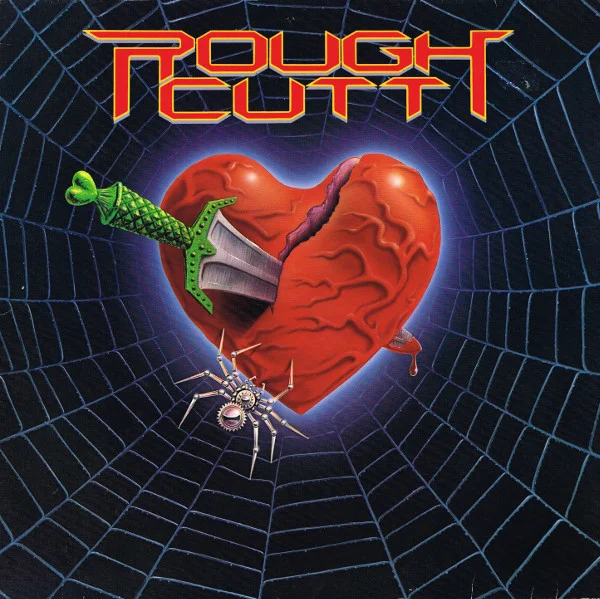
Here is a list of bands that included, at one point or another in the early 1980s, a musician who would pass through Rough Cutt: Ratt, Dio, Ozzy Osbourne’s band, Giuffria, Quiet Riot, Badlands, Orgy. The list of significant rock acts of the same era that did not include a Rough Cutt alumnus is shorter than you would expect. The catalog of musicians who came through the band before, during, or after its two-album Warner Bros. run between 1985 and 1986 reads less like a discography than a directory of mid-1980s Los Angeles hard rock — a band that, by some accident of timing and circumstance, became a hinge point through which an entire generation of metal musicians passed on their way to other projects.
The Rough Cutt that actually made the two albums — Rough Cutt in 1985 and Wants You! in 1986 — was, by most measures, the version that mattered least. The lineup that signed to Warner Bros. arrived after Jake E. Lee had left to join Ozzy Osbourne, after Craig Goldy had left for Giuffria and eventually Dio, after Claude Schnell had left for Dio’s band, after Joey Christofanilli had departed and briefly rejoined Ratt. The configuration that opened arenas for Dio in 1985 and 1986 was the one that had survived long enough to be in the room when the deal closed, after the more historically significant members had moved on to bigger things. The story of Rough Cutt, in that sense, is not really the story of two albums. It is the story of a Los Angeles club band that functioned, in the early 1980s, as an unofficial apprenticeship program for musicians who would go on to define hair metal — most of them from inside other bands. This is the story of those records, the network that produced them, and what happens to a band when nearly everyone who passes through it gets a better offer somewhere else.
The Magic Era: 1981–1982
The band formed in late 1981 in Los Angeles under the name Magic, with frontman Paul Shortino — an Ohio-born vocalist whose powerful, bluesy delivery put him in the broad register of a Lou Gramm or a Glenn Hughes — alongside guitarist Jake E. Lee, keyboardist Claude Schnell, bassist Joey Christofanilli, and drummer David Alford. It was already a meaningful collection of LA metal players before recording anything. Lee, in late 1981, was a twenty-four-year-old Virginia-born guitarist working the same club circuit as Mickey Ratt (the band that would become Ratt) and Mötley Crüe. Schnell was a New York-born keyboardist whose technical skill made him valuable to multiple competing bands. Alford had played in an early incarnation of Ratt.
What Magic was after, by various accounts, was a fusion of British heavy-metal aggression and American hard-rock accessibility, with an audible and deliberate Judas Priest influence. The new wave of British heavy metal — Iron Maiden, Saxon, Diamond Head, early Def Leppard — was by 1981 filtering into the LA club scene and producing a specific kind of American band: heavier than the Sunset Strip glam mainstream, more accessible than the thrash emerging from the Bay Area, indebted to British songwriting but located in the LA studio tradition. Magic were one of those bands, and so were several of the acts they shared bills with — Ratt in their pre-debut Mickey Ratt form, the early Dokken, the pre-Bark at the Moon Ozzy project that would soon be hunting for Randy Rhoads’s replacement.
The first major change came in the fall of 1982, when Schnell left to join the band Ronnie James Dio was assembling after leaving Black Sabbath. His exit triggered a broader reconfiguration: Christofanilli was replaced, and guitarist Chris Hager and bassist Matt Thorr — both former members of Sarge and, more tellingly, both former members of Mickey Ratt — joined what remained. The expanded lineup was rebranded Rough Cutt. Within weeks, Lee left, auditioned for Dio, was briefly considered, and was then hired by Ozzy Osbourne to replace the deceased Rhoads. His Rough Cutt tenure had lasted a few months. The replacement was Craig Goldy, from the San Diego band Vengeance, and the new five-piece — Shortino, Goldy, Hager, Thorr, Alford — recorded the band’s first demos with Ronnie James Dio producing.
The Dio Mentorship
The connection between Rough Cutt and the Dio organization is the central fact of the band’s early history, and the record on it is unusually clear. By 1982 Dio had his own band, had pulled Schnell out of Magic for it, and had married Wendy Gaxiola, a music-industry professional who would become one of the more consequential managers in 1980s hard rock. Through her Niji Management, the Dio organization took an active interest in Rough Cutt: Wendy Dio became the band’s manager, Ronnie produced the first demos with Goldy on guitar, and two earlier demo tracks featuring Lee — “A Little Kindness” and “Used & Abused” — appeared on a 1983 compilation, L.A.’s Hottest Unsigned Bands, putting the band’s name into the industry conversation before they had a label.
The mentorship was real, not nominal. In a May 1985 Hit Parader interview, Shortino was direct about it: “We were incredibly lucky because Ronnie James Dio took us under his wing,” adding that “without a little luck, we might still be playing the clubs.” The candor is striking and, in retrospect, accurate. The LA club circuit in 1982 and 1983 held dozens of bands of comparable caliber, most of which never signed major-label deals. What Rough Cutt had that the others didn’t was a direct line into the apparatus that signed bands — the Dio organization, by 1983 one of the more powerful brands in mainstream metal.
Dio’s own characterization explained why he put his name behind them: “I enjoy their energy. I get a thrill out of working with young musicians because I pick up on their enthusiasm, and they pick up on my experience. Rough Cutt can go a long way in this business if they keep their heads screwed on right. I probably would have considered producing their album, but I had commitments of my own which made that impossible.” That last detail is the kind that, in hindsight, suggests how close the band came to a different career. A debut produced by Ronnie James Dio and pushed through his connections would have been a categorically different commercial proposition. His unavailability was an early version of the structural problem that would define Rough Cutt: the Dio organization was their primary advantage, and it had its own priorities that did not always align with maximum effort on their behalf. In the meantime, Goldy followed the established pattern out the door — first to Giuffria, the band fronted by former Angel keyboardist Gregg Giuffria, and later, in the late 1980s, to Dio itself, replacing Vivian Campbell. His replacement, Amir Derakh, rounded out the lineup that signed with Warner Bros. in late 1984.
Rough Cutt (1985): The Debut
Rough Cutt, released February 11, 1985, was recorded at The Record Plant in Los Angeles with Tom Allom producing. Allom — best known for Judas Priest’s British Steel, Screaming for Vengeance, and Defenders of the Faith, and soon the go-to producer for the rougher end of mid-1980s metal — favored heaviness over polish, riff over arrangement, live feel over layered overdubs, and his presence signaled that the band understood itself as closer to the Judas Priest end of the spectrum than the Mötley Crüe end.
The result is a solid but unspectacular debut. The opener, “Take Her,” co-written by Ronnie James Dio and the band, is its clearest argument for itself — a propulsive, riff-driven mid-tempo rocker that closes with a tribute to Edvard Grieg’s “In the Hall of the Mountain King,” an art-metal flourish that ties the song to Dio’s own classically inflected instincts. Shortino’s vocal shows what the band actually had in him: a blues-rooted delivery that sat comfortably in Allom’s heavier palette, with the range and grit that would later make him a credible Quiet Riot singer. Decades on, it remains the track defenders cite when arguing for what Rough Cutt could have been.
The album’s confidence in its own material is harder to defend. Two of the first three tracks are covers — “Never Gonna Die,” from the 1983 Australian band The Choirboys, and “Piece of My Heart,” the Erma Franklin song made famous by Janis Joplin — an unusually high ratio for a debut, and one that reads more like commercial calculation than artistic statement. The standout, by general consensus then and since, is “Dreamin’ Again,” a heavy ballad co-written by the whole band plus Wendy Dio: a structured, dynamic, emotionally controlled power ballad that uses Shortino’s range to lift what could have been generic. Louder Sound’s 2016 reissue retrospective called it the record’s “one outstanding song” — a description that shortchanges the rest but captures the track’s quality. The remaining songs — “Cutt Your Heart Out,” “Black Widow” (also co-written with Wendy Dio), “You Keep Breaking My Heart,” “Kids Will Rock,” “Dressed to Kill,” and “She’s Too Hott” — are competent and professionally performed, and the songwriting is the weak link: the band’s instincts on individual tracks are sound, but the cumulative impression is of three or four distinctive songs surrounded by the comfortable middle territory mid-1980s metal produced in bulk.
The commercial reception was modest at best. Rough Cutt failed to reach the Billboard 200, peaking at number 210 on the “Bubbling Under the Top LPs” chart. For comparison, Dokken’s Tooth and Nail had reached number 49 the previous September, and Ratt’s Out of the Cellar had hit number seven and gone double platinum in March 1984. The album that Rough Cutt made with Warner Bros.’ resources, Dio’s network, and Allom’s production fell well short of the peers the band measured itself against.
The supporting tour, organized largely through Wendy Dio, gave the band visibility it could not otherwise have reached. Rough Cutt opened multiple legs of Dio’s Sacred Heart tour, playing arenas in the United States and abroad and touring Japan, where the audience for American hard rock was more receptive than at home. Louder Sound noted that they “played in various enormodomes as Dio’s opening act” — true, and an understatement of what the access meant: through 1985 and into 1986 the band performed for far more people than their sales suggested they had as fans. The conversion from audience to record-buyer largely never came.
One small detail captures the circumstance. Shortino’s cameo as “Duke Fame” in 1984’s This Is Spinal Tap — a rock star blanking the band in a hotel lobby, a few seconds of screen time — put him into one of the most enduring rock films of the decade before Rough Cutt had released an album. Their singer had been in Spinal Tap. He looked the part. The band had everything it was supposed to need. The audience simply did not show up.
The Wants You! Album
The follow-up, Wants You! (titled Rough Cutt Wants You! on some pressings), arrived in 1986 with Jack Douglas producing — and the change mattered. Douglas was best known for Aerosmith’s Toys in the Attic (1975), Rocks (1976), and Draw the Line (1977), and for John Lennon’s final recordings, and where Allom emphasized British-metal heaviness, Douglas emphasized American rock-and-roll groove and live feel. The shift is audible: Wants You! is looser, less mechanically tight, more comfortable in its mid-tempo grooves. Several retrospective reviews read the moderated, more conventionally American sound as a deliberate reach for the rock-radio audience the debut had missed, but that probably underrates how much of it was simply producer-driven — a Jack Douglas record was going to sound different from a Tom Allom record regardless. Either way, the available evidence is that the difference did not serve the band’s commercial prospects.
Wants You! failed to chart in any meaningful way and drew less critical attention than the debut. Louder Sound’s 2016 retrospective gave it a 5 out of 10, half a point below the debut, and observed that “even a singer of Shortino’s calibre couldn’t lift songs as routine as their titles: Rock The USA, We Like It Loud, Hot ‘N’ Heavy.” The jab at the titles is pointed: tracks like “Bad Reputation,” “Hot ‘N Heavy,” “We Like It Loud,” and “Double Trouble” sit in a comfortable American hard-rock register without ever finding the distinctive identity “Dreamin’ Again” had suggested the band was capable of. There is a final irony, noted by the same reviewer: the cover featured a limousine, the same rock-star-arrival prop Spinal Tap had deployed. By 1986, two albums in with no breakthrough in sight, the limo read less as aspiration than as unintended commentary.
The supporting tour ran through 1986, ending with a date opening for Dio’s Sacred Heart tour at the R.C. Coliseum in San Juan, Puerto Rico, on October 10, 1986, before a return to the warmer Japanese market. During that Japan run, Shortino decided to leave the band over what later accounts described as internal differences about musical direction. His departure ended Rough Cutt as the band it had been — and began the dispersal that defines its actual significance.
The Dispersal
Wendy Dio, manager and connected industry figure, engineered Shortino’s next move. Quiet Riot had just fired Kevin DuBrow — the singer who had fronted Metal Health (1983) and Condition Critical (1984) — and Shortino joined for the band’s 1988 self-titled album, a higher-profile platform than Rough Cutt had ever offered, even if it never approached the DuBrow-era success. The transition is worth noting: the same manager who had built Rough Cutt’s career moved its lead singer into a bigger project, an outcome that served Shortino and ended the band she managed. Rough Cutt continued briefly with Parramore McCarty, formerly of Warrior, on vocals, but produced no further album, and by 1987 it had effectively dissolved.
What happened to the rest of the band is the genuinely interesting part. Amir Derakh would, in the 1990s, join Orgy, whose 1998 album Candyass went platinum on the strength of a cover of New Order’s “Blue Monday” — one of the rare cases of a Rough Cutt alumnus finding far greater success after the band than during it. Dave Alford formed Jailhouse with Matt Thorr, a lower-tier concern that kept working into the 1990s and 2000s. Both connect back to a smaller origin story: Mickey Ratt, the band that became Ratt, had included Stephen Pearcy, Jake E. Lee, Matt Thorr, Chris Hager, and Dave Alford at various points across 1981 and 1982. By 1985, Pearcy was fronting one of America’s most commercially successful glam metal bands, Lee was Ozzy Osbourne’s guitarist, and Thorr, Hager, and Alford were in Rough Cutt — the dispersal pattern was set before Rough Cutt’s commercial career had even begun. Thorr and Hager would both periodically reunite with Pearcy in the years that followed, professional relationships that had started in Mickey Ratt and continued across decades.
The others scattered into more successful projects. Lee, after his Ozzy run through Bark at the Moon (1983) and The Ultimate Sin (1986), formed Badlands, whose two albums (Badlands, 1989, and Voodoo Highway, 1991) have drawn substantial critical reappraisal since. Goldy became a long-tenured Dio member through much of the next two decades. Schnell, who had left Magic for Dio back in 1982, anchored the keyboards on Holy Diver, The Last in Line, Sacred Heart, Dream Evil, and beyond. In aggregate the pattern is unmistakable: the musicians who passed through Rough Cutt populated substantially more successful bands across the rest of the decade and into the 1990s, and the configuration that recorded the two Warner Bros. albums was the one left standing after the more significant members had gone.
Reformations
Rough Cutt has reformed repeatedly since 1987. Shortino tried to revive it in the early 2000s with a lineup including Sean McNabb (Dokken, Quiet Riot) and Jimmy Crespo (formerly of Aerosmith), though it produced no major release. In 2016 the classic lineup — Shortino, Alford, Derakh, Hager, Thorr — reunited and has toured intermittently since, and in June 2021 a version featuring Shortino, Derakh, and Thorr released 3, the band’s first studio album since Wants You! These reformations have not aimed at commercial success and have not found it; the post-2016 band operates as a nostalgia-circuit project, performing the catalog for an audience that discovered it retrospectively. That the brand retains enough value for more than one faction to use it is clear from founding drummer Dave Alford’s 2025 announcement of “Rockin’ Dave’s Rough Cutt” for the band’s 40th anniversary — a sign that the original-member factions have not always operated in coordination, but that the name still carries weight with the dedicated audience.
What Rough Cutt Actually Were
The temptation is to write this as a missed-opportunity story — a band that had every advantage and didn’t make it. That framing is not wrong, but it misses what is distinctive. What Rough Cutt actually were, across the full arc, was a Los Angeles club band that sat at the precise center of the early-1980s LA metal network: close enough to the genre’s breakthrough to be handed repeated chances at it, never quite distinct enough as a creative unit to convert them. The musicians who passed through were genuinely talented — Lee proved it with Ozzy, Goldy with Dio, Schnell on some of the most respected metal records of the decade, Shortino with Quiet Riot, Derakh later with Orgy — and that they all passed through Rough Cutt was not coincidence.
For a specific stretch of early-1980s LA, that is what it was: a flexible configuration with established industry connections and enough institutional momentum to function as a credible day job while better opportunities developed. The two albums it released are the record of the lineup that survived long enough to make them — not the records the more significant members would have made, had they stayed. The Lee era was over before the debut sessions began; the Goldy era ended during the demos; the Schnell era ended before the band had even been renamed from Magic. What got recorded was whoever was still in the room when the contract was signed. The band’s significance, in other words, is structural rather than musical.
Heard now, three decades and change after the original dissolution, the records sound exactly like what they are: well-produced mid-1980s LA hard rock by a competent band with a strong vocalist, in service of songwriting that was professional without being distinctive. They do not reward the close listening that the era’s better records support. The story of how they came to exist does. The Dio mentorship, the Wendy Dio management, the Allom and Douglas production choices, the constant cycling of musicians, the Spinal Tap cameo, the Quiet Riot transition that ended the band — together they form a portrait of how mid-1980s LA hard rock actually worked at the level just below the breakthrough. Most bands at that level vanished without leaving a documentary trail. Rough Cutt’s two albums are more interesting as artifacts than as music, and that distinction is exactly what makes the story worth retelling now, when the LA metal narrative has had decades to settle and the small bands have become more interesting than they were while the big ones were still active.
What Ronnie James Dio said in 1985 turned out to be precise in a way he probably did not intend: the band could go a long way in the business if they kept their heads screwed on right. The heads stayed screwed on, and the band went a long way — through Quiet Riot, Ozzy Osbourne, Dio itself, Badlands, Orgy, Jailhouse, every project its alumni eventually populated. It just never went far as Rough Cutt. The work was the network, not the records, and three decades on that is what they are remembered for, when they are remembered at all.