Long Plays
Wrong Decade, Wrong Closet, Wrong Building: Enuff Z'Nuff, Strength, and the 1991 Album That Was a Power-Pop Classic Disguised as Hair Metal
Their 1989 debut sold half a million copies and produced two MTV hits. Their guitarist was a virtuoso who would die of an overdose at 37. Their lead singer was a Beatles-obsessed songwriter who would spend the next three decades fighting addiction while continuing to make some of the most accomplished power-pop records of his generation. Their manager was the same one who built Journey. Rolling Stone called them the Hot Band of 1991. The album that should have made them stars peaked at number 143 on the Billboard 200, sold a fraction of what its predecessor had sold, and was eventually parodied on Beavis and Butthead. A Long Play on Strength, the album doomed by the band's own visual presentation.
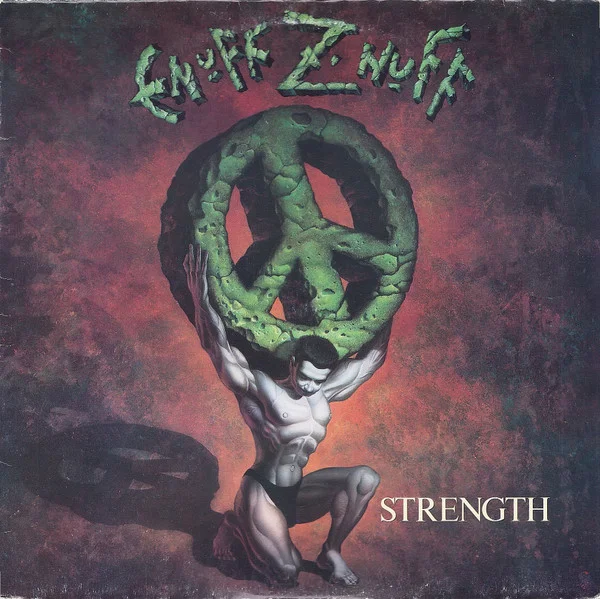
The standard rock-history version of Enuff Z’Nuff runs roughly like this: a Chicago-area band with a glam metal look released a 1989 debut, scored two MTV-rotation singles, put out a 1991 follow-up the marketplace ignored, and faded into the hair metal collapse reorganizing the whole landscape across 1991 and 1992. The framing is technically accurate. It is also, in the way that matters, almost entirely wrong about what the band was, what the 1991 follow-up contained, and why the marketplace did not reward what it received.
This Long Play engages with Strength — the band’s March 26, 1991 second album on Atco Records — on its own terms. The standard narrative treats Enuff Z’Nuff as a hair metal band whose moment ended when grunge arrived. The truth is more complicated. By every measure of how its principal songwriters Donnie Vie and Chip Z’Nuff understood their own work, the band was a Beatles-influenced power-pop group whose label, marketing, and visual presentation had been built to compete in the late-1980s hair metal economy. The mismatch between what the band was and what the marketplace had been told it was is the fact at the center of the entire story, and Strength is the album that made it most visible. It was the record Vie and Z’Nuff had been trying to make all along; it was also, by the marketplace’s existing categorization of the band, incompatible with what the audience the marketing had assembled was prepared to receive. The two facts coexisted, were causally linked, and shaped the album’s trajectory in ways the rock-history vocabulary has never quite engaged with.
The deeper irony is that Strength was, by the consensus of musicians and critics who heard it carefully, one of the most accomplished commercial-rock records of its moment. Rolling Stone, in its 1991 hot-issue coverage, called Enuff Z’Nuff “The Hot Band of 1991.” Robert Plant, Steven Tyler, Robert Palmer, Paul Stanley, and the members of Cheap Trick were all public fans. Howard Stern, whose national audience reached much of the rock demographic, was an enthusiastic supporter who would write the liner notes for the band’s 1994 album 1985 and feature them repeatedly. The recognition from people who listened closely was real; the response from the hair metal-adjacent audience the band had been marketed to was negligible. The album peaked at number 143 on the Billboard 200 and number 56 in the UK, and effectively ended the band’s run within the major-label infrastructure that had supported the debut. By 1993, after the follow-up Animals with Human Intelligence had similarly disappointed, the band had declared bankruptcy. The decline was real. The achievement was also real. Both registers still operate, three and a half decades on, in the assessment of an album the dedicated audience has always understood to be something other than what the marketing positioned it as.
The Pre-History: Blue Island and the Vie–Z’Nuff Partnership
Enuff Z’Nuff formed in 1984 in Blue Island, Illinois — a working-class suburb on Chicago’s southwest side with exactly the bar-band rock culture the Midwest had been producing since the late 1970s. The two creative leaders, Donnie Vie and Chip Z’Nuff, had each built a reputation in the Chicago scene across the early 1980s: Vie’s voice already drawing attention from other local musicians, Z’Nuff’s bass playing and his role as the band’s eventual business manager and continuing institutional anchor forming the foundation the band’s multi-decade survival would later rest on.
The partnership operated within a creative framework the rock-history vocabulary has consistently failed to register. Both men had been shaped, in their formative years, by the Beatles — specifically the mid-to-late-1960s psychedelic-pop catalog: the Lennon-McCartney framework, the harmonic sophistication of the Revolver and Sgt. Pepper’s eras, the melodic accessibility laid over real structural complexity. The secondary reference was Cheap Trick, the Illinois band whose own Beatles-informed catalog (the late-1970s peak of In Color, Heaven Tonight, and Dream Police) had proven the framework could translate into American commercial rock. Vie and Z’Nuff were, in essence, trying to extend that lineage into the late-1980s landscape.
The earliest configuration — originally “Enough Z’Nuff,” rebranded to “Enuff Z’Nuff” by 1989 — included drummer B.W. Boeski and a rotating cast of guitarists: Gino Martino, then Pete Comita, then in 1987 Alex Kane (who would later form Life, Sex & Death). The band’s first visibility came through “Fingers on It,” featured in John McNaughton’s 1986 cult film Henry: Portrait of a Serial Killer — early exposure within the Chicago independent scene without a wider breakthrough. The peak lineup consolidated across 1988: lead guitarist Derek Frigo, formerly of the Chicago-area band Le Mans, joined that year with real technical capability and the hard-rock guitar vocabulary the major-label template would require, and drummer Vikki Foxx completed the rhythm section. The Vie–Frigo–Z’Nuff–Foxx unit would record the band’s first two major-label albums.
The Manager: Herbie Herbert and the Journey Connection
The management infrastructure the band assembled by the time it signed to Atco in 1989 captures something specific about how its trajectory was being built. The manager was Herbie Herbert, the legendary Bay Area figure whose CV by the late 1980s included Journey’s entire commercial peak, the Steve Miller Band, and much of the Bay Area cohort across the 1970s and 1980s. Herbert’s approach — intensive promotion combined with long-haul, multi-album career development of the kind that had built Journey’s sustained trajectory — was a different thing entirely from the standard hair metal management of the moment.
Bringing him in signaled what Vie and Z’Nuff thought they were doing. They were not trying to compete with the hair metal cohort on its terms; they were trying to position themselves within the continuing-career infrastructure bands like Journey had operated in — careful development of a band’s public identity over time. It was their institutional bet on what the trajectory could become, and it would not produce the outcome the apparatus was built to support. Why is the broader subject here.
The Debut and the Marketing Catastrophe
Atco — a reactivated Atlantic subsidiary whose 1960s catalog had included Cream and Buffalo Springfield — was positioning itself in the late 1980s as a commercial-rock label developing new acts, and the Enuff Z’Nuff signing was one of its early major commitments. Its marketing approach for the band would produce the mismatch the rest of the band’s career had to navigate.
The self-titled debut was released on August 18, 1989, recorded at Royal Recorders in Lake Geneva, Wisconsin, and produced by the band with Ron Fajerstein. It was what Vie and Z’Nuff actually were — a Beatles-influenced power-pop band whose harder-rock vocabulary was real but whose center of gravity was melodic-pop songwriting. The first single, “New Thing” — co-written by Vie and Z’Nuff, recorded as a demo in Z’Nuff’s one-bedroom apartment that he was, by his own account, too broke to afford — reached number 67 on the Hot 100 and number 35 on Mainstream Rock; the follow-up, “Fly High Michelle,” written by Vie about a friend who had died, reached number 47 and number 27. Both had heavy MTV rotation across 1989 and 1990, spending over sixty weeks in the network’s most-played Top 10, and the album sold roughly 500,000 copies.
What the marketing did with the band was the problem. Atco positioned them squarely in the hair metal cohort — neon clothing, peace-sign jewelry, big hair, videos in the standard bright-primary-color, choreographed-performance MTV template. The band’s actual content — Beatles-derived harmony, melodic sophistication, accomplished pop songcraft from the Cheap Trick / Big Star / Raspberries tradition — was buried under the look. The audience the marketing assembled was the hair metal-adjacent one the visuals were designed to attract; the power-pop listenership the music would have spoken to most directly was never assembled around the band at all. Vie has been blunt about it: “From the beginning of our climb everything was wrong,” he told Legendary Rock Interviews. “Chip and I as a team were right but nothing, NOTHING else made sense. Vikki Foxx as a drummer did not make sense, Derek Frigo as good as he was, did not make sense, the production, the management, the image… did not make sense.”
What the broader audience absorbed across the debut cycle was the look, not the songcraft. The band resembled Poison or Warrant or any of a dozen others, and for listeners not already attuned to what the songwriting rewarded, the music was largely invisible behind the presentation. A small later moment captured how completely the look had defined the public identity: in the mid-1990s, MTV’s Beavis and Butthead parodied the band’s videos, targeting the glam presentation as exactly the hair metal product the show was built to mock. The band Vie and Z’Nuff had been trying to make was not the band the culture had encountered.
Strength: Music Grinder, Hollywood, 1990–1991
Recording began in 1990 and ran into early 1991, across two studios — Music Grinder in Hollywood and Chicago Recording Company — with Paul Lani producing alongside Vie and Z’Nuff, Bob Ludwig mastering at Masterdisk, and a cover illustration by Mark Ryden, the pop-surrealist artist who two years later would produce the cover for Michael Jackson’s Dangerous. The production resources Atco committed signaled what the label expected: a release positioned to compete at the top tier.
What the band did with the material was push toward the direction Vie and Z’Nuff had wanted from the start. The arrangements were denser, the lyrics more serious — addiction, loss, depression — and the compositions further into the Beatles-derived harmonic vocabulary. The album ran fourteen tracks and about fifty-eight minutes, longer than the standard early-1990s release, with room for the full range. It opens with “Heaven or Hell,” a McCartney-flavored melodic vehicle built for radio; “Missing You” extends the harmonic complexity; the Vie-written title track works the harder edge while keeping the melodic accessibility; “In Crowd” attacks more directly; “Holly Wood Ya” works the satirical-pop tradition Cheap Trick had operated within; “The World Is a Gutter,” another Vie solo composition, goes darker. The emotional centerpiece is “Mother’s Eyes,” co-written by Vie and Derek Frigo — the guitarist whose own struggles with addiction would, thirteen years later, end with his death by overdose. “Baby Loves You” works a more direct pop register, “Blue Island” engages the band’s hometown, “The Way Home / Coming Home” runs nearly six minutes, “Something for Free” rides what some reviewers have called an AC/DC-style riff, and the brief “Time to Let You Go” closes things on a restrained note.
Heard in 2026, it is the record the band had been trying to make all along — denser, more serious, further into the Beatles-derived harmony, working as a coherent statement across fourteen tracks. It was also, by every measure that mattered to the hair metal-adjacent audience the marketing had built, incompatible with what that audience was prepared to receive. The band the album represented was not the band the audience had been told they were following.
The Reception: Critics, Musicians, the Marketplace
The critical reception in 1991 was strong. Rolling Stone, in its spring hot-issue coverage, named Enuff Z’Nuff “The Hot Band of 1991,” and the band appeared on Late Show with David Letterman in support. The musician-community response was stronger still. Robert Plant told MTV the band was “a perfect combination of pop music and metal.” Steven Tyler and Robert Palmer were fans; so were the members of Cheap Trick, one of the band’s primary reference points. Paul Stanley would later call Enuff Z’Nuff “the greatest thing going” and their records “the first thing in his car stereo.” Howard Stern became one of their most enthusiastic public backers, eventually writing the liner notes for 1985. None of it translated into sales.
The album peaked at number 143 on the Billboard 200 and number 56 in the UK — far below the debut, below the threshold the major-label apparatus was organized around — and the singles followed suit: “Mother’s Eyes” got a video and some promotion but did not chart, and “Baby Loves You” fared similarly, the campaign tailing off across spring and summer 1991 as the label recognized the outcome would not match the debut’s.
The reasons are worth being precise about. The album was more accomplished than the debut, but the audience that had supported the debut was not the audience it was written for. The hair metal-adjacent listeners the marketing had assembled wanted more of what the debut’s hit singles delivered — accessible hooks, the look, the straightforward vocabulary of the moment. The power-pop listenership that would have engaged with the album’s sophistication had never been assembled around the band at all. The mismatch between the band’s actual output and its marketed audience was the central reality the album had to navigate, and it didn’t. There was also the timing: the hair metal collapse the 1991 release cycle would consolidate was already in motion, and the same forces undermining White Lion’s Mane Attraction (released the same month) and the whole late-1980s infrastructure were working against Strength even though it wasn’t a hair metal album. The listeners who might have engaged with it were redirecting their attention toward the alternative-rock reorganization Nevermind would consolidate that fall. The album was caught between two moments — too sophisticated for the audience it was marketed to, not aligned enough with the emerging vocabulary to be received by what was taking shape.
The Aftermath: Bankruptcy, Arista, and the Long Continuation
The aftermath followed the pattern the collapse produced in abundance. Having failed to deliver the trajectory Atco was organized around, the band was dropped within a year, and the accumulated debt — recording plus tour support — forced a bankruptcy filing; by 1992 the Atco relationship was over. The continuing viability came through Clive Davis, who signed the band to Arista in 1992. The third album, Animals with Human Intelligence, arrived in 1993 with real label backing; before its release, Vikki Foxx left to join Vince Neil’s solo project and Ricky Parent replaced him. It drew critical acclaim and failed commercially — the infrastructure the band’s trajectory needed had largely closed across 1991–93 — and by 1994 Arista had released them.
What followed across three decades was the continuing trajectory the band’s actual work had always pointed toward. They recorded for a string of smaller labels — Mayhem, Music for Nations, Spitfire, Perris, Frontiers — building a catalog the dedicated audience engaged with at modest scale. 1985 (1994), made with input from Howard Stern, who wrote its liner notes, pushed further into sophisticated power pop, and subsequent records (Tweaked, 1995; Seven, 1997; Paraphernalia, 1999; Welcome to Blue Island, 2003) kept the range while operating in the reduced post-collapse economy. Vie’s struggles with addiction increasingly shaped his availability; he left the band for the first time in 2002 to pursue a solo career, with Johnny Monaco taking over lead vocals across portions of the post-Vie period, though Vie and Z’Nuff periodically reunited for projects including the 2009 album Dissonance.
The losses were heavy. Derek Frigo, whose addiction paralleled Vie’s, died from an apparent drug overdose on May 28, 2004, at thirty-seven, shortly before a planned Japanese reunion tour with the original lineup. Ricky Parent, Foxx’s replacement, died of cancer in October 2007 after roughly twelve years with the band. By then the continuing concern was effectively centered on Chip Z’Nuff as its sole institutional anchor, having absorbed real personal trauma alongside the commercial diminishment. The band continues to operate in 2026, with Z’Nuff at the center and a catalog now spanning eighteen studio albums and around twenty-eight total releases, while Vie continues his own solo career with periodic engagement with the Enuff Z’Nuff catalog. The arrangement — Z’Nuff running the band’s identity, Vie pursuing his parallel work — amounts to one of the more genuinely continued post-peak musician partnerships the hair metal generation produced.
What Strength Actually Is
The compressed narrative has consistently missed what the record actually demonstrates. Enuff Z’Nuff was not a hair metal band whose moment ended when grunge arrived; it was a Beatles-influenced power-pop band whose label, marketing, and look had been built to compete in the late-1980s hair metal economy, and Strength is the album where that mismatch became impossible to miss. It sold poorly because the audience that would have engaged with it had never been assembled around the band, and the audience that had been assembled wanted something else. The outcome was a referendum on the marketing, not the music.
This is the editorial reality the Long Plays section is built to recognize. The category is not “albums that flopped because they were bad” but “albums whose commercial reception was disconnected from their actual quality.” Strength fits it cleanly: the album is good, was always good, and the conditions that produced its brief moment — the marketing mismatch, the 1991 reorganization, an infrastructure organized around different content than the band was making — determined its trajectory. Heard carefully in 2026, it remains far better than its reception positioned it to be remembered. The people who listened closely at the time understood that; the dedicated audience has understood it ever since.
Coda
The album sold poorly. The album was a real accomplishment. Both facts are true, causally linked, and still shaping the record’s availability across the decades. Donnie Vie is alive and recording; Chip Z’Nuff continues to lead the band’s identity; Derek Frigo died in 2004 and Ricky Parent in 2007; Vikki Foxx left for Vince Neil’s band and built his own career after. The lives of the people who made the album have run in very different directions in the thirty-five years since.
The album itself remains the discrete artifact of one set of sessions — Music Grinder in Hollywood, Chicago Recording Company in Chicago, across 1990 into early 1991. Mark Ryden’s illustration on the cover. Paul Lani’s production. Vie’s vocals across fourteen tracks. Frigo’s guitar work, thirteen years before his death. Z’Nuff’s bass and the institutional commitment that kept the band alive. Foxx’s drumming, the last full album he would cut with them before leaving. All of it captured, all of it still available, the power-pop record the broader infrastructure of 1989–1991 was never positioned to recognize — and the audience that has kept finding it on its own terms continues to.